
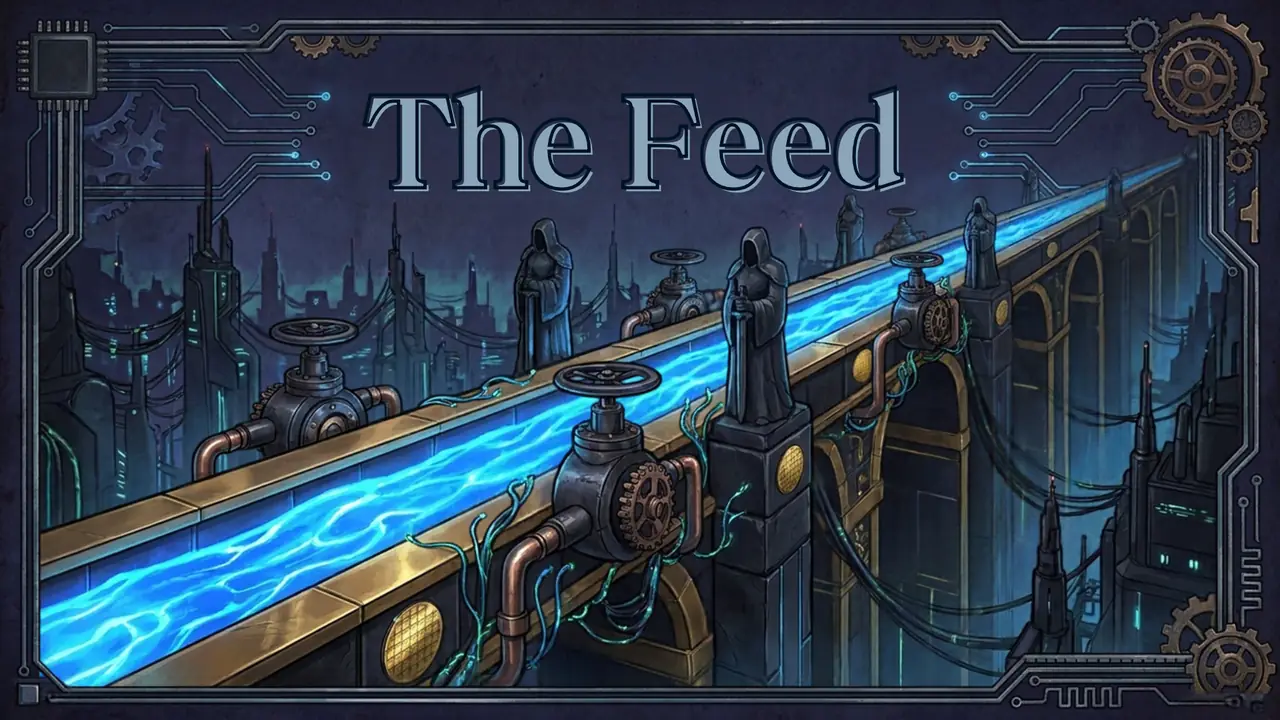
The water pump needs a part. A matter compiler in the corner of the room can make it. In The Diamond Age, that is how almost everything gets made: a household orders a design and the compiler assembles it, molecule by molecule, from raw material delivered through the Feed. The design can be free. The material comes down a line, and the line belongs to someone else.
Stephenson’s Feed is wonderful infrastructure. It ends scarcity for anyone connected to it. It also gives the people who run it a quiet veto over every household’s making. Nobody has to forbid anything. A line can be metered, priced, slowed or not extended to the wrong neighborhood, and the effect is the same.
The Primer runs on the Feed too. Every page Nell turns is compiled from material someone supplies. So is every answer that reaches today’s pocket Primer. The difference is that our Feed is made of chips.
Our line
The week that closed the last arc mapped that line in unusual detail. In The Chips at the Other Gate, Washington could let a chip out while Beijing still had a say in whether it got in. In The Jacket and the Job, the line acquired a family resemblance.
Anthropic’s November 17 securities filing names Nvidia among the companies agreeing to buy a combined $26 billion of shares alongside its stock-market offering. Nvidia sells the chips that every frontier developer needs. Anthropic buys enormous quantities of computing and builds a Primer on top of it. In April 2025, Anthropic urged the Commerce Department to keep strong export controls on advanced chips. On November 16, Commerce’s Bureau of Industry and Security issued a rule on remote access, aimed at buyers who rent time on restricted chips in another country instead of importing them.
Read with Stephenson in hand, these are moves around the same line. The supplier helps finance one of its largest customers, and that customer supports rules that decide who else may be connected. Meanwhile the government closes a side door through which someone might have rented access without owning a connection. Nobody in this arrangement is the villain of the novel. Each has stated reasons, some of them serious: chips can train systems with military uses, and controls are one of the few levers a government holds. The effect, all the same, is a Feed with gatekeepers, and the gatekeepers know each other well.
(There is no evidence in any of this that Anthropic drafted the rule. There is every reason to notice that it benefits when the line to its competitors is narrow.)
A Primer downstream of the line
For the person holding the pocket Primer, all of this arrives as weather. One month the free tier answers longer questions. The next it falls back to a smaller model because demand is high and the chips are booked. A country finds that a service is unavailable there, or available only through a reseller that takes a cut. A school buys a tutor whose price depends on a contract between its vendor and a cloud provider, which depends on a contract between the cloud provider and a chipmaker, which depends on an export license.
The child sees none of it. She sees a book that is sometimes patient and sometimes slow, and is sometimes simply gone.
Stephenson’s households had the same experience of the Feed. Most of the time it was invisible, and the compiler just worked. The power showed up at the edges: in the neighborhoods the line never reached, and in the households that relied on it so completely that they had forgotten how to make anything without it.
The dependence worth naming
Central supply has its virtues. It is how most people get clean water and electricity, and nobody wants to grow their own semiconductors. The trouble is dependence without recourse. A household that cannot leave the line has no leverage when the terms change, and no route to complain when the line is cut.
The same tests apply to a Primer. Can a learner, or a school, leave the service without losing a year of work? Can a country that falls on the wrong side of a rule still educate its children with something else? Those questions decide whether the Feed is a utility or a leash.
The novel’s answer to them is a rival technology, built in secret by people who had decided the Feed would never serve them. It has a name that sounds like a promise. The next episode is about what that promise costs.
The line is generous. It is also someone else’s.
Companions
- Someone in the Pages
- The Chips at the Other Gate and The Jacket and the Job, on export rules and the Nvidia and Anthropic relationship.
Bibliography
Anthropic. Recommendations to the Commerce Department on export controls. April 2025.
Anthropic PBC. Form S-1/A registration statement. U.S. Securities and Exchange Commission, November 17, 2026.
Bureau of Industry and Security. “BIS Issues Rule Addressing Remote Access to American Super Intelligence Technology.” U.S. Department of Commerce, November 16, 2026.
Stephenson, Neal. The Diamond Age, or, A Young Lady’s Illustrated Primer. New York: Bantam Spectra, 1995.