
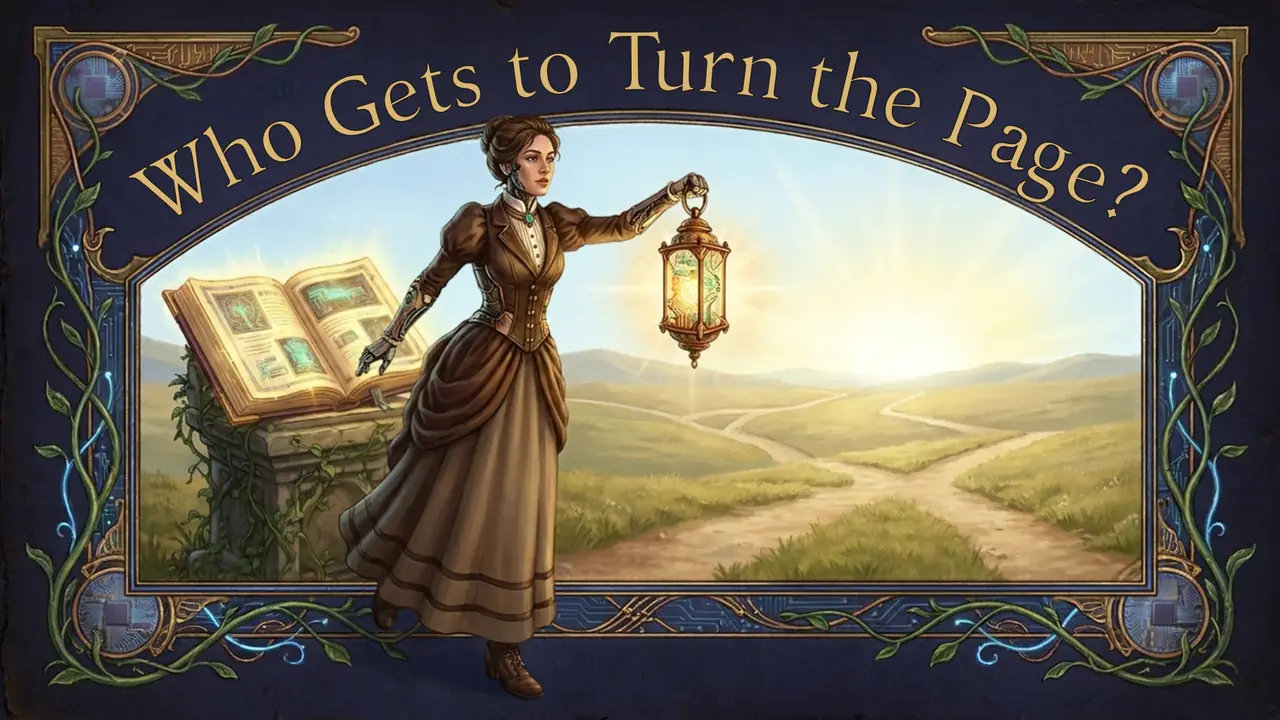
Nell outgrows the book. By the end of The Diamond Age, the girl who received a stolen Primer on a dark street has become someone the book could not have predicted. She leads, she chooses her own allegiances, and in the novel’s closing movement she goes into the Drummers’ underworld to find Miranda, the woman whose voice raised her. The Primer gave her stories. The person inside it gave her a reason to go looking.
That ending is the clearest answer Stephenson offers to the question the arc opened with. A Primer is a magnificent tool. What it becomes in a child’s life depends on everything around it: who paid for it, who performs inside it, whose line feeds it and whether anyone else is paying attention to the particular child holding it.
The week’s ledger
Made for Elizabeth started with the commission. Primers are built for the people who can afford to specify them, and reach everyone else by copying or by accident. The free tier is real help. The gap lies in what surrounds it.
Someone in the Pages found Miranda’s descendants in Nairobi and Manila, rating answers so that the voice in the pocket sounds kind. Kenya’s draft policy treats them as workers owed a duty of care by whoever profits from their judgment. The question of who answers for their conditions is the same one that has followed every extractive supply chain.
The Feed traced our line from chipmaker to export rule, and found the supplier financing a customer that would prefer the line stay narrow. The Seed followed the open models that route around it, including the ones the Feed’s owner gives away. Both arrive defended in the language of safety. Both have someone’s revenue standing quietly behind them.
The Mouse Army ordered Primers by the hundred thousand, as England now plans to, and asked what happens to a generation raised in one supplier’s voice with too few adults left to notice the differences.
The renewal meeting
Imagine a school two years into an AI tutoring contract, deciding whether to renew. The vendor’s dashboard reports lessons completed and minutes spent. The numbers are accurate, and they describe the book. They cannot see the child who learned to ask her teacher a sharper question, or the one who kept asking the tool the same thing because its answer never fit.
A school that wants to know whether the Primer is helping has to look outside it. A teacher can work beside a pupil, hand her an unfamiliar problem and watch where she begins. She can see what the child carries from the tool into her own reasoning and where she still leans on it. That takes time, and time is the very thing a tutoring contract is often bought to save.
The renewal meeting is also where the Feed and the Seed stop being metaphors. Can the school leave this vendor without losing two years of pupils’ work? Does the service still run if its supplier’s chips are rationed or its prices rise? Is there a second supplier, or an open model the district could host itself, so that the children are not raised in a single voice? Who answers when a pupil’s complaint about a wrong answer goes nowhere? Those questions sound like procurement. They are how a buyer decides who gets to turn the page.
Independence, with help
Nell used the Primer for years, gratefully. Her freedom came from the book being one of several things in her life that knew her. A woman on the other end cared, and Nell eventually found her. The Mouse Army had the same book and no Miranda, and turned out loyal.
Independence for a learner today looks similar. She can choose help, including from a machine, knowing roughly what it contributes and where it fails. Her work is hers to carry elsewhere. Someone near her has the time to hear what the book could not settle. And whoever supplies the book can be questioned by someone with the standing to change the answer.
The track got the spirit right. A book that talks back is worth dancing to. A girl who once had a soot-covered shovel now has an explainer that never sighs. Whether she also has a teacher with time and a line nobody can cut on her behalf is decided far from her pocket, in contracts and rating queues she will never see.
She turns the page. Someone else decides how many there are.
Companions
- The Mouse Army
- Primer in Your Pocket, where the arc began.
- Primer in Your Pocket, the track.
Bibliography
Stephenson, Neal. The Diamond Age, or, A Young Lady’s Illustrated Primer. New York: Bantam Spectra, 1995.