
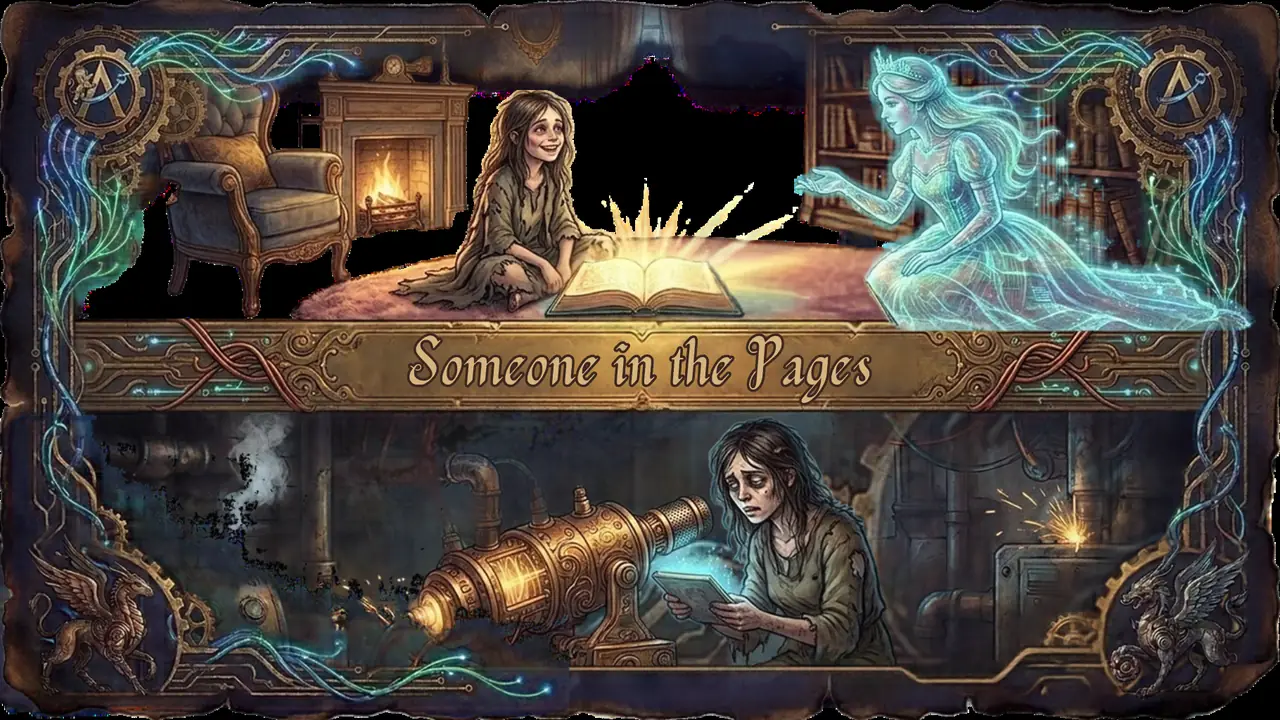
Nell opens a book and someone answers. In Neal Stephenson’s The Diamond Age, the reader can see a person Nell cannot: Miranda, a “ractor,” a professional performer who takes paid shifts voicing characters in interactive entertainment. One of her contracts routes her into Nell’s Primer. She does not know who the child is or where she lives. She reads the lines the book supplies and fills them with whatever a voice brings that a script cannot.
Over the years Miranda gives the job more than the job asks. She keeps returning to the same anonymous child, notices her growing up, and starts to care about her. Eventually she goes looking for her. The book’s engineers built a machine that could tell Nell stories. Miranda is the reason the stories loved her back.
It is tempting to read this as a parable about human warmth beating machine coldness. Stephenson’s novel is sharper than that. Miranda is a worker on a platform. She is paid by the shift, she has no rights over the child she shapes, and the company that runs the platform treats her attention as a feature it sells. Her care is real and also, from the platform’s point of view, an unpaid surplus.
The people in today’s pages
Today’s Primers have their Mirandas too, though they rarely speak live. Before a model reaches anyone’s pocket, people rate its answers and flag the replies that should never be repeated. Their judgments are folded into how the model talks. The patience a child hears at bedtime was partly trained into it by people paid to prefer patient answers.
Some of that work is skilled and well paid. A great deal of it is not. In 2023, TIME reported that Kenyan workers labeling harmful content for OpenAI through the outsourcing firm Sama took home between about $1.32 and $2 an hour, reading descriptions of abuse so that the eventual product would know to refuse them. Workers described lasting psychological harm. Similar accounts have come out of the Philippines, where annotation work arrives through platforms that can move it to a cheaper country overnight.
Miranda at least got to hear the child. Most of today’s raters never learn which conversation their judgment reached. The care flows one way, through a contractor, into a product, out to a customer who experiences it as the machine’s personality.
A complaints office for the people inside
In July, Kenya’s Ministry of Information, Communications and the Digital Economy published a draft AI and Emerging Technologies Policy that proposes minimum pay and mental health care for data workers, covering the annotators and content moderators whose judgments train and police these systems. According to press coverage, it would apply to international firms working through local outsourcing partners, and would benchmark pay against international rates. It is a draft. Whether it survives consultation, and whether anyone can enforce it against a company whose headquarters is an ocean away, are open questions.
The draft is nonetheless interesting for what it notices. It treats the people inside the book as people with a workplace, owed a duty of care by whoever profits from their judgment, including the firm at the top of the subcontracting chain. That is the logic of a supply-chain grievance mechanism, applied to a supply chain whose product is a voice.
Anyone who has worked around a mine or a gas plant will recognize the shape. The brand sits in a capital city. The work happens far away, through a contractor of a contractor. The people doing it have a complaint and nowhere obvious to bring it. The company’s standards say the right things. Then someone has to ask whether a worker in Nairobi can reach anyone with authority to change the conditions, and whether raising the complaint costs her the next contract.
What the child cannot see
Nell never sees Miranda. That is part of the magic, and part of the problem. A child who experiences care as a property of the book will reasonably conclude that books care. When the contract ends, she loses the voice without knowing there was a person to lose.
The present version runs at a larger scale. Millions of people now experience a patient, warm, endlessly available voice, and very few of them know that its manner was shaped by people they will never meet, under conditions they will never see. Some of those people are well treated. Some are reading the worst of the internet for less than the price of the subscription.
None of this makes the warmth fake. A rater who prefers the kinder answer has done something kind, at one remove. The question is whether the companies selling that kindness owe anything back down the line to the people who taught it.
Miranda went looking for Nell. Most of today’s raters would settle for being found.
Companions
- Made for Elizabeth
- Primer in Your Pocket, the track.
Bibliography
Business Daily Africa. “AI Giants Face New Minimum Pay, Mental Healthcare Rule in Kenya.” July 2026.
Perrigo, Billy. “OpenAI Used Kenyan Workers on Less Than $2 Per Hour to Make ChatGPT Less Toxic.” TIME, January 18, 2023.
Stephenson, Neal. The Diamond Age, or, A Young Lady’s Illustrated Primer. New York: Bantam Spectra, 1995.