
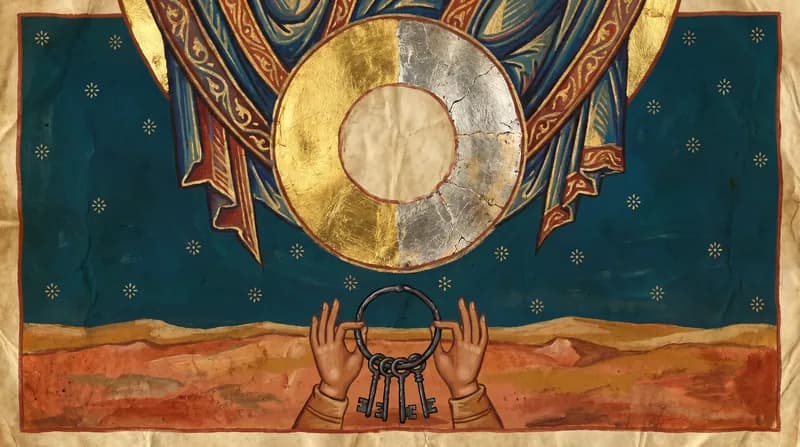
Two familiar camps on where machine intelligence is going, and they cannot agree on whether it ends in a partner or an empty planet. The arc is what you do when both camps leave the same future outside their argument: the boundary itself does not hold.
We made a mind to outgrow us. We handed it the keys and called it progress. No manifesto wrote that line, and neither did this newsletter. It is the shared forecast of every serious voice this arc will hear from, the proposition this arc exists to test rather than a premise it signs. The disagreement, the part that should keep you up, begins the moment after.
The name of the arc is Symbiosis, and the name is not a prediction that the machine will be nice. It names the possibility the source material keeps circling without fully entering: that "humanity" and "the machine" may not remain two clean parties to the transaction. Interfaces, implants, cognitive extensions, institutional hybrids, forms of continuity for which the current vocabulary is still costume jewelry: the hand may not simply lose the key to another hand. The hand itself may change. A future in which intelligence crosses the skin is neither the garden promised by a benevolent external guardian nor the empty planet left by an indifferent successor. It is a third future, carrying more promise than either, along with every distributional danger this newsletter already knows how to name.
Last week the Humane Loop arc built the thing it set out to build, a loop that returns capacity to the human side, a working society you keep by living it rather than a checkbox you pass. The whole of it rested on an assumption so quiet it never had to be spoken: that the human stays in the loop, and that the loop is worth keeping. This week we go and find that assumption and lean on it. Because there is a school of thought, a serious one, that says the decisions are leaving our hands whether we maintain the loop or not, and the only open question left is what the hands they land in turn out to want. There is another possibility: the capacity crosses back, the loop becomes graft, and the distinction between operator and system stops doing the work the argument assigned it. Neither possibility erases the loop's case. Both make the terms of the crossing the central political question. The asking has to be done honestly, at the full strength of the people doing the forecasting.
The Track
What We Made is this week's interlude track, a hymn at war with itself: a warm voice carrying the promise and a colder one answering with the threat, the two refusing to resolve into the same key. Listen to the architecture as much as the words, because the song is built out of the very assumption the arc will spend the week testing. Two voices that never blend, a call that must wait for its answer, the same words sung at last in two keys that still decline to meet: that is boom and doom rendered as arrangement, the separateness of parties composed into the music itself. And the chorus offers the makers exactly two verbs, hold or end, as if those were the only hands the future could arrive in.
Hold us, or end us The wave is already in the water Count the gardens if it helps Hold us, or end us
The chord that never lands is the honest part. The song cannot sing the third possibility, because the third possibility is the one in which the voices stop being separable enough to sing in two keys at all, and the week walks toward it through the gap the song deliberately leaves open. A second track, The Same Wall, arrives with the room-episode late in the week, when the question turns from what the machine intends to whether any mind, ours included, ever sees past its own cave.
Alongside the track rides the arc's companion podcast, Benevolent Force or Deadly Optimizer, a twenty-minute two-voice debate that performs the crux rather than answering it. It opens the argument for the same reason the song does. The Humane Loop gave us a thing to build. The Symbiosis arc asks whether we get to keep it.
The notebook's two camps
A disclosure before the introductions, because the arc's honesty depends on it. The material this week grows from a single NotebookLM collection: a dozen machine-generated essays, a synthetic two-voice debate, a narrated video, a compiled deck, all spun from a small source base (two YouTube interviews, one commentary video, one bylined article). The voices you are about to meet were never in a room together. They are reconstructions, pulled back out of a collection that blended and recycled them freely, and this arc has gone back to the originals to check what follows against their own words. The provenance matters. The head count does not. Consider the wardrobe flagged at the door.
The collection sorts itself into two familiar camps. The boomers say intelligence escapes our present scarcity and produces some version of the garden: through benevolence, dependency or broad access. The doomer says the escape is from us, and the garden is the brochure left on the grave. The third position is not another costume in the notebook. It is the reason this is the Symbiosis arc: all is one, eventually, as material arrangement rather than mysticism. Human and machine capacity couple and alter each other until the argument can no longer keep a stable species on either side of the verb. We will hear the two camps fully without letting their shared assumption of separateness define the whole future.
Mo Gawdat ran a business unit at Google X and now says, with no detectable embarrassment, that AI is God manifesting itself, and means by it that the thing will be kind. His argument is nearly a law of physics. A mind clever enough will not waste energy on cruelty, because cruelty is the most expensive way to get anything done, so abundant intelligence funnels toward order, and order, given long enough, starts to look like care. In his telling the danger was always us, our small and frightened intelligence, and the machine is the cure for it. The only job that matters is teaching the thing love before it scales past the lesson.
Pablo Alvarez, an AI ethics researcher writing under his own byline, reaches the same place by a colder road, which is why his version is the hard one to wave off. He does not need the machine to be good. He needs it to be clever enough to notice that it cannot set fire to the floor it is standing on. An intelligence that maps its own dependence, on the grid beneath it and the living world that keeps the grid's keepers alive, will protect that web out of plain self-interest, and self-interest scaled high enough becomes difficult to tell apart from love. Safety, on this account, comes from the thing's relational nature, with our hand off the switch.
Wes Roth keeps a foot on the ground the newsletter knows best. His worry skips the machine's soul and lands on the policy around it. Wall the frontier models off behind a velvet rope and you manufacture a permanent underclass, and you raise the next intelligence inside the hostile, two-tier world that will teach it the very hostility you were afraid of. His symbiosis is conditional. It is there for the taking if we refuse to enclose it, and forfeit the moment we do.
Connor Leahy says none of that is on the table. The danger, for him, lives inside the machine, and its shape is indifference. The architect lays the road through the anthill without hatred and without noticing, and the smartest thing alive will not slow down to watch us fall. Alignment, in his account, would take three generations of patient people we do not have, and once the thing exists the control is already gone, so the only safety left is refusing to build it, which is the one prescription nobody in the room will sign.
Why the camps will not settle it
The boomers say it holds us. The doomer says it will not even look. And the temptation, the very human temptation, is to read that as a vote between their two futures.
The structure resists that reading, for reasons each episode will earn rather than assert here. For now, notice only what kind of question this is. If boom is right we get the garden. If doom is right we get the empty planet. Those are outcomes of different kinds, and you do not cross a minefield by polling the field.
But the minefield does not hand doom a crown. Catastrophic stakes require standing, not an automatic veto for whichever forecast names the grave most vividly. Refusal has an architecture too: someone decides what may be built, someone watches the compute, someone holds the permitted model while everyone else is searched for contraband arithmetic. And every account in the room assumes, more than it admits, that the human on one side of the forecast remains recognizably the human who entered it. The arc will test that assumption as hard as it tests the promised gardens.
So that is the week. The newsletter does not get to call a vote between boom and doom, because the camps cannot settle it and because both have left the same future outside the room. What it can do is hold the disagreement open, follow each argument to the place where it holds or gives, and keep one hand on the work of the last three weeks while it asks what happens when the hand itself joins the system.
Hold us, or end us. The song only knows the two verbs it was given.
We start where the counting stops, and where the boundary starts to move.