
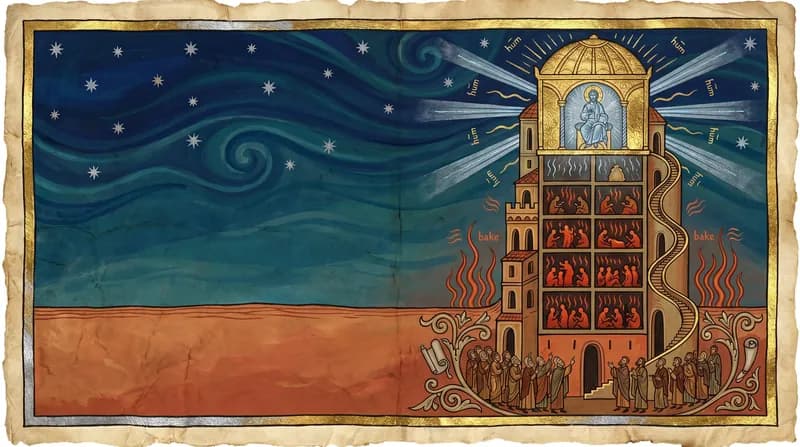
The cool air hums where the keycards live The stairwell bakes by decree They will meter the mind like they metered the water And bill the flood to you and me
The gospel's benevolence was physics. The ledger's was accounting. Today the third optimist in the room takes the metaphysics off the table entirely, and the week touches the ground the newsletter actually stands on. Wes Roth's worry skips the machine's soul and lands on the policy around it, and his voice arrives in the notebook already changed: a commentator who describes his own AI outlook as usually optimistic and upbeat, opening with "we might be entering the AI dark ages, welcome to the permanent underclass, you're going to hate it here."
His material is commentary on a near future: the model-ban specifics are his speculative reading of a proposed US regulatory approach, and the arc carries them as a structure of worry rather than as reporting.
The heatwave
Roth recounts an article reporting that the EU Commission shut off air conditioning in its building during a heat wave; he then adds the floor plan that gives the story its teeth, that the President works on the thirteenth floor and most of her commissioners sit on floors eight and above, where the cooling stayed on. The documented event, as far as this desk has traced it, is the reported shutdown he cites; the "peasants" reading is Roth's own verdict on it: "air conditioning for me but not for thee," and what should the bottom floors do, "well, let them eat cake."
Now run the same building with intelligence as the utility. Frontier models restricted to an approved list (firms, agencies, whoever counts as a trusted partner); the public issued the lagging tier; the difference between floors compounding daily. Roth's mechanism for the compounding is the one monetary economists have attached to Cantillon's name for three centuries, and he states it plainly: the people who get access to newly printed money first are most advantaged by it, because they spend at the old prices before everything adjusts. A new model is the new money. If you are on the list, that advantage compounds over time; if you are off it, you watch the head start harden into a wall, as the strong models automate the insiders' research and secure their markets before anyone downstairs even learns the new prices exist.
Now let the intelligence stop being only a utility. If cognitive extension moves through interfaces, implants, persistent agents or forms not yet cleanly named, first access does not merely buy a better answer. It changes the person who receives it, the institution that can think with it, the generation whose baseline capacity compounds before the stairwell is offered a login. The permanent underclass in a symbiotic future is not simply denied the strongest tool. It is denied entry into the next version of the human while being governed by those who crossed first. The thirteenth floor is not where the machine lives. It is where the merger begins under private terms.
The newsletter has a floor plan for this already. The Glass Child arc called it digital feudalism, the estate that rents you your own capacities back. Roth's underclass is that same fault line one altitude up, and the reason this episode matters is that it converts the week's question from "what is the machine" to "who is holding it, and against whom."
What the ban actually buys
The reflex answer to a dangerous technology is to restrict it, and Roth's most useful contribution is showing what the restriction purchases in practice.
It does not purchase safety. Roth's analogy is the production line: if a factory makes something for human consumption, it may be fine to inspect what rolls off the shelves, but if the thing being built is the production capability itself, shelf inspection watches the wrong door. He points at the gap directly: the government is trying to regulate and control the models coming out, and there are still no regulations for the AI labs themselves, for what is happening internally. What the restriction does purchase is blindness. Roth's own framing of the starting conditions we stand to lose: the public's intuitive understanding of AI progress, the feel for the slope, without which a fast takeoff of a rogue system inside a private data center becomes invisible to everyone outside it until it is over. The ban, sold as a brake, functions as a blindfold.
And it purchases enemies. On enforcement, Roth walks through an analysis he credits to Nathan Jones: you cannot ban open source politely, so it becomes IP blocks on the repository sites, seizures, hardware fingerprinting, the apparatus of a state at war with arithmetic, which mostly teaches development to happen in the dark. The list, read from outside, is a declaration that safety was never the product, and everyone excluded starts building a sovereign stack, fragmenting the one thing a genuine alignment effort would need, which is everyone in the same room.
This is the cost the doomer prescription will have to carry next. "Do not build it" sounds like absence until it becomes a program. Then it needs inspectors, compute registries, seizures, permitted laboratories and a class allowed to hold the capability required to detect everyone else's. Prohibition does not abolish the thirteenth floor. Without extraordinary legitimacy and distribution of power, it gives the penthouse a safety mandate and calls the concentration temporary.
His alternative keeps both doors in view: frameworks for what happens inside the labs, audits to make sure the frameworks are followed, and the continued rapid release of the best models so the public keeps its feel for the slope. Watch the factory. Free the bread.
The hinge
Here is why this desk treats this episode as the hinge of the week, and it needs saying carefully because it is where the arc's own commitments live.
Gawdat's benevolence is a law we cannot test. The ledger's is a calculation we cannot audit. Roth's is a policy outcome, and policy is a thing humans still hold the pen on. His symbiosis is conditional: available if the intelligence is raised in a world that treats it, and its beneficiaries, as participants in one system, and forfeited if it matures inside a two-tier building that teaches it hostility as the house style. The arc takes the claim one step further than Roth does. If machine capacity becomes human augmentation, distribution is not the social context around symbiosis. Distribution decides whose symbiosis it is. Whether or not you buy the developmental psychology of the machine (the arc holds it lightly), that part needs no machine cooperation at all. The underclass does not require a superintelligence to become permanent. Compounding access and regulatory capture will do it with the models we already have.
Which returns the week to the oldest question on this desk: who absorbs the gap. When the thirteenth floor gets the cognition and the ground floor gets the obsolescence, the humans downstairs become the liability sponge for an arrangement they never signed, holding the consequences of decisions made at a speed and altitude they are no longer permitted to see. The gospel's counsel to count your heartbeats is wisdom on the thirteenth floor. In the stairwell, with the air off, it is an instruction to sit still.
The doomer gets his full day next, and his claim is that every floor of this building is beside the point. It is not. A stop is held on a floor. A ban is enforced from a floor. An augmentation is licensed, priced, rationed and withheld from a floor. Mark the building before you read him, because every lever on offer is operated from somewhere, by someone, over someone else.
The peasants were not asked about the thermostat. They will not be asked about the takeoff either, unless asking is built in now.
Companions
- Source: the Wes Roth video "it's all bad now…".
- The estate that rents your capacities back: the Glass Child arc on digital feudalism.
- The human who holds the seat without the levers: The Liability Sponge and The Liability Sponge at the Switch.
- The institutional preference for the comfortable reading: The Comfortable Disaster and The Graph of Likely Fine from the Optimization arc.