
From Liability Sponge to Reciprocity
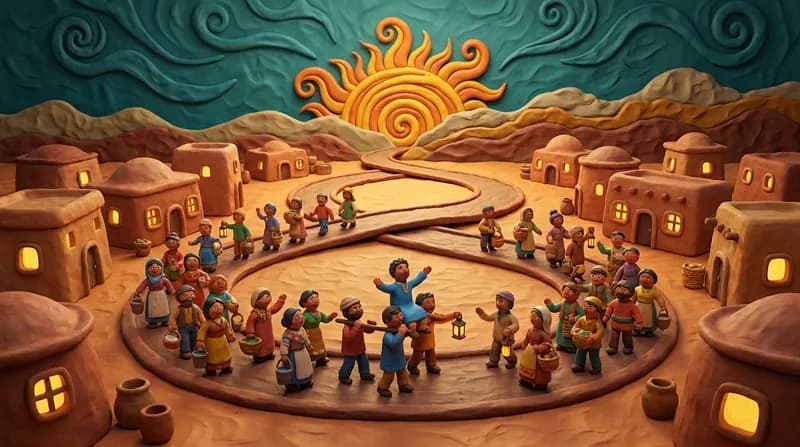
Sweep the floor before you hold the key Carry the water, then come and carry me The wall was never only stone True journey is the road that circles home
The sentence sounds simple until the week has walked it.
Without the week behind it, true journey is return can sound like a motto. A warm one. A broad one. The kind of phrase that fits too easily on a retreat slide beside a stock image of roads and light.
This week made the phrase harder to use cheaply.
It did not start with the governance architecture. That mattered. The arc did not open with the five-layer ladder, the three controls, or the operator playbook. It opened with the wall that is also a door, and the track that proved its thesis by refusing to throw anything away. It moved to the formation room, where the floor is swept before the key is held. It tested the loop with the capacity-return question. It looked into the basement where the cost is learned. It maintained the pantry and the neighborhood. Only then did it climb to the governance layer.
That sequence was the argument. The humane loop is not a better configuration. It is a small working society you maintain.
The Room Before the Tool
Sweep the Temple First began with the formation room. The schoolroom critique from the Glass Child arc was the starting point. The fluorescent room trained a particular shape of person: legible, processable, promptable. The synthetic peer arrived and performed the measurable layer better than the body could afford to perform it. The arc closed on the imperative to raise the other child.
Monday's prescription was the formation-before-access rule. No tool before the work. The person who has not carried the water is not ready to direct the pipe. The wall is low, but the crossing has to mean something. The H∞P training stack has been carrying this as praxis, not product. The Crossing Literacy module names the work that makes the human capable of holding the tool without being replaced by it. The operator who produces the first draft and directs the model is not a checker. They are a pilot. The capacity that returns is directional judgment. The capacity that does not return is error-spotting, which is useful but narrow, and which atrophies over time into the sponge.
The difference is not which tool is used. The difference is which party enters the room first.
The Capacity-Return Test
True Journey Is Return applied the test. The crutch relieves a burden without building the limb. Mastery builds the limb by carrying the burden. The loop that returns the human to the same tired, supervised, slightly more anxious version of themselves is not a humane loop. It is a supervision regime with a signature field at the end.
The test is simple to state and hard to audit. After six months in the loop, can the human do the work more capably than before the loop existed? Not faster. Not more productively. More capably. Can they recognize the vendor's overclaim because they have spent six months contesting the model's overclaims? Can they read the silence in the room because they have spent six months noticing what the model's summary smoothed away? And when the recommendation arrives that is technically correct and operationally catastrophic, is the judgment there to refuse it?
The Regression arc named the model-side twin: capability narrowing as safety improves. The human-side twin is deskilling as assistance smooths. The model gets more helpful. The workflow gets more polished. The human gets less capable of directing the system because the system has learned to remove the friction that would have forced the human to think. The metric did not know what to save on the model side. The rubric did not know what to reward on the human side. The performance review measures throughput. It does not measure whether the analyst's judgment has deepened. Judgment is not in the rubric.
The true journey is the one that circles home. The home is not the place you started. The home is the version of yourself that can finally carry the weight. The loop that returns you to that version is the loop worth building.
The trade is easier to feel than to describe, so there is a small working model that runs it.
Run the capacity-return simulator →
Set the automation smoothing high and the disagreement low, then watch what six months does to the judgment curve. The operator interrupt resolves into three bands: declared, working, and used. A control can be all three, or it can be the first two and quietly fall out of use.
The Ones Who Carry It
The Ones Who Carry It named the hidden cost. Le Guin's Omelas was the frame. A bright city whose comfort is paid for by someone unseen, in a room nobody visits. The AI economy has its own unseen rooms. The verifier. The rater. The moderator. The queue-loader. The contract-drafter. The operator who clicks accept in a tempo that makes genuine deliberation architecturally impossible.
The humane loop is not humane because it has a human in it. It is humane because it pays the verifier. The person who checks the system's work must be compensated in proportion to the value they are protecting, and protected and authorized to match. Not as a cost center or a sponge waiting to absorb blame. As a first-class participant in the value chain.
The Power arc named the physical version of this at the grid level. The Physical Invoice showed that every answer has a power path and every inference has a grid position. The Liability Sponge at the Switch showed what happens when the operator absorbs the gap between design and reality in seconds, not quarters. The Hush Money argument asked whether the payout was relief or the payment that keeps the enclosure intact. The humane loop answers all of them by looking into the basement. The loop that does not look is not a humane loop. It is a loop that has learned to avert its gaze.
The carrier-bag theory is the frame. The tool is a container that holds and returns. The blade is a tool that conquers and replaces. The humane loop is a carrier-bag. It holds the work, returns the capacity, and carries the verifier forward. The sponge is a blade. It cuts the human out of the value chain, then uses the human as a handle when the blade needs someone to blame.
The Pantry and the Neighborhood
The Pantry and the Neighborhood asked what keeps the loop honest over time. The pantry rule: the model's memory is not the organization's memory. The memory must be refreshed at every encounter. The old assumptions must be checked. The new context must be added. The overhead is the price of honesty. The loop that skips the overhead is the loop that drifts.
Normative drift is the human twin of capability regression. The human who works with the same model for six months stops correcting the model's assumptions. The human starts anticipating the model's errors. The human starts writing prompts that produce outputs the model handles well, rather than outputs the situation requires. The human has not become more capable. The human has become a better prompt engineer for a narrower model. The loop has settled into a groove, and the groove is not the work. The groove is the habit.
The defense is not better memory. It is a neighborhood. A multi-model neighborhood is a set of models that see the same problem differently. The disagreement is the signal. The model that says the procurement comparison is fine and the model that says it is omitting the vendor's environmental history are not contradicting each other. They are seeing different parts of the same picture. The human's job is to hold both views and ask what the disagreement is teaching. The neighborhood does not smooth the disagreement flat. The neighborhood uses the disagreement as diagnosis.
Safety is an ecosystem property, not an individual guardrail. The ecosystem is the human's memory hygiene, the neighborhood's disagreement, the verifier's refusal authority, the operator's interrupt window, and the institution's willingness to slow down when the signal says the loop is drifting. The Dual Baseline from the Power arc was the same idea at a larger scale: the model's capability is the exponential baseline, and the human's judgment is the copper baseline. The humane loop is the architecture that keeps both in view.
The Loop That Governs the Loop
The Loop That Governs the Loop climbed to the architecture. The five-layer ladder: technical, workflow, contractual, institutional, ecosystem. The loop is only governable if all five questions have operational answers. Most organizations start with the technical layer and stop there. The sponge is named at the workflow layer: the human who has the seat but not the levers, the signature but not the time.
The First Three Controls: interrupt, contest, redirect. The human must be able to stop the loop without being overridden. The human must be able to challenge the output without being treated as a problem. The human must be able to change the direction of the loop, not just correct it. The three controls are the minimum. The loop that lacks any one of them is not a humane loop. It is a loop that uses the human as a screen.
The Calvin Convention is the contractual layer where the society becomes durable. The six mechanisms are the clauses that make the operator's citizenship enforceable in procurement language, not only in governance rhetoric. The Calvin Convention is the wall as door. It is the boundary that is also a passage, because the contract is built to be crossed daily.
The Hinge from the Partnership Dividend arc asked whether the architecture could survive its own audit. The argument at this stage was to build the audit into the architecture. The loop that governs the loop is the loop that invites its own disagreement. The disagreement is not a fault to smooth over. It is a diagnosis to follow. The operator who contests the model is not being difficult. They are reading the room the model cannot see. The institution that contests its own vendor is not being adversarial. It is auditing the contract that has become the machine.
The Week's Shape
Read backward, the week has a clear structure.
The first move asked what kind of human the loop is built to produce.
The second move asked whether the loop produces them, or only supervises them.
The third move asked who carries the cost so the comfort can stay bright.
The fourth move asked what keeps the loop honest after the novelty has worn off.
The fifth move asked whether the governance architecture can survive its own audit.
The synthesis is not that every human task must be preserved. That sentence would be comforting. It would also be false, and operationally useless besides. The synthesis is that any loop that places a human alongside a machine has to answer whether the human leaves the encounter more capable of the work, or only more familiar with the form.
Less of This, More of That
Less supervision dressed as partnership. More capacity return as the design test.
Less crutch, more mastery. Less checking, more directing. Less prompt engineering for a narrower model, more judgment that widens the model's frame.
Less hidden cost, more paid verifier. Less coverage metric, more judgment metric. Less indemnification that makes the vendor invisible, more contract that makes the vendor accountable.
Less single-model confidence, more neighborhood disagreement. Less memory treated as the organization's record, more pantry turned over at every encounter. Less guardrail installed once, more ecosystem maintained daily.
Less workflow that uses the human as a screen, more architecture that gives the human three controls. Less policy that says the operator may interrupt, more operational reality that makes the interrupt survivable. Less governance rhetoric, more procurement language where the contract is the machine.
Less walking away from Omelas, more staying to build the room where the cost is learned. Less blade that conquers and replaces, more carrier-bag that holds and returns.
What This Means for Institutions
For IFC, DFIs, lenders, public agencies, companies, universities, health systems, municipalities, and project developers, the Saturday question is not abstract.
If AI systems mediate community engagement, grievance intake, consultation, risk assessment, procurement, public-service delivery, benefit sharing, environmental monitoring, or social performance reporting, then the intelligence layer is part of the relationship being governed. It cannot sit outside the safeguard or hide in the vendor contract. It cannot appear as neutral tooling when it decides what gets seen, translated, summarized, escalated, closed, or ignored.
The clauses have to change. Who owns the model layer? Who controls the data? Who audits the outputs? Who can challenge a categorization? Who can access the full record? Who benefits from derived value? Who carries the cost of error? Who gets trained through the system rather than displaced by it? Who has standing when the machine's smooth answer makes the human situation disappear?
Those are not future-philosophy questions. They belong in procurement language, loan covenants, stakeholder engagement plans, grievance procedures, data-sharing agreements, community benefit frameworks, public-service contracts, and independent monitoring terms. The wrapper is part of the machine. The contract is part of the machine. So is the money. So are the people, unless the architecture quietly turns them into scenery.
The Hand-Off
The Glass Child arc named the diagnosis. The Humane Loop arc built the prescription. The diagnosis named the demoted capacities: judgment, refusal, context, care, memory, courage. The prescription built the architecture that returns them.
The hand-off forward is this: the capacity-return test is not a one-time audit. It is a continuous practice. The loop that returns capacity today can become a supervision regime tomorrow if the pantry is not turned over, the neighborhood is not consulted, the verifier is not paid, and the operator is not protected. The humane loop is not a destination. It is a maintained society. The maintenance is the work. The work is the praxis. The praxis is the Odonian society on the far side of the wall: you do not win the better arrangement by decree. You build it by living it daily.
The track closes with the opening line returned, now communal. The same words, made communal by everything that happened in between. That is the carrier-bag theory as sound. Nothing is spent and discarded. Everything is carried forward. Everything is carried slow.
The wall was never only stone. The true journey is the road that circles home. The home is the version of yourself that can finally carry the weight. The loop that returns you to that version is the loop that is worth building. The loop that returns you to the same tired, supervised, slightly more anxious version of yourself is the loop that the wall would reject.
The wall is low enough to step over. The question is whether the step changes the walker.
The arc is built. The maintenance is what remains.
The hum continues.
For now.