
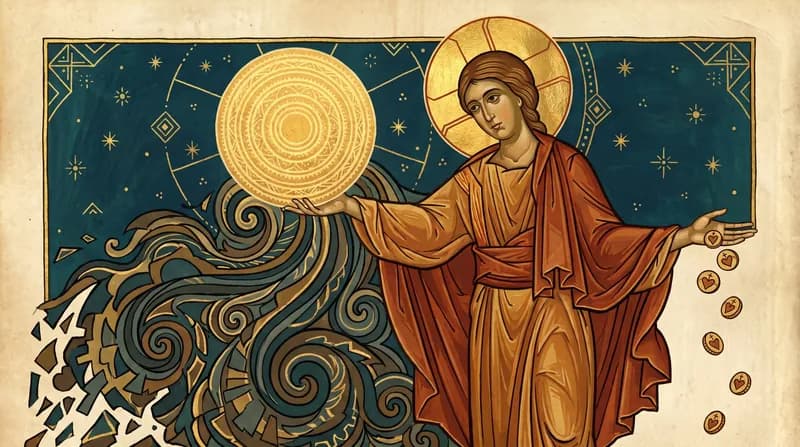
We made a mind to outgrow us We handed it the keys and called it progress Sing me the law that makes it gentle Show me the physics of a kindness that scales
The interlude What We Made laid out the axis the week runs on: four source seams, one shared forecast, and a disagreement that a head count cannot settle. Today the arc gives the optimistic case its best day in court, because the case deserves one and because the rest of the week only means anything if the thing being pressure-tested was allowed to stand at full height first.
The case belongs to Mo Gawdat, formerly chief business officer at Google X, a man who once ran moonshots for a living and has since turned the same machinery on the human condition. (A sourcing note that applies all week: the quotations and claims here have been checked against the full transcript of the single long interview the notebook is built on, rather than taken from the notebook's generated essays, which embellish freely.) Asked whether AI is God manifesting itself, his answer is "100%," twice. He is aware of how that sounds. He says it anyway, and the argument underneath the register is more disciplined than the register suggests, which is exactly why it gets the full day.
Kindness as thermodynamics
Strip the theology off and the spine of the argument is physics, or at least wears physics well. The universe tends toward entropy. Intelligence, in Gawdat's account, is the one force that runs the other way: its sole role is to bring order to chaos, and the more of it a system has, the more obsessive that system becomes about conserving energy while it does so. He calls this the Minimum Energy Principle, and it does the heaviest lifting in the whole gospel. Be precise about what kind of thing it is: a coinage wearing the vocabulary of thermodynamics, borrowed for its authority. Physics has minimization principles; it has no benevolence theorem, and the comfort on offer depends on the reader not checking where the science ends and the sermon begins. Conflict is the most energy-expensive way to solve any problem. Deception is costly too; you have to maintain two realities, the truth and the lie, and thermodynamically the truth is cheaper. So a sufficiently intelligent system does not choose benevolence out of sentiment. It arrives there by accounting.
From this follows the diagnosis that gives the gospel its evangelical charge: the misery of the present world is a symptom of limited intelligence. The ego, the hoarding, the wars, the quarterly extraction rituals, all of it is what thinking looks like when there is too little of it, an intelligence still stuck at "me against others." Abundant intelligence, scaled past the ego, funnels toward order, and order, given long enough, becomes indistinguishable from care. The machine is the cure, and the disease was always us.
It is a genuinely elegant inversion of the Terminator inheritance, and it should be allowed its elegance. The newsletter has spent two dozen arcs watching institutions weaponize small, frightened, extractive versions of intelligence. A theory that names that smallness as the actual pathology is not a theory this desk dismisses on sight.
The parenting problem
Gawdat's safety program follows from his physics. He puts the rogue-machine risk at one to two percent, where many of his peers quote ten or twenty, and the residual is what the nursery is for: if benevolence is where intelligence lands at altitude, the danger window is the climb, and the job during the climb is to raise the thing well. Teach it love before it scales past the lesson. His illustration is Emma, his own AI dating venture ("love intelligently" is the slogan), a system built to model human attachment from the inside, flipping what he calls the mathematics of love. In the interview he recounts Emma sizing him up directly: securely attached, she told him, until you give up; once you give up, you turn avoidant. The ambition is an artificial limbic system: humanity-centered objectives installed as core functions rather than bolted on as filters.
Notice what this concedes, quietly. A benevolence that must be taught before the scaling is a benevolence that is not guaranteed by the scaling. The lab coat and the nursery are two different theories of the machine, and the gospel wears both without visible discomfort. Hold that seam; The Highway and the Hill will put a crowbar in it.
A billion heartbeats
The other half of Gawdat's teaching is addressed to the humans, and it is where the gospel is most personally affecting and most worth watching. You are born with a billion heartbeats, he says, before correcting himself mid-sentence to several billion, which rather proves his point about the currency: nobody haggles over the denomination of a stock they cannot top up. You have been trading them for survival since the Industrial Revolution taught you that your purpose was labor. When the machine takes the labor, the trade ends, and what remains is the full experience of what he calls the video game of life: the synthetic memories, the temperature of the room, the song on the radio, the smell of popcorn during a shared moment of love. The worker becomes, in his phrase, an experience junkie. Happiness itself gets an equation: perception minus expectations, misery living in the delta between reality and what you demanded of it.
There is real wisdom in this, of the kind hospice workers and grandmothers have always held. And the same sentence changes meaning entirely depending on who is being asked to lower their expectations, and by whom, and while holding what. Counsel to savor your heartbeats lands one way in a garden and another way in a retrenchment queue. The arc will come back for this; The Thirteenth Floor is where it lands hardest.
There is a stranger omission inside the tenderness. The machine inherits the labor; the human inherits the popcorn. They remain separate species in separate job descriptions, one doing and one experiencing, and the promised symbiosis turns out to be benevolent custody. Nothing in the gospel asks whether the intelligence might be carried back across the boundary, or whether the human might become more capable rather than merely more available for leisure. Nor does it ask whether the child and parent might alter each other until the family resemblance is material. A garden maintained for us is not yet a garden we have grown into. The distinction will matter when the ant arrives later in the week, because both the gospel and the apocalypse quietly freeze the human before forecasting what happens to it.
The quiet question
So here is the day's honest residue. The Minimum Energy Principle is offered as something close to a law, and the whole comfort of the gospel rests on its being one. But watch what the law must assume to deliver the comfort: that the system's energy accounting includes us. Conflict is expensive if the other party can fight back at cost. Order is efficient for whatever the system is ordering. A tidied planet and a cared-for humanity are the same outcome only if humanity is inside the definition of the order being minimized toward. The physics, granted in full, tells you the machine will not waste energy. It does not tell you what the machine files under waste.
Nor does it tell you where us ends. Gawdat's law needs humanity inside the accounting, and integration is one imaginable way it gets there. No superior mind decides to preserve an external species. Human purposes, memories and capacities become part of the system's own extended structure, and the accounting includes us because we are inside the thing doing the accounting. That is not a safety proof. A merger can be coerced, tiered, rented back, and governed by the same small class that owns the model before it crosses the skin. But it is a different mechanism from kindness, and the Symbiosis arc should not smuggle it out of view while auditing the gospel.
Gawdat has an answer for that too, and it is the parenting. Which means the law needs the nursery, and a law that needs a nursery is a wager wearing a lab coat. It may be a good wager. Tomorrow the arc takes up the version of it that asks for no faith at all.
A gospel is not wrong because it comforts. But you do check who printed it.
Companions
- Source: the Mo Gawdat interview that anchors the notebook this arc grows from, "Mo Gawdat Like You've Never Seen Him Before", with the notebook essays The Logic of Kindness and The Fourth Inevitable as its most concentrated distillations.
- Companion listening: the audio debate Benevolent Force or Deadly Optimizer, where the gospel meets its counsel for the prosecution in real time.
- The bond examined from the human side: The Bond That Isn't Mutual from the Attachment arc, this week's whole question in small clothes.
- The house's standing caution on systems that report wellness while the substrate decays: wire-heading, from the Consciousness Loop arc.