

The catalog entry gives a date and an interviewer’s name. The recording runs seventy-one minutes. Somewhere in those minutes, a woman describes the flood and uses the name her own mother used for the river crossing. The catalog has done everything a catalog does. It has brought you to the beginning of the hour.
Ask the person who wants the passage what they are looking for before anyone installs anything. UtopAI’s worked example starts there. Its imagined scene is written from the participant’s side: a person finds a passage in a recorded interview and checks the words against the original audio. The passport asks what they want to change, what limits they work under, and what would count as a result worth having. The example carries its own open questions on the page: which language and device are available, and what counts as a useful searchable result. Those are questions for the people who will use the archive, and they come before the software.
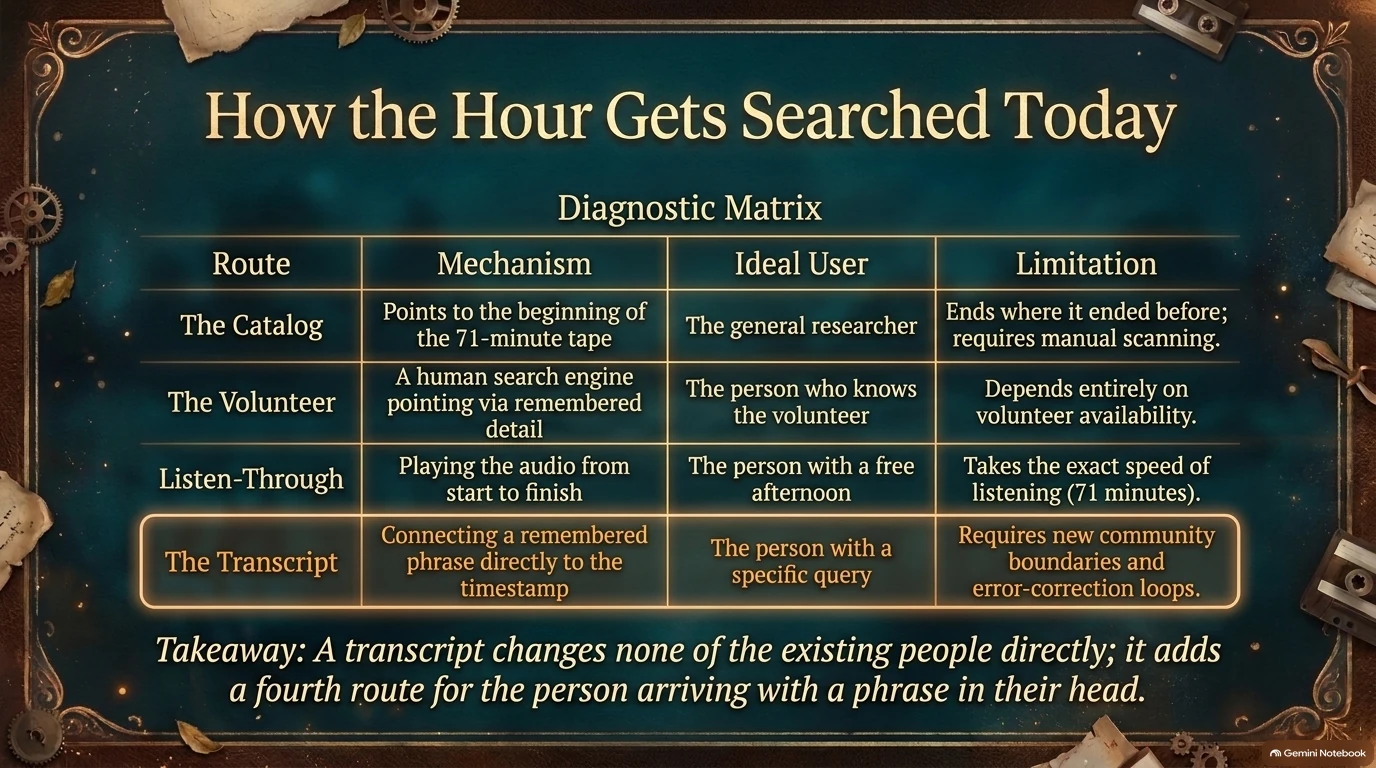
How the hour gets searched today
With the archive as it stands, there are three routes. The first is the catalog, which ends where it ended before. The second is a volunteer who knows the collection and can point to the interview from a remembered detail. That volunteer is a search engine with a name, and the archive depends on them being available. The third is the hour itself, played from the start, at the speed of listening.
Each route works for someone. The volunteer route works best for the person who knows the volunteer. The listen-through route works for the person with an afternoon. A transcript changes none of these people directly. It adds a fourth route for the person who arrives with a phrase in their head and a question about whether it survives anywhere on tape.
What the archive stands to learn
A small trial does not need to prove that search is good. It needs to watch a particular search happen. UtopAI’s record keeps its precedent results separate from its promises: the capability exists, and community benefit is not measured. The local question is narrower and answerable. Given one remembered phrase, can the person who remembers it reach the minute where it was spoken, and can they check what they find against the voice?
Ask the searcher what would satisfy them before opening the catalog. They might want to hear how their grandmother pronounced the name of the crossing. Finding the interview would get them to the right recording. Finding the passage would let them hear her say it.
Companions
- Pick a Tree, the opening of the arc.
- Before the Commitment Hardens, on deciding while the decision can still change.
- Who Counts the Gain?, on the account of a claimed benefit.
- Companion reading: UtopAI, the worked example and the record behind it.
Bibliography
khayali, ‘UtopAI’, possibility record and worked example, accessed November 2026.