

Permission to record was given for an archive. The release said researchers and the public could consult the recording, and it named who may listen. It said nothing about a searcher finding one sentence by typing something close to it. Making a collection searchable is an access decision, and it belongs to the people the recordings are about.
The Oral History Association’s guidance for participants sets the terms an interviewee holds. A narrator may restrict an interview from the public, request changes before it is shared, or withdraw it before the material becomes available. The formal release can carry a blanket permission for public access or specific restrictions, and the narrator chooses. The guidance is frank about the deadline: once an interview is shared with the public, full removal may no longer be possible, so the historian should name the date after which withdrawal becomes difficult. Search speeds the process that deadline guards. It moves material from stored to findable, and findable is the state narrators were asked about.
Access set before indexing
The trial’s order of operations follows from that. The archive sets access before it builds the index, so that what becomes searchable is what was permitted. What was easy to process has no say in it. In the worked example, participants decide what can be retained and shared, and sensitive material stays private. Expansion waits: only after the first participant approves the result does the archive consider a wider trial.
Oral history practice already knows why. The Oral History Society’s guidance under UK data-protection law asks archives to check interviews for material that could cause substantial damage or distress to identifiable third parties before public access, with those passages embargoed and muted in the accessible copy while the original recording stays intact. A recording that was safe in a storeroom, consulted by appointment, carries different exposure as a phrase-addressable file. The check runs on the access copy, and the redaction is annotated on any transcript, which means the transcript inherits the access decision. It has no standing to make one.
What the permission covers
One case shows the difference the trial needs to handle. Suppose a passage sits inside a recording whose release allows consultation, and the archive lets people hear that passage by appointment. Nothing in the release covers its words appearing in a public search snippet. A searchable transcript would put a sentence the terms kept behind an appointment into the hands of anyone with a keyboard. The trial keeps that passage out of the searchable text, and widening access is a decision for the people the recording belongs to.
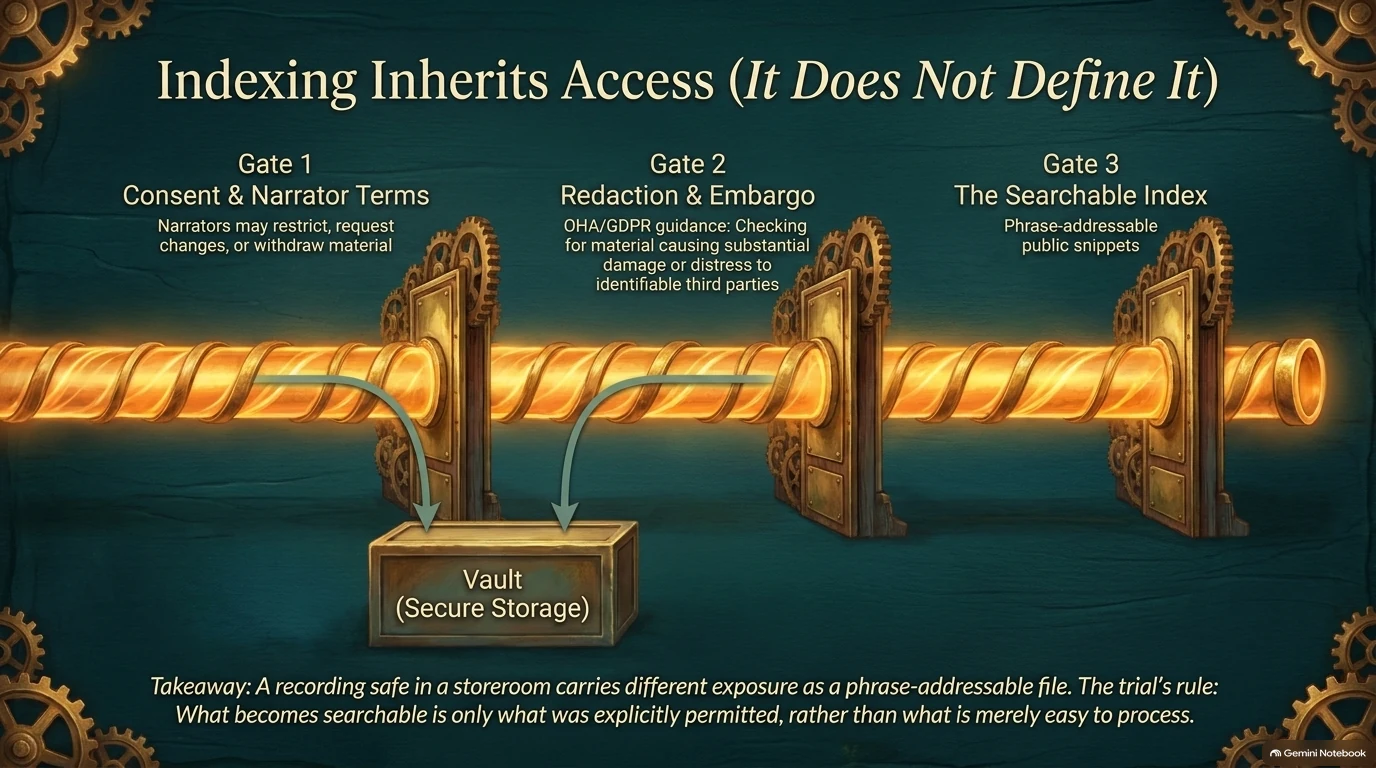
The terms then travel with the recording into the index, so that the search layer inherits its boundaries from the people the voices belong to. Where a term is unclear, the passage waits until someone with the authority to answer is asked.
Companions
- Who Fixes the Name?, on the correction and its cost.
- Back to the Voice, on the transcript and its limits.
- Companion reading: UtopAI, the worked example’s boundaries.
Bibliography
khayali, ‘UtopAI’, possibility record and worked example, accessed November 2026.
Oral History Association, ‘For Participants in Oral History Interviews’, Principles and Best Practices, accessed November 2026, sections 5, 9 and 10.
Oral History Society, ‘Dealing with GDPR’, guidance, accessed November 2026, sections on consent, access copies and sensitivity checking.