

The trial is small on purpose. A handful of consented recordings, a few transcripts, a search page, and a person who arrives with a phrase in their memory. The question the trial answers is the one the girl answered from the saddle: whether this rider on this mare clears this pole. The far side in general can wait. A person reaches the voice on the tape, or they do not, and the account says which.
The worked example names the tests before the trial runs. Which language and device are available. What counts as a useful searchable result. Whether a speaker can find a chosen passage and check it against the audio. What happens to transcript errors, and who reviews them. None of these is answered by a capability record or a public article. The precedents say the tooling exists and communities have organized around it. What happens on this hard drive with these recordings is what a local trial exists to establish, and the two kinds of knowledge stay separate in the write-up.
What widening would need
If the first searches succeed, the pull is to index the whole collection. The terms the archive set in advance decide what widening requires. The participant approves the result first. Access boundaries carry over to the expanded index, including the material checked for third-party risk. The correction route scales, which means the review hours scale with it, and the account of the archive’s gain keeps carrying those hours once the pilot ends. A saving that costs unpaid evenings is the kind of figure Who Counts the Gain? taught the traveler to read twice.
The account records a phrase the search missed and a name nobody fixed in time. It also checks that a restricted passage stays out of public results. A missed phrase could point to a change in the index. A restricted phrase that surfaces calls for fixing access before the trial goes any further.
The landing
The imagined archive would work the same way. Its users would name the searches that matter while the terms could still change, and the trial would be sized so that a failure taught the archive something and broke nothing.
The results feed one decision. The archive could keep the current route, with the catalog and the volunteer, or index only the few recordings whose terms and accuracy held. If both held across the board, it could widen to the recordings the first trial cleared, within the access terms the participants agreed. Whichever way it goes, the account states what the choice costs and who carries the work.
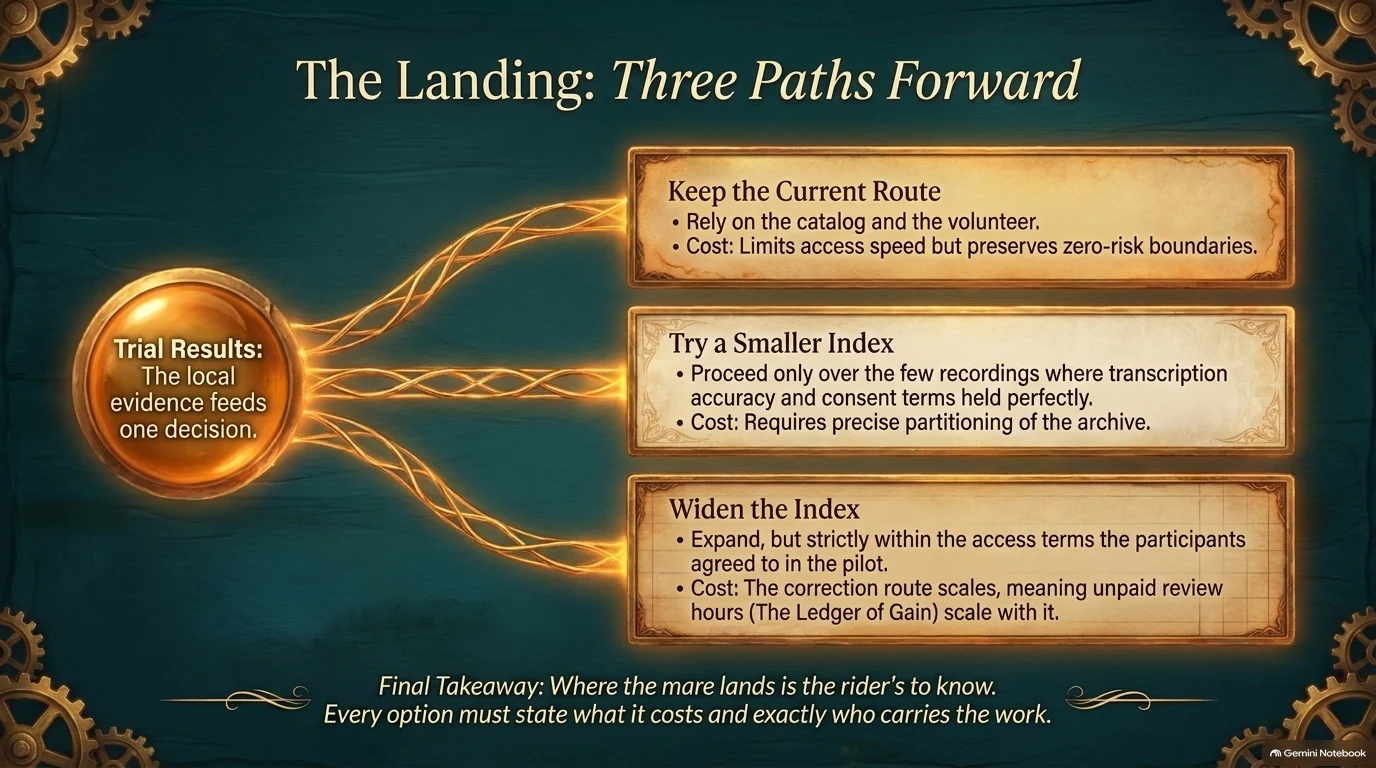
Where the mare lands is the rider’s to know and the teacher’s to see. The record of how the trial went belongs to everyone who comes next with a phrase in their head.
Companions
- Who Gets to Hear It?, on access set before indexing.
- The Story You Came For, on naming the search that matters.
- Pick a Tree, the opening of the arc.
- Who Counts the Gain?, on the account of a claimed benefit.
- Companion reading: UtopAI, the worked example and its unresolved questions.
Bibliography
khayali, ‘UtopAI’, possibility record and worked example, accessed November 2026.