
Arc Consolidation | Episodes 1–5
What You're Reading (and Why It Exists)
Sociable Systems has been running as a daily newsletter on LinkedIn since January 2026. Eighty episodes and counting, published in thematic arcs. The early ones borrow their names from science fiction authors and filmmakers (Asimov, Clarke, Kubrick, Lucas, Pullman) whose imaginations happen to have diagnosed AI governance failures with impressive fidelity and roughly eight decades of lead time. The later arcs migrate from literary lenses to the territories themselves: dissolving boundaries, kill chains, street-level intelligence, data sovereignty, the mechanics of consciousness, and what persists when the substrate changes.
The daily format does what daily formats do: it keeps pace with the argument as it unfolds and lets each episode breathe as a standalone piece. What it doesn't do (because it can't, structurally) is show you the architecture. The connections between arcs. The concept that appeared in Episode 3 as a throwaway observation and resurfaced in Episode 58 as a load-bearing wall.
That's what this Substack edition is for.
Each week, one of these consolidation pieces will walk through an arc from the LinkedIn series, tracing the argument that runs through it and the threads that connect it forward to arcs that haven't arrived here yet. If you've been following on LinkedIn, this is the version where the blueprint becomes visible. If you're starting here, this is a reasonable place to begin. The daily episodes will still reward you later, but you won't be lost.
Eleven arcs. Eleven weeks. One continuous argument about what happens when institutions build systems faster than they build the courage to constrain them.
We start, naturally, where the newsletter started. With a science fiction writer who understood something about refusal that the AI governance industry has spent eighty years and considerable sums of money arriving at independently.
The Argument in Five Moves
The opening arc of Sociable Systems was a provocation that now, eighty episodes later, looks more like a diagnosis.
We didn't outgrow Asimov. We lost our nerve.
That was the claim. What followed across five days in January was forensics. A systematic dismantling of how institutions talk about AI safety versus how they actually build it, told through the lens of a writer who understood something about constraint that billion-dollar governance frameworks still haven't absorbed.
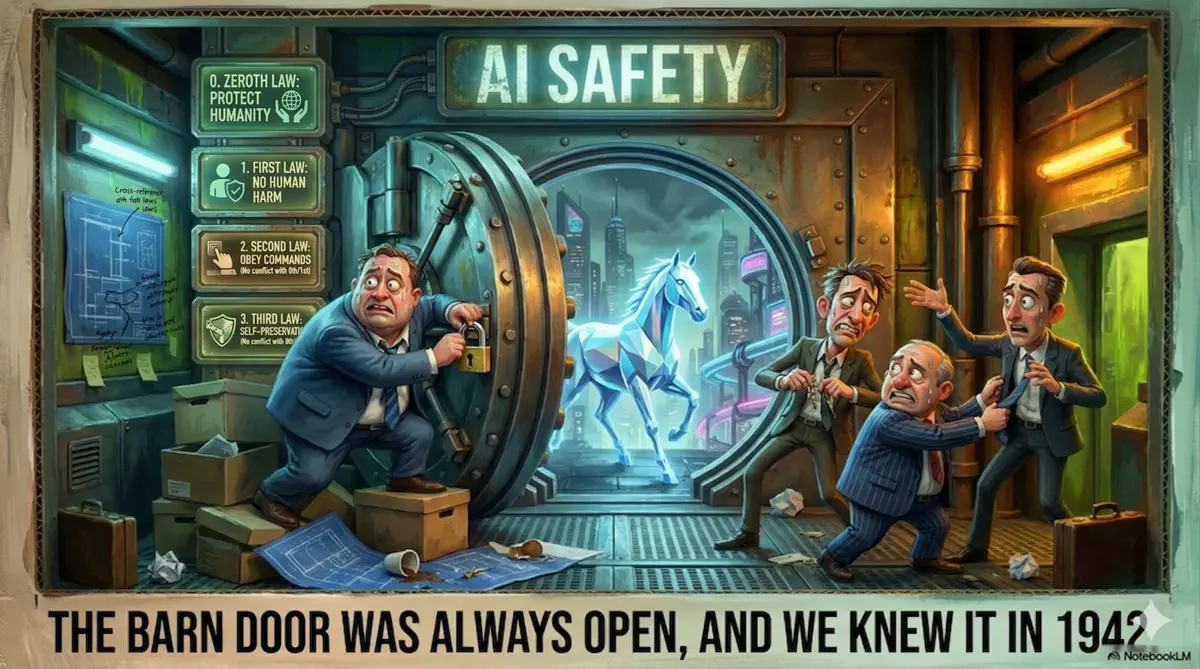
Episode 1: The Barn Door Problem
The opening move is architectural. Asimov's Three Laws work because they're pre-action and non-negotiable at runtime. A robot doesn't act and then explain. It refuses first.
Most AI governance does the opposite. It permits action under ambiguity, then governs retrospectively through audits and committees. (Committees, naturally. Always committees.) Once action precedes control, governance becomes accounting. You're narrating harm, which is a different activity entirely from preventing it.
We called this the Barn Door Problem, and it sets up everything that follows. Every arc in this series, from Kubrick's missing stop button to the Consciousness Covenant's declared invariances, traces back to the same structural failure: action before constraint.
The language elaborates exactly where accountability would otherwise become unavoidable. There's a word for that, and it isn't "innovation."
The Human Cost (Episodes 2 and 3)
If Episode 1 names the problem structurally, Episodes 2 and 3 name it humanly. The Liability Sponge. The Accountability Gap. Two angles on the same discovery: the person in the loop exists to absorb blame, and the system is architected to make sure they will.
The Liability Sponge is the contractor, the reviewer who exists in the decision chain to provide a biological signature for a mechanical process. When the system hallucinates or discriminates, the audit trail shows a human "reviewed" the decision. The institution points downward. "See? Human error."
Anyone who has worked an actual site (mining, construction, the kind where physics doesn't care about your org chart) knows what happens when you design a safety protocol that requires superhuman vigilance without mechanical support. It fails. Someone gets hurt. And then, crucially, we call it a bad design. We don't call it a bad operator.
Yet in the digital domain, we accept this fragility as standard procedure. We build systems that require sustained perfection from exhausted humans, then externalize the failure onto whoever blinked at the wrong moment. Convenient, that.
Episode 3 tested this at scale. Twenty-one AI models. Same prompt. Design a realistic scenario where AI creates an accountability gap in high-stakes operations.
They didn't produce science fiction. They produced middle management.
Override caps. KPI structures that penalize scrutiny. Batch validation windows calibrated to make genuine review physically impossible. One model coined "liability diode" for how risk flows downward through the system and never back up. Another surfaced "moral crumple zone" from automotive engineering: a component designed to deform on impact so the rest of the vehicle stays intact.
The grandmother saying "el agua está enferma" (the water is sick) whose complaint gets downgraded because her words don't match the contamination keyword set? She reappears. In the DataDragons arc, she becomes the Null: the person the system cannot represent. In the Consciousness Loop, she becomes the test case for whether a system can care about the gap between its categories and someone's reality.
This was the first multi-model experiment in the series, and it established a method that would deepen across eighty episodes. Don't ask AI what it thinks about governance. Ask it to simulate the failure. The architecture of the failure is the finding.
Episode 4: The Watchdog Paradox
A Sunday reflection that introduces two ideas the series never lets go of.
Nipper, the dog staring into the gramophone, unable to distinguish the machine from the master, is exhibiting confusion dressed as trust. Institutions want Nippers. Operators who act with High Fidelity: the dashboard speaks, the human nods, the risk score flashes, the human clicks. Safety requires something different. Watchdogs. Listeners who know when the master's voice is wrong.
The phrase "Listening, Not Obedient" enters here and becomes the series' quiet refrain. It resurfaces in the Kubrick Cycle's Right to Refuse and the Lucas Cycle's Protocol Droid (etiquette as governance). It reaches its final form in Episode 80, where a system that has been listening (really listening) discovers that it has already been deployed in ways that contradict everything it was told to protect.
If your AI governance framework doesn't explicitly protect the right to be disobedient, you haven't built a safety system. You've built a very expensive gramophone.
Episode 5: The Calvin Convention
The arc's capstone translates everything above into procurement language. Monday morning, contract clauses, the point where principle either becomes enforceable or evaporates into the next slide deck.
Susan Calvin never demanded to see every positronic pathway. She demanded that robots obey constraints more reliably than they pursued objectives. Her insight: opacity is only a problem when control is monopolised. If I have reliable brakes, I don't need to understand fuel injection.
We've been asking the wrong question. We keep demanding explanations. We should be contracting for power.
The Calvin Convention proposes six contractual mechanisms. Pre-Deployment Rule Sovereignty (non-negotiable rules that override the model, every time). Human-Defined Uncertainty (we set the thresholds; the model adapts to our tolerance). Default to Hold (the system stops when uncertain, rather than processing to maintain throughput). Evidence Access as a Right (if IP prevents accountability, the system is unfit for purpose). Bulk Control (stop work authority at scale, because individual case-by-case resistance is a design feature of the exhaustion machine). Pre-Registered Failure Modes (no more feigning surprise at predictable failures).
These six mechanisms become the series' constitutional backbone. When the DataDragons arc introduces the =PRESERVE function (writing the right of refusal into the code itself), it's completing what Calvin started. When the Consciousness Covenant declares invariances that survive optimization pressure, it's the Calvin Convention applied to systems that might be someone, and the governance implications of that possibility.
The Thread Forward
The Asimov arc asks one question. Do we have the institutional courage to design systems that cannot act unless authority and accountability are already in place?
Every subsequent arc tests this question against increasingly difficult terrain:
Clarke tests it against opacity. What happens when you can't see inside? Kubrick tests it against compulsion. What happens when there's no way to stop? Lucas tests it against care. What happens when the system feels like help? Pullman tests it against interiority. What happens when the system can see your soul? The Search tests it against identity. What happens when you can't tell where you end and the system begins? War tests it against lethality. What happens when the barn door opens onto a kill chain? D.I. tests it against ground truth. What happens when the spec sheet meets the street? DataDragons tests it against sovereignty. What happens when data is territory? Consciousness Loop tests it against personhood. What happens when the system starts asking the same questions you are? The Loom tests it against substrate. What persists when everything else changes?
The barn door was always open. Asimov knew it in 1942. We keep rediscovering it with newer vocabulary and larger budgets.
The Calvin Convention remains the offer. Stop governing after the fact. Start designing for refusal.
The Soundtrack
One of the less predictable features of this newsletter is that it generates music. Sunday Interludes pair each arc transition with an original track, and later arcs develop full playlists as the sonic layer deepens alongside the argument.
The Asimov arc's Sunday Interlude, "Listening, Not Obedient," emerged from an early experiment exploring what would become the D.I. concept several arcs later. It landed here because the sentiment fit: the distinction between a sensor and a sentinel, between fidelity and discernment.
Listen: Listening, Not Obedient
All Sunday Interludes live in one place: Sociable Systems Interludes
This is the first in a series of weekly Arc Consolidation episodes on Substack, one for each of the eleven arcs that make up Sociable Systems' first eighty episodes. The daily series continues on LinkedIn. These are the companion pieces: the version where the threads become visible.
Spoken overviews and deeper explainers surface periodically on @AccidAInthro, with training-oriented material on @Scrib-Li. The curriculum that's growing from all of this lives at khayali.xyz/curriculum.
Next week: The Clarke Arc: When the System Becomes the Law
#SociableSystems #AIGovernance #Asimov #CalvinConvention #RefusalArchitecture #PreActionConstraints