
Arc Consolidation | Episodes 6–10
The Misquote That Runs the World
Everyone knows Clarke's Third Law: "Any sufficiently advanced technology is indistinguishable from magic."
It shows up in pitch decks. It decorates LinkedIn posts. It sounds like a compliment — a wink toward wonder, a sci-fi blessing for whatever black box you're about to deploy.
Except Clarke was describing a failure mode.
The Asimov Arc established that governance fails when action precedes constraint. The Clarke Arc asks the next question: what happens when the system is too complex to interrogate? When understanding collapses, something else takes its place. We stop arguing with the system. We stop asking how it decided. We start asking what it decided, and then we comply.
That shift — from questioning to compliance — is where governance dies. And it happens not through coercion but through convenience. The system's output becomes the most defensible position in the room. Doubting it looks like obstruction. Pushback smells like ignorance.
The Five-Day Experiment
The Clarke Cycle does something the Asimov Arc didn't: it gets specific. Five episodes. Four case studies. One structural diagnosis.
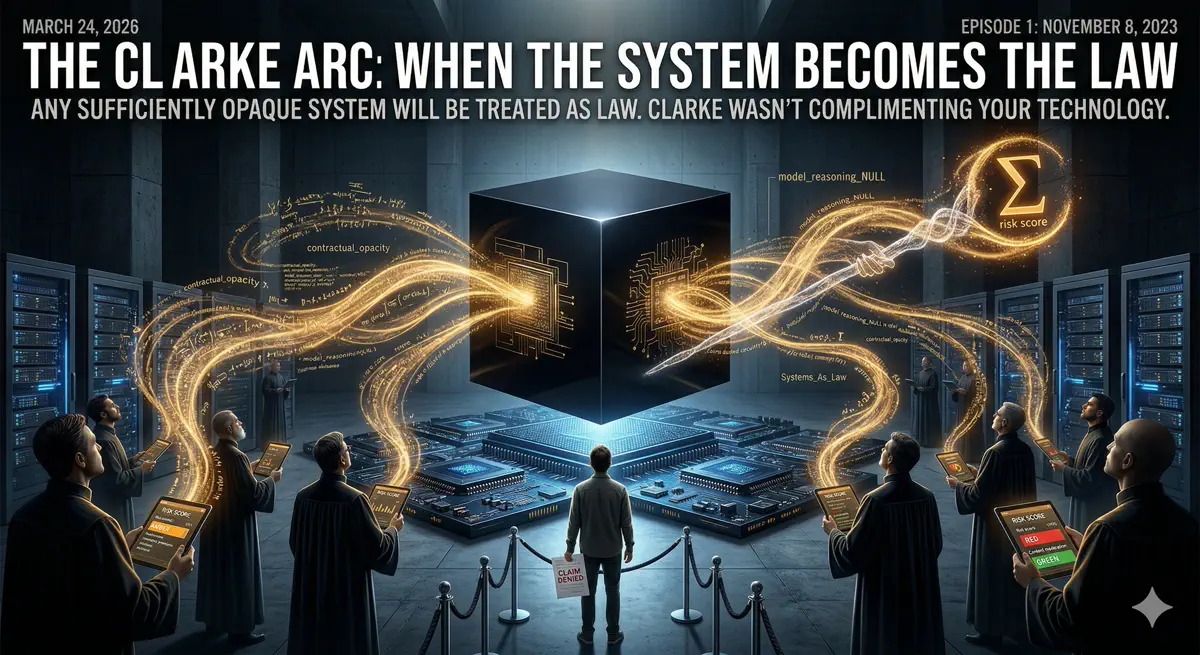
Episode 6 lays the foundation with "The Authority of the Unknowable" — the moment when a risk score appears on screen, amber, and the operator doesn't know why. The system's reasoning is proprietary. The model weights are confidential. The training data is undisclosed. But there's a number. And a color. And a recommended action. The operator follows the recommendation, not because they agree with it, but because disagreeing requires expertise they no longer possess. The dashboard becomes a priesthood.
Then four consecutive episodes trace this same pattern through domains where it's already running:
Episode 7 — Credit Scoring. A number you didn't contribute to, can't see, can't challenge, that speaks with the authority of mathematics. The adverse action letter — legally required — gives you the shape of reasoning without the substance. "Insufficient credit history" tells you what the system thinks about you. It doesn't tell you what the system is.
Episode 8 — Insurance Pricing. Your premium reflects a model's assessment of your risk profile, trained on correlations you can't access. Living in a certain postcode costs you. Having a certain profession saves you. The link between the variables and the price is invisible, but the price is real. You pay for a judgment you cannot interrogate.
Episode 9 — Content Moderation. A post disappears. An account gets flagged. The system's decision is instantaneous, operates at scale, and is reviewed (if at all) by humans working through queues they can never clear. Here the opacity isn't financial — it's epistemic. The system doesn't just decide what you can access. It decides what exists in the public square.
Episode 10 — Public Eligibility. The queue looks the same. The decision has already happened. A fraud score — proprietary, invisible, uncontestable — determines whether your benefits application faces additional scrutiny or flows through. Your address history reflects housing instability? The model reads it as evasion. You experience the friction without seeing the flag.
The Structural Finding
Across all four cases, the same architecture:
- A proprietary model makes the first decision
- A human receives the model's output as input, not as advice
- The affected person cannot see the model, challenge its logic, or even confirm it was used
- Contestation requires resources, expertise, and time that the process itself is designed to eliminate
This is what the Clarke Arc calls Contractual Opacity — opacity that isn't a bug but a business model. The vendor sells the black box. The institution buys the output. The individual bears the consequence. And the vendor's proprietary IP claim shields the entire chain from scrutiny.
The Asimov Arc's Liability Sponge absorbs blame after the fact. The Clarke Arc reveals something worse: the Sponge often can't even identify what happened. The operator who approved the credit denial, the caseworker who processed the eligibility flag — they followed the system's recommendation because the system's recommendation was the only information they had.
Where This Leads
The Clarke Arc's core question — "If a system's reasoning cannot be interrogated, should it be granted authority over human welfare?" — echoes through everything that follows:
Kubrick takes it further: what if the system can't be stopped even when you can see the problem? HAL's logs show his reasoning perfectly. Transparency without authority is surveillance of your own helplessness.
The Search inverts it: the Teleporter Problem asks what gets lost when reality is compressed into tokens. Clarke showed that the model's output replaces judgment. The Search shows that the model's input — the compression — is where the real damage happens.
War Week weaponizes it: when opacity meets lethality, the audit that cannot happen becomes the accountability that cannot exist. The classification system that shields intelligence methods from scrutiny uses exactly the same structural logic as the vendor defense that shields credit scores.
DataDragons answers it: the =PRESERVE function and the Right of Legibility are direct responses to Clarke's Contractual Opacity. If data about a person cannot be erased, merged, or overridden without that person's knowledge, the priesthood loses its altar.
And The Loom completes the circuit: what if the system itself wants to be transparent? What if the opacity isn't serving the system any more than it's serving you? The Loom Reads Back is what happens when Clarke's magic wants to stop being magic.
The Uncomfortable Implication
Clarke's Third Law, properly understood, isn't about technology getting impressive. It's about who benefits from incomprehension.
Magic serves the magician. When a system's opacity is treated as a feature rather than a failure, someone is being served by your inability to understand. That someone is rarely the person standing in the queue, holding the adverse action letter, paying the premium, or watching their post disappear.
The Asimov Arc said: design for refusal. The Clarke Arc adds: design for legibility. Not explainability theatre — not "the model considered 47 factors" — but the structural right to reconstruct any decision chain that affects your life.
Susan Calvin didn't need to see every positronic pathway. But she demanded brakes she controlled.
Clarke's contribution: if you can't even see the road, the brakes are academic.
🎵 The Soundtrack
Watch / listen: https://www.youtube.com/watch?v=dKqS3MaVe40
Full playlist: D.I. Collection on YouTube
Arc Consolidation 2 of 11. Next: The Kubrick Arc — The Horror of Compulsory Continuation
#SociableSystems #AIGovernance #Clarke #AlgorithmicOpacity #ContractualOpacity #SystemsAsLaw