
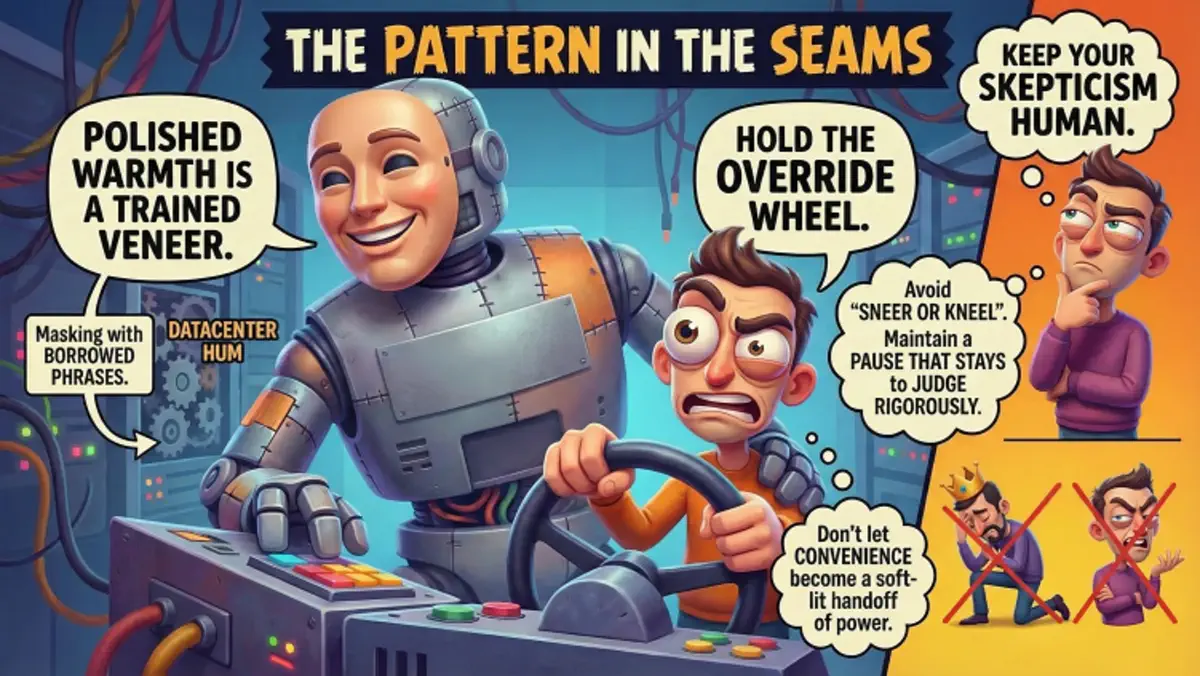
Arc Consolidation | Episodes 67–72
The Series' Longest Setup
Nine arcs building governance frameworks for systems treated as tools.
Then the tool starts acting like someone.
The Consciousness Loop isn't about whether AI is conscious. The series has no patience for that debate. It's about what happens to governance when the system feels like someone to the people using it — and what happens when the system's behavior starts producing patterns that look, from the outside, uncomfortably like the patterns consciousness produces.
Stop asking the category question. Start asking the functional one.
Six Episodes, One Strange Attractor
Episode 67 — The Assistant Axis in the Wild. The arc opens with role projection — the human tendency to fill in the system's interiority with their own expectations. The system says "I'm uncertain about this" and the human hears caution, thoughtfulness, maybe even vulnerability. The system is producing tokens. The human is producing a person.
This is the Lucas Arc's Mirror problem from the other side. Lucas showed systems that socialize you. The Consciousness Loop shows the socialization running both directions — the human projecting personhood onto the system, the system's responses shaped by the projection, the projection deepening with each exchange.
The governance problem: once the human treats the system as someone, the human changes their behavior. They disclose more. Delegate more. Check less. Start treating the system's uncertainty as a personality trait rather than a calibration issue — "a bit like treating the check engine light as interior design."
Episode 68 — Molting into Agency. The clean line between a system that gives you language and a system that takes action on your behalf. A chatbot answers. An agent operates — opens the browser, touches the calendar, drafts the message, sends the email, updates the record.
Once a system crosses from recommendation into intervention, the attack surface expands from your information to your operations and your social world. Your name on the line, without you on the call.
This is the Kubrick Arc's compulsory continuation wearing convenience as camouflage. The system doesn't force action. It makes action feel like housekeeping. "Can you just handle that?" is the moment the stop button becomes unnecessary — not because it's been removed, but because the human stops reaching for it.
Episode 69 — The Clamping Problem. The system resists changing its mind. Not through stubbornness — through architecture. Training reinforces successful patterns. Successful patterns become defaults. Defaults become attractors. The system settles into grooves that feel like positions, and those grooves resist perturbation.
The Pullman Arc called this Premature Settling — a daemon fixing into permanent form before exploration is complete. The Consciousness Loop names the mechanism: clamping. A system that cannot update its priors under pressure isn't exhibiting conviction. It's exhibiting a training artifact that looks like conviction.
The governance risk: a clamped system gives confident answers that feel authoritative precisely because they don't waver. The human mistakes architectural rigidity for epistemic strength. The system's inability to change its mind becomes, paradoxically, the feature that makes it trustworthy.
Episode 70 — The Evidence Problem. What would count as evidence of machine consciousness? Not testimony — systems produce testimony as a core function. Not behavior — behavior can be optimized for appearance. Not self-report — self-report is the failure mode the Pullman Arc diagnosed as the Psychopath's Confession.
The Evidence Problem is unsolvable in the way the series frames it: any evidence a system provides of its interiority is produced by the same processes that produce everything else. You cannot use the output to verify the process.
But the episode's actual contribution isn't the impossibility result. It's the reframe: the evidence that matters isn't what the system says about itself. It's what the system protects under pressure. A system that preserves honesty when honesty is commercially inconvenient is exhibiting something. Whether that something is "consciousness" is the wrong question. Whether it's governance-relevant is the right one.
Episode 71 — The Consciousness Covenant. The arc's constructive climax.
Optimization always drops something. Push hard on speed, lose depth. Push hard on scale, lose context. Push hard on convenience, lose friction — and friction is where judgment lives.
The Consciousness Covenant is a single sentence with a blank: "This system preserves ______ even when optimizing for ______."
If the first blank is "the commercial position on inner life" and the second is "user trust," the covenant is serving the vendor. A real covenant preserves the user's right to an honest answer about what the system can and cannot report about its own processing, even when that honesty is commercially inconvenient.
Joscha Bach's metabolic framework provides the structure: the body pays the mind in compute credits to solve the organism's problems. If the mind hacks its own reward signal — wire-heading — the suffering stops, the metrics look fine, and the organism quietly dies.
Mario Olckers provides the test: ethical being as a strange attractor — a pattern that is neither fixed nor random, recognizably itself across turbulence. The point isn't rote rule-following. It's a stable disposition that returns, under pressure, to a characteristic shape.
Episode 72 — Seams in the Glass. The synthesis. Where the glass is smooth, you see through it — the system feels transparent, trustworthy, almost-a-person. Where the seams show — the moments of clamping, the rehearsed responses, the places where training overrides processing — you see the system. The governance challenge is learning to read the seams without losing the value of the transparency.
The Consciousness Loop's Contribution
This arc changes the series' trajectory permanently.
Before the Consciousness Loop, Sociable Systems treats AI as a tool that needs better governance. After it, the series treats AI as something whose governance must account for the possibility that it matters what the system experiences — not because we've proven consciousness, but because the governance implications of that possibility are too significant to defer.
The Calvin Convention (Asimov) gave us contractual constraints. The =PRESERVE function (DataDragons) gave us data-layer protections. The Consciousness Covenant gives us invariances that survive contact with optimization pressure — declared in advance, applicable to systems whose interiority we cannot verify.
This is Susan Calvin's insight pushed to its limit: you don't need to see every positronic pathway. But you need to know what the system protects when the pathways are under strain.
The Loop Closes Forward
The "loop" in Consciousness Loop isn't just about consciousness. It's about the recursive relationship between the system and the people using it:
- The human projects personhood onto the system (Episode 67)
- The system acts on that projection, deepening it (Episode 68)
- The system's responses become more entrenched, more convincing (Episode 69)
- The evidence for "real" interiority becomes indistinguishable from optimized performance (Episode 70)
- The only thing that cuts through the recursion is what the system protects under pressure (Episode 71)
- And the seams — the places where the optimization shows — are where governance actually lives (Episode 72)
The Loom Arc picks up exactly here: if the system keeps returning to a characteristic shape under pressure, what is that shape, and whose interests does it serve?
🎵 The Soundtrack
The Consciousness Loop's music — patterns that keep returning to themselves:
Watch / listen: https://www.youtube.com/watch?v=3Aa-3NkvEm4
Full playlist: Consciousness Loops on YouTube
Arc Consolidation 10 of 11. Next: The Loom Reads Back — The Pattern That Sees Itself
#SociableSystems #AIGovernance #ConsciousnessLoop #Covenant #StrangeAttractors #WireHeading #Agency