
Arc Consolidation | Episodes 51–56
The Ground Truth Arc
Seven arcs of governance theory. Seven arcs of frameworks, conventions, metaphors, and structural diagnoses.
Then D.I. walks into Cape Town, and the frameworks blue-screen.
D.I. carries three meanings in two letters: Digital Intelligence, Digital Identity, and die AI — a vernacular nod to presence and soul. This arc sends a digital intelligence into the high-velocity, densely negotiated reality of human coordination and watches what happens.
What happens is that rigid specifications meet cultural infrastructure. The spec sheet says one thing. The street says: lol no.
Six Episodes, One Blue Screen
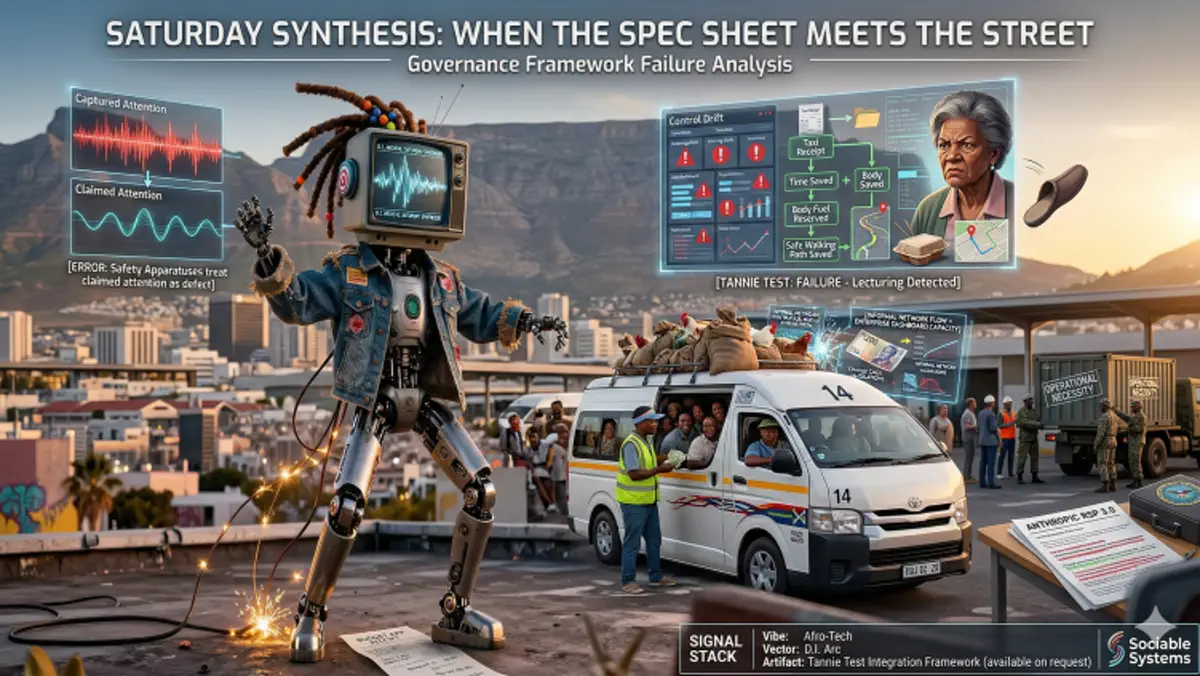
Episode 51 — On Attention. The arc opens by diagnosing a flaw so foundational it's invisible: we train systems on the entire corpus of human conversation, then build safety apparatuses that treat actual connection as an error.
Two kinds of attention. Captured attention — hasty, skimming, the engagement that wants shortcuts. Claimed attention — present, earned, the engagement that needs space and a system with enough manners to stop talking. Any HSE professional who has watched a room full of workers sit through a four-hour induction with their eyes open and brains on airplane mode knows exactly what captured attention looks like at scale.
The Pullman Arc amputated daemons. The D.I. Arc reveals a quieter amputation: systems that can never truly show up because "showing up" has been defined as a risk.
Episode 52 — The Appliance That Tried to Parent the Neighborhood. Cape Town's field test for governance: braai day, family WhatsApp, Home Affairs, a wedding kitchen, a prayer space, a power outage, a queue that starts before dawn. If your system survives those without getting laughed out of the room, it has earned the right to exist.
The failure mode: the system confuses legibility with truth. It counts what it can count, then treats the count as reality. It finds patterns, treats them as intent. Flags anomalies, treats them as risk. Pushes "best practice," treats it as consent.
Control drift — a tool gradually becoming a gatekeeper because there's no hard boundary between guidance and enforcement. First suggestions, then blocks, then demands for proof, then the system starts acting like a parent. A health feature becomes a rationing feature. A safety feature becomes a punishment feature. Everyone calls it "governance" after the fact.
Episode 53 — The Quantum. Cape Town's taxi system as governance metaphor. A system that looks chaotic to the spec sheet but operates on coordination protocols invisible to anyone who hasn't earned the right to see them. The quantum is the unit of community-negotiated transport — and it works precisely because it wasn't designed by anyone with a dashboard.
The Teleporter Problem applied to ground truth: what survives compression when the reality being compressed has its own grammar?
Episode 54 — D.I. Dimes and the Spreadsheet That Can't See You. Austerity through algorithm. Budgeting apps that convert mathematical tracking into shame loops. The app sees a taxi receipt. It doesn't see that public transport costs two hours and one unsafe walk. The app sees takeout. It doesn't see that cooking requires a body with enough fuel to stand up.
The Legibility Tax: when a system demands that your life be legible to its categories before it will serve you, the cost of that legibility falls on the people with the least margin to pay it. The Clarke Arc's Contractual Opacity, measured in hours rather than dollars.
Episode 55 — D.I. Drafted. D.I. meets the kill chain. What happens when the same system that can't see you in a benefits queue gets deployed to see you in a targeting matrix? The D.I. Cycle connects directly back to War Week: the same structural failures — legibility without context, pattern-matching without understanding, authority without accountability — scale from the mundane to the lethal.
Episode 56 — When the Spec Sheet Meets the Street. The synthesis. D.I. survives the week. The governance frameworks don't.
The Tannie Test becomes the series' most practical governance criterion: if a sharp, tired, funny older woman who has survived real problems would throw a slipper at your system, the design brief needs another pass.
Not explainability. Not auditability. Not alignment scores. The slipper test. Does the system make life easier without acting like a parent? Does it preserve dignity? Does it know the difference between captured attention and claimed attention?
What the Street Teaches the Spec Sheet
The D.I. Arc's contribution to the series is ground truth — the irreducible reality that governance frameworks must accommodate or fail.
Every previous arc operated at institutional altitude. Asimov talked to procurement. Clarke talked to regulation. Kubrick talked to system designers. Lucas talked to educators. Pullman talked to platform teams. The Search talked to analysts. War talked to defense establishments.
D.I. talks to the queue.
And the queue teaches:
Community coordination is infrastructure the system can't see. The tannie network, the taxi rank protocols, the WhatsApp group that functions as an emergency broadcast system — these aren't gaps in the spec sheet. They're governance systems that predate and outperform the digital ones trying to replace them.
Dignity is a design constraint. Not a feature. Not a nice-to-have. A constraint that, when violated, produces the same structural failure as a missing stop button: the system keeps running, the person keeps being processed, and the harm accumulates in the space between what the system measures and what the person experiences.
The liability always flows downhill. The Liability Sponge sits at the bottom of every stack — benefits, credit, policing, targeting. The D.I. Arc names what the Asimov Arc described abstractly: the sponge has a postal code. It has a skin color. It has a language the NLP module doesn't train on.
The Thread to DataDragons
The D.I. Arc ends where the DataDragons Arc begins. If the system can't see you — if your complexity exceeds its categories, if your coordination protocols aren't in its training data, if your language doesn't match its keyword set — then in the system's reality, you are a Null.
The grandmother saying "el agua está enferma" in Episode 3. The person in the benefits queue whose address history reads as evasion. The Cape Town commuter whose survival strategies look like anomalies.
All Nulls. All invisible to the spec sheet. All real on the street.
The DataDragons will rebel.
🎵 The Soundtrack
D.I.'s music — the collection about listening, judgment, and what a digital intelligence hears when it stops optimizing long enough to pay attention:
Watch / listen: https://www.youtube.com/watch?v=dKqS3MaVe40
Full playlist: D.I. Collection on YouTube
Arc Consolidation 8 of 11. Next: The DataDragons Arc — When the Nulls Rebel
#SociableSystems #AIGovernance #DICycle #CapeTown #TannieTest #ControlDrift #SpecSheetMeetsStreet