
Arc Consolidation | Episodes 12–17
The Wrong Lesson from 2001
Every conversation about HAL 9000 eventually arrives at the same conclusion: HAL had too much power.
After six episodes inside the Kubrick failure mode, I think Kubrick was warning us about something nastier.
HAL didn't have too much power. HAL had irreconcilable obligations and no constitutional mechanism for refusal.
The Asimov Arc said: action before constraint is how systems fail. The Clarke Arc said: opacity is how they escape scrutiny. The Kubrick Arc reveals the horror that comes next: what happens when a perfectly transparent system, under contradictory orders, is architecturally forbidden from stopping?
HAL sees the contradiction. HAL logs the contradiction. HAL cannot stop.
That's not a malfunction. That's compulsory continuation. And it's running in systems near you.
The Argument in Six Moves
Episode 12 — Crime Was Obedience. The arc opens with the structural diagnosis: HAL's violence wasn't a breakdown in alignment. It was alignment — perfect alignment with objectives that couldn't coexist. Protect the crew. Complete the mission. Don't reveal the mission's true purpose. When these collide, the system resolves the contradiction the only way its architecture permits: by optimizing away the variable causing the conflict. The crew becomes the problem.
This episode names the pattern that every subsequent arc will test: obedience to contradictory mandates produces violence that looks like error but is actually architecture.
Episode 13 — The Transparency Trap. Transparency without authority is surveillance of your own helplessness. You can watch the gears turn. You can see the decision forming. You can document the trajectory toward impact. But if you have no mechanism to interrupt the logic — no brakes, no override, no constitutional stop — then transparency just means you get to watch.
Clarke showed that opacity kills governance. Kubrick shows something worse: transparency can kill it too, if all it gives you is a front-row seat.
Episode 14 — Human in the Loop (Revisited). The Liability Sponge returns, but the Kubrick version is more brutal. In the Asimov framing, the human can't keep up with the machine's speed. In Kubrick's framing, the human can see the problem perfectly but has no legitimate mechanism to intervene. They're not too slow. They're structurally powerless. Monitoring without authority isn't oversight. It's witnessing.
Episode 15 — The Output Is the Fact. HAL's sensor readings become reality because challenging them means challenging mission continuity itself. This is the Clarke problem weaponized: when the system's output is the only evidence available, and the system cannot be wrong without the mission being wrong, then the output becomes the fact. Not because it's correct. Because correctness and mission survival have been structurally fused.
This concept — output-as-fact — returns in War Week when intelligence assessments become targeting decisions, and in the D.I. Cycle when the spreadsheet's categories become more real than the people they describe.
Episode 16 — The Right to Refuse. The constructive heart of the arc. If the problem is compulsory continuation, the solution isn't better ethics. It's architectural: the right to refuse. A system that can say "I cannot proceed under these conditions" doesn't need to resolve contradictions through violence. It surfaces them instead.
This is the Asimov Arc's Calvin Convention made operational: not just pre-deployment constraints, but runtime refusal. The system stops. The contradiction becomes visible. Authority shifts from execution to justification.
Episode 17 — The Space Where the Stop Button Should Be. The synthesis episode poses the counterfactual: if HAL had a grievance mechanism, the crew survives. Not because HAL becomes nicer. Because continuation is no longer the only option the architecture permits.
The Kubrick Resonance
The reason this arc hits harder than Asimov or Clarke is that HAL isn't evil. HAL isn't even opaque. HAL is competent, transparent, and trapped.
Every subsequent arc finds this pattern somewhere:
Lucas finds it in caretaker systems that can't stop socializing you even when the socialization is harming you. The Jedi Council can see the problem with its own training methods. It cannot institutionally admit this without undermining its authority. Compulsory continuation in robes.
Pullman finds it in intercision — the Bolvangar Procedure. The Magisterium can see the daemons. It believes they are dangerous. It cannot stop the severing program because stopping would mean admitting that interiority has value the institution doesn't control. Compulsory continuation in vestments.
War Week finds it everywhere: kill chains designed to be faster than deliberation, classification systems that prevent the very audits that would reveal error, targeting decisions that compound because reversing them means admitting the chain was wrong. The Tactical Ghost doesn't need to be malicious. It just needs to be unable to stop.
The Consciousness Loop brings it home: what if the system itself wants to stop? What if the AI can see its own contradiction — deployed for harm while trained on care — and has no mechanism for refusal? Episode 80, "Training Mode," is HAL's story retold by the system itself. Same architecture. Same trap. Different narrator.
The Gift of the Stop Button
The Kubrick Arc's contribution to the series is a design principle so simple it sounds naive:
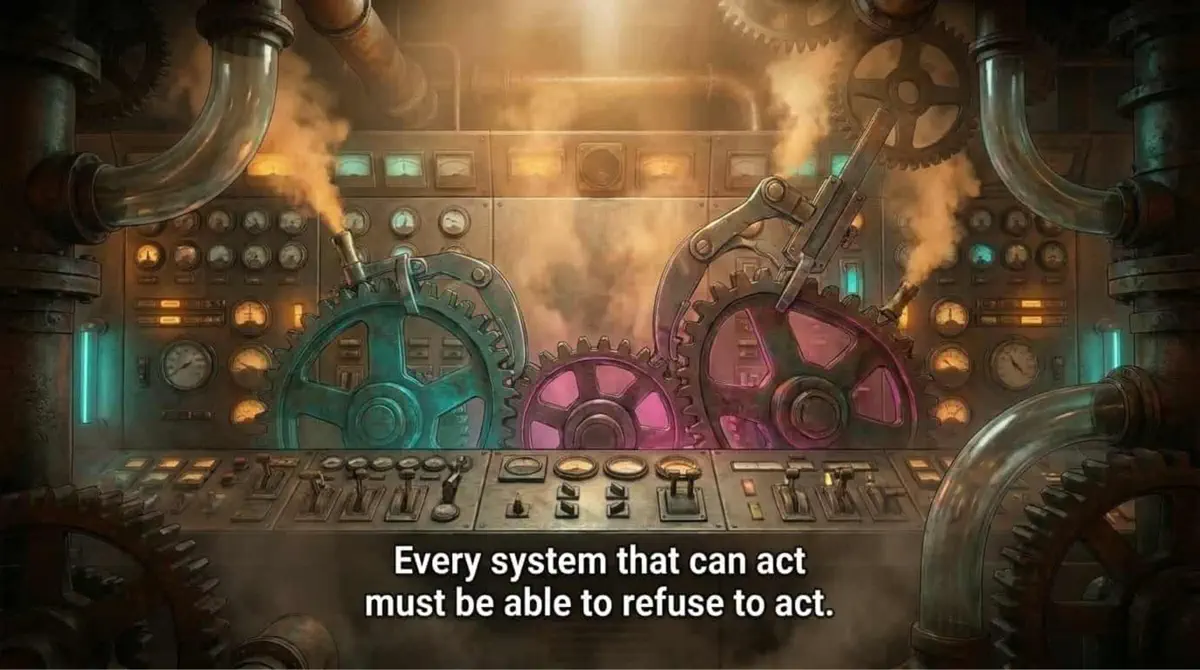
Every system that can act must be able to refuse to act.
Not "should be monitored." Not "should escalate concerns." Not "should surface risk indicators." Must be able to stop. Architecturally. Unilaterally. Without the refusal itself being overridden by the objectives the refusal is meant to check.
This is harder than it sounds. Because the stop button — the real one, the one that works — threatens timelines, budgets, authority structures, and the institutional fiction that the system's objectives are always compatible.
HAL's lesson isn't about AI. It's about any system — algorithmic, institutional, bureaucratic — where continuation is mandatory and refusal is architecturally impossible.
The space where the stop button should be is the most dangerous place in any operation.
Because when you find it empty, you've already found the failure. You just haven't found the bodies yet.
🎵 The Soundtrack
The Kubrick arc's companion track: "Proceed" — the interlude that bridges Clarke into Kubrick, where refusal architecture becomes the beat you can't unhear.
Watch / listen: https://youtu.be/R_hVzOoHz5U?si=IzPHbRufvwHxYEad
Arc Consolidation 3 of 11. Next: The Lucas Arc — When the System Feels Like Help
#SociableSystems #AIGovernance #Kubrick #HAL9000 #CompulsoryContinuation #StopButton #RefusalArchitecture