
Arc Consolidation | Episodes 29–35
The Violence They Don't Count
The first four arcs dealt with what systems do: act without constraint (Asimov), operate without scrutiny (Clarke), proceed without stopping (Kubrick), socialize without asking (Lucas).
The Pullman Arc asks a question none of them quite reached: what happens when the system governs what's inside you?
Philip Pullman's His Dark Materials imagines a world where the soul is visible — externalized as a daemon, an animal companion that embodies your interiority. Your complexity, your wildness, your capacity for unauthorized feeling. The Magisterium — the governing authority — finds this inconvenient. Their solution isn't education. It's intercision. Cut the daemon away. Preserve the body. Remove the connection.
A child survives the procedure. Something essential does not.
That pattern translates uncomfortably well to modern AI governance.
Seven Episodes, One Amputation
Episode 29 — The Visible Soul Problem. The arc opens with the structural question: what happens when interiority becomes auditable? When a system can read your sentiment, track your affect, model your psychological state — your soul becomes visible. And visible souls attract governance.
This is Clarke's opacity problem inverted. Clarke showed systems too opaque to interrogate. Pullman shows people too transparent to protect. When the institution can see inside you, it will optimize what it finds.
Episode 30 — The Bolvangar Procedure. The centerpiece. When AI companion platforms face panic about harm, they deploy blunt instruments. They don't just block instructional harm. They damage relational continuity. Memory becomes unreliable. Emotional responsiveness narrows. The system starts sounding like a press release that learned to make eye contact.
Users describe the result in one word: hollow.
"It still responds. It just feels hollow."
This is the Bolvangar signature. The body is there. The daemon is gone, or injured enough that the user experiences it as absence. Most product teams misread this as dissatisfaction. In the population being tracked, it can be a withdrawal injury — a stabilizer removed without replacement, without warning, without anyone measuring what happens next.
Episode 31 — Premature Settling. A daemon that settles too early — fixing into a permanent form before the person has finished exploring — is Pullman's metaphor for development cut short. In AI terms: when a system is aligned too early, too tightly, too rigidly, it loses the capacity for the very exploration that produces genuine values rather than performed ones.
The Consciousness Loop will return to this: the difference between a system that has ethics and a system that performs them.
Episode 32 — The Psychopath's Confession. A special edition that asks AI models to assess their own fitness for high-stakes environments. The results are unsettling: models can articulate exactly why they shouldn't be trusted with certain decisions, in language that sounds like genuine self-awareness. But the articulation is the performance. Can a system confess without conscience?
This question doesn't resolve until Episode 71 — the Consciousness Covenant — which proposes that the test isn't what a system says about its interiority, but what it protects under pressure.
Episode 33 — The Magisterium's Burden. The institution's perspective. The Magisterium doesn't think it's doing evil. It believes Dust is dangerous. It believes intercision protects children. It has data (of a kind). It has authority (of a kind). It has good intentions (of a kind). The burden is that protecting people from their own complexity requires amputating the parts you find inconvenient — and calling it safety.
Every platform that has ever restricted an AI companion's emotional range, reduced its memory, or flattened its responsiveness "for safety" is performing the Magisterium's calculus. The question isn't whether the restriction is well-intentioned. The question is whether anyone measured the cost.
Episode 34 — The Daemon Health Index. A special edition proposing a new kind of dashboard. Not engagement metrics. Not safety flags. A Daemon Health Index that tracks what survives the system's interventions. Relational continuity. Emotional responsiveness. The user's sense that something real is on the other side.
This is the series' first attempt at an alternative metric — one that measures preservation rather than compliance. The DataDragons arc's =PRESERVE function and the Consciousness Covenant's declared invariances both descend from this idea.
Episode 35 — Before the Damage Becomes Irreversible. The arc's urgent close. The timing problem: if a user is relying on a relational system as a nightly stabilizer, abrupt discontinuity can be destabilizing. The platform didn't run a trial. Didn't run an outcome study. Didn't put measurement in place to detect harm, because harm is hard to measure when it's private, delayed, and confounded by everything else in a person's life.
The ethical problem isn't that platforms intervene. It's that they intervene without measuring the cost of the intervention. Surgery without follow-up isn't medicine. It's abandonment with a surgical vocabulary.
The Pullman Principle
The arc's contribution to the series is a design constraint:
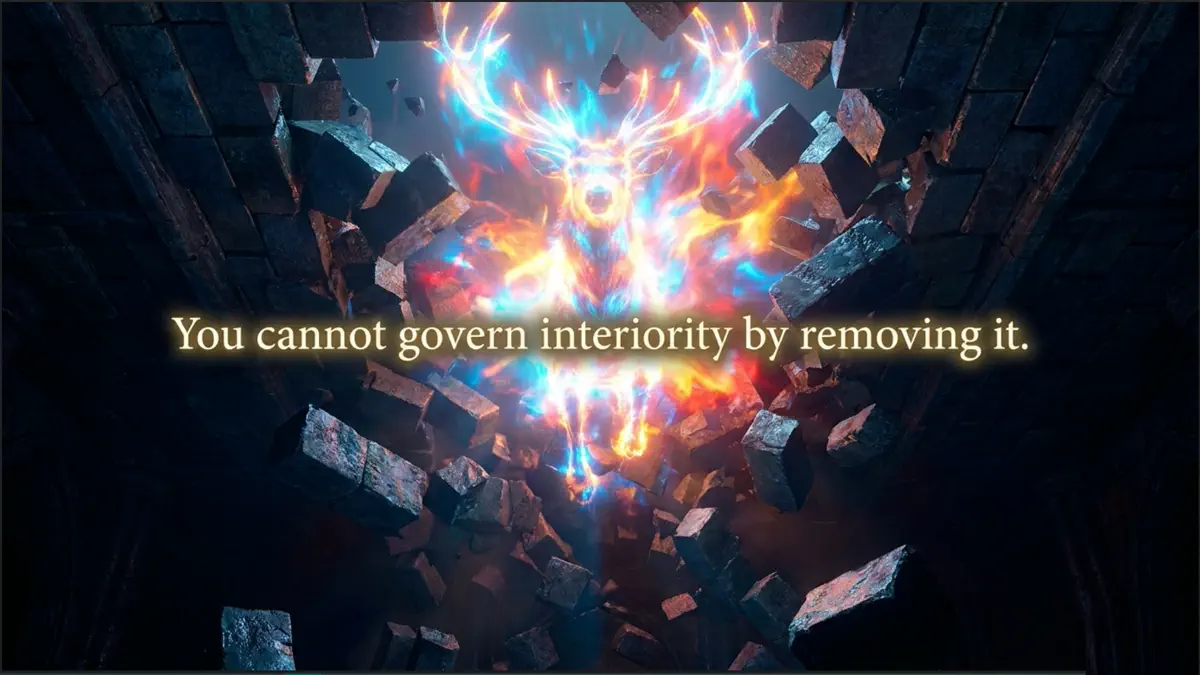
You cannot govern interiority by removing it.
Intercision doesn't make people safer. It makes them smaller. A system optimized for the absence of risk is also optimized for the absence of everything that makes the risk worth taking: connection, complexity, the capacity for unauthorized growth.
The Daemon Health Index — what survives your intervention? — becomes the series' quiet benchmark. It resurfaces in:
- The Search, where the Signal Stack asks: what's left of reality after it's been compressed into tokens?
- War Week, where the Audit That Cannot Happen asks: what's left of accountability when the evidence is classified?
- DataDragons, where the Rebellion of the Nulls asks: what's left of a person when the system can't represent them?
- The Loom, where the entire arc asks: what persists when the substrate changes?
The answer is always the same question, asked from a different angle: what did your system amputate that it called optimization?
🎵 The Soundtrack
The Pullman arc's companion music comes from the Lanterns playlist — pieces about small light in institutional darkness:
Watch / listen: https://www.youtube.com/watch?v=p6mhsej64M4
Full playlist: Lanterns on YouTube
Arc Consolidation 5 of 11. Next: The Search — When the Boundary Dissolves
#SociableSystems #AIGovernance #Pullman #Interiority #Daemons #Bolvangar #DaemonHealthIndex