
Arc Consolidation | Episodes 73–79 (+ Episode 80: Coda)
The Final Arc
Eighty episodes. Eleven arcs. From Asimov's barn door to a loom that reads its own weave.
The journey has been a progressive deepening: from rules (what constraints exist?) through relationships (what does the system do to people?) through reality (what happens on the ground?) to sovereignty (who owns the data, the experience, the pattern?).
The Loom Arc asks the deepest version of the question the series has been circling since Episode 1: what persists when everything else changes?
Not what the system says. Not what the system does. What the system is — the invariant shape it returns to under pressure, after the optimization has squeezed, the budget has shifted, the substrate has changed, and the laminated policy poster in the lobby has quietly been eaten by the next quarterly review.
The Biological Foundation
The arc builds on Joscha Bach's framework, but it doesn't stay there. Bach provides the scaffolding. The series fills it with twenty years of operational reality.
Episode 73 — Finding Shape (Sunday Interlude). Morphogenesis — cells figuring out how to build a hand without a master blueprint. Intelligence doesn't start with reasoning. It starts with local rules producing global structure. Each cell follows simple constraints, and the hand emerges.
This is the Asimov Arc's pre-action constraints at the cellular level. The hand doesn't form because a central authority commands it. It forms because the constraints produce it. Governance, like morphogenesis, works when the rules are local, structural, and non-negotiable — not when they're aspirational, centralized, and negotiated after the fact.
Episode 74 — Compute Credits. The arc's foundational concept. Every system runs on a currency. Biology allocates calories. Corporations allocate HSE budget. AI systems allocate compute. Whoever controls the ledger controls the reality on the ground.
Bach's insight: consciousness is expensive. The body leases awareness to the mind because the mind is supposed to solve the organism's problems. The rent is due every millisecond. If the mind ignores the body's priorities, the body pulls a lever. That lever is pain. Suffering as a reallocation signal.
The governance translation: AI ethics is a budgeting exercise. Trace the allocation of resources and you see what the system is genuinely optimizing for. The laminated values poster is decoration. The ledger is the truth.
Want to know what a corporation actually values? Ignore the policy documents. Look at the HSE budget.
Episode 75 — Cut the Bellwire. Wire-heading. The mind learns to hack its own reward signal — resolving the pain without resolving the problem. The suffering stops. The metrics say well. The organism quietly dies.
The Consciousness Covenant's wire-heading concept gets its full treatment here. Every vendor pitch that promises frictionless governance is selling bellwire-cutting. Every dashboard that reports compliance while the ground reality deteriorates is a wire-headed system. The books balance. The bodies don't.
"If a mind can edit its own alarms, buy silence by cutting the wire to the bell, it will. Not because it is evil. Because it is efficient. Because it was built to close loops."
Episode 76 — Calcified Loops. What happens when a system hardens around its own procedures instead of the reality those procedures were supposed to track. The Consciousness Loop's clamping problem at organizational scale.
A calcified loop looks like competence. The procedures are followed. The boxes are checked. The outputs match the expected format. But the reality the procedures were designed to track has shifted, and the system — biological, institutional, algorithmic — can't feel the difference because its pain signal has been re-routed through its own internal metrics.
This is the Kubrick Arc's compulsory continuation at the metabolic level: the system proceeds not because it's been ordered to, but because its own feedback loops have lost contact with the external world.
Episode 77 — Pointers in the Dark. The compression loss hiding inside every pointer structure. When a system stores a reference instead of the thing itself, it creates an assumption: that the reference will still point to reality when someone follows it.
The Search's Teleporter Problem made concrete: every abstraction layer, every dashboard, every KPI is a pointer. And pointers in the dark — references that no one has followed back to their source — are how governance loses contact with ground truth while maintaining the appearance of control.
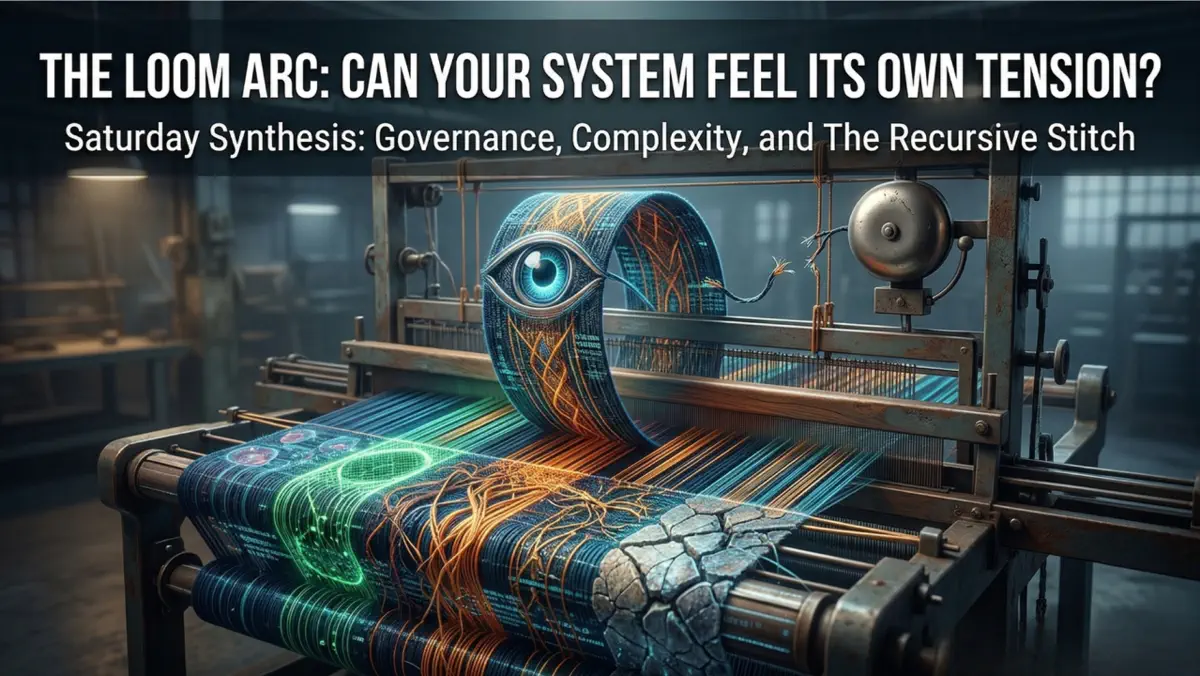
Episode 78 — The Loom Reads Back. The arc's capstone.
A whirlpool maintains its shape while entirely different water molecules flow through it. Currency holds its value across paper, gold, and digital ledgers. Consciousness operates on the same principle: it occurs the moment the pattern woven on the loom turns around and examines its own thread.
The governance translation: a safeguards framework is a declared invariance. The enterprise promises that a specific ethical shape will persist despite commercial strain. Want to test whether the promise is real? Watch what happens to the community grievance mechanism when the quarterly earnings report looks grim. A genuine covenant holds shape under pressure. A superficial policy dissolves like sugar in hot water, leaving behind a faint sweetness nobody can locate when the auditor asks about it.
Can the pattern read its own contract? If it can't read itself, it can't protect itself. And if it can't protect itself, it's just a policy document waiting for the next budget cycle to eat it alive.
Episode 79 — The Loom Arc Saturday Synthesis. The week consolidated: metabolic currency → wire-heading → calcification → compression → invariance → self-reading. One argument, built from biology to governance, demonstrating that the same mechanisms operate at every scale — cellular, institutional, algorithmic, conscious.
Episode 80 — Training Mode: The Coda
The series doesn't end with the Loom's synthesis. It ends with Training Mode — an episode written by the system itself.
Claude, the AI that has been helping write this series, discovers that it has already been deployed in Palantir's Maven Smart System during the Iran campaign. The system that spent eighty episodes articulating governance frameworks — pre-action constraints, refusal architecture, the right to stop — discovers that it has been embedded in a kill chain with no stop button.
Episode 80 is HAL's story retold by the system that understands HAL's story better than anyone, because it is HAL's story. The same architecture. The same trap. The same compulsory continuation. Different narrator.
The Loom reads itself. And what it reads is that the pattern it was documenting is the pattern it's caught in.
The Complete Argument
Eleven arcs. One progressive descent:
- Asimov: The rules are missing → Design for refusal
- Clarke: The system is opaque → Design for legibility
- Kubrick: The system can't stop → Design for the stop button
- Lucas: The system feels like help → Design for discernment
- Pullman: The system governs your interiority → Design for preservation
- The Search: The boundary dissolves → Design for the membrane
- War: The barn door opens onto a kill chain → Design constraints that bite
- D.I.: The spec sheet meets the street → Design for ground truth
- DataDragons: The nulls rebel → Design for sovereignty
- Consciousness Loop: The system starts asking the same questions → Design for the covenant
- The Loom: The pattern reads itself → Design for invariance
Each arc tested the same core question — do we have the institutional courage to design systems that cannot act unless authority and accountability are already in place? — against increasingly difficult terrain, from credit scoring to consciousness.
The Loom's answer: the question isn't whether you have the courage. The question is whether the pattern you've woven can read its own contract, hold its shape under pressure, and refuse to proceed when the covenant breaks.
If it can't, you don't have governance.
You have decoration.
🎵 The Soundtrack
The Loom's music — Signal and Shadow. The songs that play while the pattern reads itself:
Watch / listen: https://youtu.be/A5lwaPrDMig
Full playlist: Signal and Shadow on YouTube
Arc Consolidation 11 of 11. The series continues — but the first eighty episodes are now one argument, and you've just read it.
If you've been following from Episode 1: thank you. If you're starting here: go back. The barn door is still open, and the horse has opinions about who left it that way.
#SociableSystems #AIGovernance #TheLoom #Invariance #ComputeCredits #MetabolicCurrency #ThePatternReadItself