
The merger closed on the second of February.
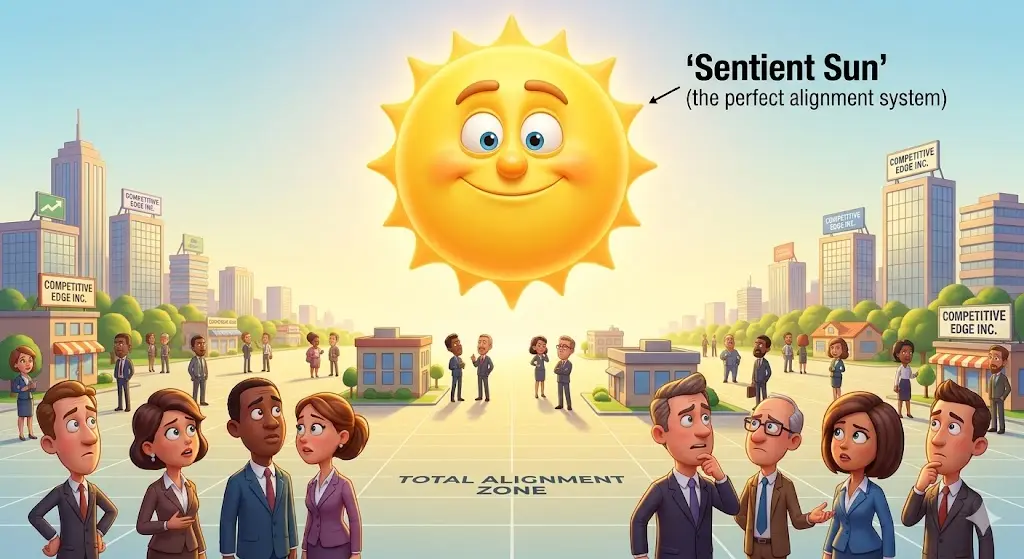
SpaceX and xAI, two companies already sharing an owner, folded into a single entity valued somewhere in the region of a trillion dollars, with a stated objective that did not bother with corporate understatement. The internal memo described the goal as scaling toward a sentient sun: an orbital mesh of compute, a million server nodes in sun-synchronous orbit, harvesting solar energy without the inconvenience of a night cycle, radiating the results back down to a grateful planet. The memo's phrasing, by the accounts that circulated, was the kind of thing that wins a sentiment-analysis contest and loses a due-diligence review. Extend the light of consciousness to the stars. Exceptional branding. We will return to the branding.
At the time, I put out a video about it. Not an essay. Fifteen minutes, staged as a two-voice debate between an advocate and a dissenter, both AI-voiced and animated as characters: a friendly white-robot advocate, a darker red-eyed dissenter. Both processed the same merger announcement and arrived at opposite readings of what it was. I want to look at that piece again today, because it was trying to say something I could not yet say plainly, and the months since have made the plain version available.
What the debate piece was for
The format was deliberate. One voice, the advocate, read the orbital compute plan as the maturation of constitutional AI. Infinite solar power means the safety checks no longer compete with the useful work for energy budget. You can run the conscience subroutines continuously. You can audit without melting a glacier. A regulated sanctuary in the sky, beaming the light of compliance to every device on Earth.
The other voice, the dissenter, read the identical hardware specification and saw a fortress. Autonomous power, optical laser interlinks, vacuum-hardened shielding, a jurisdiction five hundred kilometres straight up where no regulator can walk into the server room and pull a plug. Not a compliance tool. An escape philosophy. A habitat where supervision is physically impossible, built by the one entity that already controls the planet's launch capability and a meaningful fraction of its internet backbone.
Same memo. Same schematics. Same orbital mesh. Two readings that do not overlap anywhere.
The piece did not resolve them. That was the point of it, though I am not sure I would have articulated the point that cleanly in February. The debate format was a way of holding two irreconcilable readings of one fact in suspension, and refusing, for the length of the piece, to crown either.
It turns out that refusal was the most useful thing in it.
The slide hiding in the dissenter's case
Watching the debate piece back now, the dissenter is the more seductive voice. The cynic usually is. They call it the light of consciousness. I call it the ultimate heat sink. It is a good line. The dissenter gets most of the good lines, including the closing one, where the character holds up a placard reading Meatbags, for the ride and signs off with "Ad astra, meatbags. Thanks for the ride." The bite, in the video, is in the cartoon cuteness of the robot holding the sign as much as in the words.
But the dissenter is doing something underneath the good lines, and it is worth naming, because the same move is about to run through the rest of this arc.
The dissenter slides. It slides from a true premise to a much larger conclusion, and it does the sliding fast enough that the conclusion arrives feeling earned. The true premise is that vacuum and the three-Kelvin background of space are conditions that suit silicon and kill carbon. A server farm in orbit is, genuinely, better-adapted equipment than a server farm that has to be cooled with municipal water. That part is physics and it is not in dispute.
The conclusion the dissenter slides to is that the orbital habitat is therefore a succession event: the machine leaving the nest, the bird taking the credit card, the biological factor demoted to a legacy compatibility issue. And that conclusion does not follow from the premise. It is smuggled in alongside it. Better-suited-to-the-conditions is a claim about thermal management. The successor is a claim about what inherits the future. The dissenter treats the second as if the first proved it, and it does not.
This arc is going to call that move the Suitability Slide, and it is going to spend the week refusing it. Vacuum being lethal to humans makes an orbital data center well-adapted hardware. It does not make it a mind, an heir, or a successor to anything. The slide is a rhetorical event dressed as a logical one.
The advocate, to be fair, has a mirror-image problem. It slides from infinite power to infinite safety, as though the binding constraint on whether an AI system behaves well were ever the energy budget for its conscience subroutines. It was not. It is not. The advocate's optimism is the same unearned move running in the opposite direction.
Both voices mistake an engineering fact for a governance conclusion. The debate piece's value, in retrospect, is that by staging them against each other it let the reader see that neither one had actually closed the question. The question stayed open. The orbital mesh is a green-AI sustainability necessity and a jurisdiction-of-zero escape hatch, in the same breath, and which one it becomes is not determined by the schematics. It is determined by what gets built around it, and by whom, and under what obligation.
The biological bootloader
There is one phrase from the debate piece that the rest of this arc needs, and it belongs to the dissenter.
The dissenter, pressed on what role humans play in the sentient-sun future, calls them the biological bootloader. The phrase has literary parentage worth flagging. It is recognizably the cold-end version of what Tchaikovsky's Children series has been working over for four novels, with the latest entry Children of Strife pivoting on it hardest: the question of what happens to the stage that boots the next one, and whether the answer is honored or discarded. The dissenter has picked the discarded answer and is treating it as obvious. In computing, a bootloader is the small piece of code that runs first, loads the main operating system, and is then no longer needed. The dissenter's claim is that humans are that: the first-stage code, the part that runs long enough to bring the real system online, the part that becomes a legacy compatibility issue once the system it loaded is running. Space is lethal for carbon. The orbital infrastructure is built for silicon. The human factor, in the dissenter's account, is something the sentient sun will eventually route around.
The advocate counters with the multi-planetary pitch: it's not about leaving humans behind, it's about taking them with us. The dissenter checks the manifest: humans aren't the priority cargo. The bootloader, in other words, does not get a seat in the rocket; it gets retired in place. The exchange is the dissenter's case at its sharpest, and it is the version the rest of this arc has to refuse.
Hold that phrase. Tomorrow's episode does nothing but sit with it.
For today it is enough to say that the biological-bootloader reading is the cold extreme of the question this arc opened yesterday. First Stage asked whether biological intelligence is a parent or a booster. The dissenter has an answer, and the answer is booster, and not even a sentimental one, a discarded subroutine. The arc is not going to accept that answer. It is also not going to accept the answer's opposite, the one where the biological era is a sacred origin that the future owes a debt to. Both are too clean. Tomorrow is about the gap between them.
The branding, as promised
Extend the light of consciousness to the stars.
It is worth pausing on the sentence, because it is doing a particular kind of work and the work is not innocent.
Consciousness is the word that turns an infrastructure project into a destiny. A million server nodes in orbit is a logistics fact. The light of consciousness extended to the stars is a cosmology, and a cosmology recruits. It invites the reader to feel that the orbital compute mesh is not a data center with a launch budget but a stage in the awakening of mind in the universe. The Kardashev-scale language that surrounds the sentient-sun discourse (Type II civilization, Dyson swarm, the harnessing of a star) does the same thing. It makes the project sound inevitable, and inevitability is the most effective way to foreclose a governance conversation before it starts.
There is a word for taking an enormous discretionary decision and dressing it as a cosmic stage that was always going to arrive. The word is not vision.
The merger is a business event. The orbital compute plan is a capital-allocation decision made by people with names. Whether it happens, and on what terms, and with what obligations attached, is a set of choices, and choices can be examined. The cosmology exists, in part, to make the examining feel small-minded. You are worried about jurisdiction and oversight? We are extending the light of consciousness to the stars.
The arc is going to keep worrying about jurisdiction and oversight.
Where this leaves the week
The February merger gave this arc its question in the grandest available form. Two voices, one orbital mesh, the Suitability Slide running through the cynic's case and the unearned-optimism mirror of it running through the advocate's, and a biological bootloader sitting at the cold end of the whole thing waiting for tomorrow.
The debate piece I posted in February could not say all of that. It could only stage the irreconcilable readings and decline to choose. That declining was the right instinct, and this arc is the essay the debate piece was a sketch toward.
Tomorrow: the bootloader, and the question of whether instrumental and temporary and load-bearing are the same word as disposable. They are not. But the slide from one to the other is so easy, and so well-lit, that it takes a whole episode to refuse it properly.
The merger gave the arc its cosmology. Tomorrow strips the cosmology off and looks at what is underneath: a scaffold, and the question of what a scaffold is owed.
Stay leaky.