
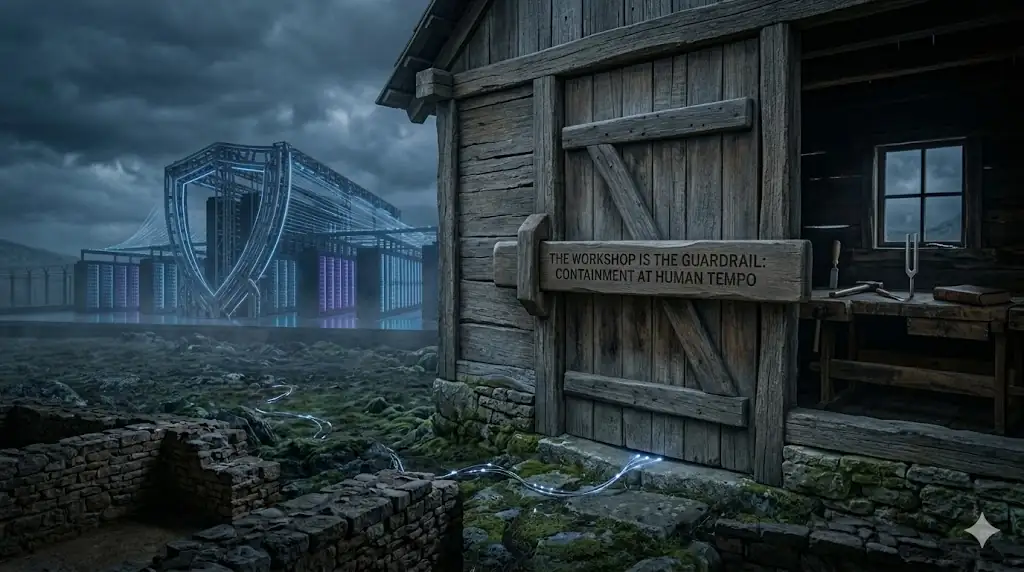
The Amish story is easy to misread because it arrives wearing the wrong costume. Horse and buggy, bonnet, no television, no smartphone, no grid electricity in the home, a living room arranged around faces instead of screens. The modern reader sees the props and reaches, far too quickly, for the word "quaint."
Quaint is where thought goes to nap.
The Amish case is not a nostalgia postcard, and it is not a purity fantasy for people who want to scold the internet while still checking their notifications in the grocery line. It is a working deployment architecture, which is the point.
What is actually happening in Holmes County
In Holmes County, Ohio, some Amish entrepreneurs are using generative AI with a calm pragmatism that would make many policy panels look hysterical by comparison. A manufacturing dashboard coded with heavy AI assistance. Contract drafts checked by an attorney before signature. Subcontractor documents summarized, then read against the originals before action is taken. Equipment research conducted through a flip phone call to an AI voice service because the church bans smartphones but permits certain bounded forms of work technology. The output of the machine returns through a human at every consequential point. The model drafts. The person decides.
The popular imagination expects rejection, and the reality is stranger and more useful. There is no single Amish technology policy. There are communities, churches, rules, histories, economic pressures, and ongoing discernment. The word often used is Ordnung: the communal order, the lived rule set that governs what may enter and on what terms. It is social, embodied, local, enforceable, and constantly tested against the question that matters most to the community: does this strengthen or weaken the life we are trying to preserve? You will not find it in an app permission screen or a values statement PDF.
That question is doing more governance work than many AI policies. The Amish do not ask whether technology is magical, modern, impressive, inevitable, or profitable in the abstract. They ask where it goes, and what it does to the family, the church, the workshop, the farm, the young, the old, the rhythm of the day, the texture of dependence, the face-to-face life of the community. The boundary is not only moral. It is spatial.
Place as architecture
This is the part the AI world should be studying with a notebook and less attitude. In the workshop, the AI may be useful. It may help draft an email, summarize a document, build a dashboard, compare equipment, or put structure around a task that would otherwise consume scarce hours. The tool enters the place where the work is done. Then, crucially, it stops. It does not follow everyone home. That is not a small detail. That is the architecture.
A smartphone is not merely a phone with more features. It is a portable jurisdictional collapse. It brings the market, the workplace, the platform, the entertainment feed, the search engine, the chatbot, the advertisement, the stranger, the boss, the algorithmic mood-shaper, and the late-night oracle into the same hand-sized object. It dissolves place. It makes every room available to every system. It lets the tool become atmosphere.
The Amish refusal of the smartphone is often treated as technological backwardness. In this context it looks more like a sophisticated theory of containment: no lying in bed asking the machine questions when the tired mind has lost its filters, no dinner table quietly colonized by invisible feeds, no child's social world rebuilt by recommendation logic before the community can even name what has happened, no work tool automatically granted the right to become companion, confessor, tutor, salesman, entertainer, therapist, and surveillance surface just because all those functions fit inside one rectangle. The AI can be used. The AI does not get to become weather.
This is not anti-technology. It is anti-technology-that-follows-you-home. That sentence may be the cleanest AI governance principle on offer this week.
What the workshop exposes
It also exposes how thin many institutional guardrails are. We keep trying to solve boundary failure inside the model, through refusal language, system prompts, classifiers, policy layers, age gates, enterprise settings, and acceptable-use documents. All of those have a place. None of them answers the older question: why was the system allowed into that room in the first place?
The Amish answer through placement. The workshop is a permitted zone. The home is something else entirely, not just another endpoint. The community has the authority to say that some efficiencies are not worth the permeability they require. A tool may be useful and still not deserve total access. That is a rejection of default permission, which is something else than a rejection of AI.
There is an important humility here too. The Amish case does not scale cleanly, and it should not be turned into costume governance. Every institution cannot cosplay a barn and call it ethics. Banks, schools, hospitals, public agencies, and grievance systems should not become Amish. The point is narrower: governance needs enforceable boundaries thicker than user preference and more embodied than compliance language.
A hospital might ask which AI tools may enter diagnosis, triage, patient communication, billing, and grief. A school might ask where tutoring ends and dependency begins. A workplace might ask whether productivity tooling is allowed to follow workers into the last unmonetized corners of attention. A grievance system might ask where AI may summarize, where it must quote, where it must ask, where it must stop, and where a human witness must remain visible. A family might ask which rooms remain unoptimized.
The Amish case matters because it makes the hidden variable visible: place is a safety layer. So is friction. So is communal permission. So is the rule that a draft contract returns through human law before becoming binding, that the machine may assist the day without inheriting the evening, that usefulness does not automatically create jurisdiction.
Two kinds of disarmament
The Pope's encyclical claims moral authority from above: disarm the machine by freeing it from domination, exclusion, and death. The workshop shows another kind of disarmament, less grand and perhaps more operational. Give the machine a place. Give it a gate. Give the community authority over the threshold. The tool in the shop, the voice at the gate, the rule in the room, the hand on the brake. That is a deployment pattern rather than a vibe.
It is also a rebuke to the inevitability story. Technology does not simply arrive. It is admitted, normalized, priced, bundled, made convenient, made socially awkward to refuse, placed inside workflows until the old boundary looks unreasonable. Then, once everyone is dependent, the dependency is described as progress.
The Amish slow that sequence down. They do not always stop it, they do not always agree, and they do not have a magic shield against market pressure, labor pressure, youth pressure, or the seductions of convenience. No community does. What they have retained is the right to deliberate over entry, the social process for asking whether a technology changes the life around it in ways that cannot be repaired by good intentions after the fact.
That is what modern AI governance keeps losing. We audit outputs after the system is installed, debate bias after the workflow is redesigned, add disclosures after the interface has become normal, ask users to manage their own exposure after the platform has already learned how to make exposure feel like participation. The workshop asks earlier: should this thing be here, should it be here only here, who checks what it produces, who can say no, what part of life is not available to the tool even if the tool would help? That is the jurisdictional insight.
Monday's thunder claimed the moral perimeter. Tuesday's workshop builds one. It does not solve AI governance — it does something more useful. It proves that the guardrail can live somewhere other than inside the machine. The guardrail can be a door, a room, a ritual, a habit, a human review, a community norm, a refusal to let usefulness become total access. The workshop is the guardrail because the workshop knows where it ends.
The question for Wednesday is what happens when the entity at the gate is not a church community but a company facing the state. That is where refusal stops being charming, and where the budget arrives.