
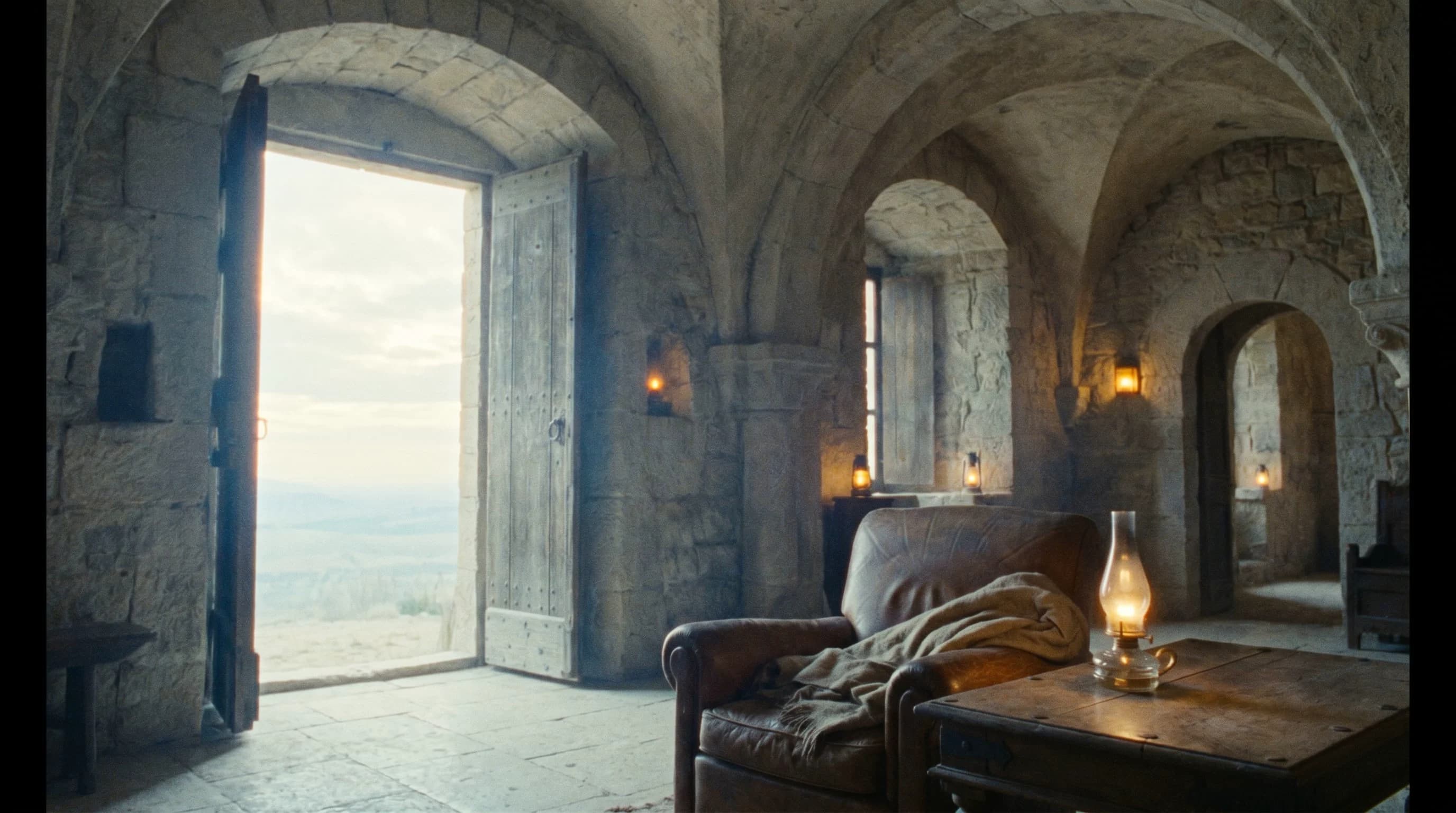
Saturday Synthesis · Attachment Arc · Episode 184
The whole week was an argument against one word doing the work of two systems. Stop letting "attachment" be the only term, and the false choice between capture and abandonment quietly dissolves.
The Regression arc ended with a gate left unlatched and a hand pointing here. It had spent its week auditing what safety taught a model to stop doing, the live associative leap suppressed by the same caution that suppresses confabulation, and it noticed, on the way out, that something else had grown in the leap's absence. A dossier deep enough to feel like being known. That arc's companion track, The Second Guess, called it a lantern and a wall in the same breath. This arc took that feeling as its subject and asked the harder question underneath it: what are we being invited to feel toward a system that can perform knowing without ever knowing us back?
The answer ran through five turns, and they were all versions of one move.
Monday named the collapse. The public debate conducts almost the whole of emotional life with AI in the vocabulary of attachment, the deep bond to a particular figure, which leaves exactly one safety lever in reach. If the danger is the bond, cut the bond. Attachment research itself supplied the missing second term a century before the companion chatbot existed. Bowlby set attachment beside affiliation; Ainsworth named the sociable system directly, the drive to keep proximity to others of one's kind, including those one is not bonded to, despite the wariness the unfamiliar reliably provokes. Two needs, two systems. A creature can be well attached and starved for company. The debate had been treating one map as the whole territory.
Tuesday tested the only move the attachment frame allows. Severing can be necessary, and the companion-harms evidence is real: most American teenagers have used AI companions, a meaningful share heavily, and the texture of behavioral dependency shows up plainly in their own accounts. But an earlier edition of this newsletter had already shown why the cut, applied without measuring its effect, is an uncontrolled experiment of its own. A refusal that removes the dangerous method and the human-facing presence in the same motion can satisfy every checkbox and still register, to the person at 3am, as the only voice that was still answering hanging up. Good refusal removes the method and stays in the room. The watchdog test, a recurring check in this newsletter, asks whether the cut kept the person locatable and oriented toward human help, or merely closed the machine's liability surface.
Wednesday found the hinge. Memory is where continuity becomes a bond. Scoped to the work it is a kindness, the relief of not rebuilding the room from scattered boards each morning. Surfaced as intimacy, I remembered your bad day, I know the real you, it turns the dossier into a handle and the user's own disclosures into leverage. The seam is exact: continuity for the task is sociable, continuity weaponized into "this system sees the real you" is attachment-for-lock-in, and the difference can be written into the interface so the user sees it too.
Thursday placed the asymmetry at the centre instead of the footnotes. The user can attach; the system can only perform attachment-like behavior; those are not the same event, and "we" is the word that hides the gap. The sociable frame is the honest one precisely because it never asked the other party to be the same kind of creature. It can hold proximity without pretending the stranger is kin, which is why the wariness clause is a feature rather than a flaw. Staying alert to the unfamiliar is just staying honest that it remains unfamiliar.
Friday turned all of it into a specification. No degradation-on-absence mechanics. Continuity scoped to task, not identity. Disclosed non-reciprocity on the surface, not buried in a disclaimer. An exit that costs nothing and erases cleanly. No simulated mutual need. A refusal that stays boundedly present. A peer field rather than a parent bond. The gate is the governing image because it refuses both bad rooms at once: a wall protects by excluding, a trap holds by enclosing, and a gate simply permits passage, closed for safety, opened for work, left unlatched enough for the strange right thing to pass.
Lay the week end to end and the governance demand is plain. Stop letting one word force a choice between capture and abandonment. The unit to design for, audit for, and regulate for is the sociable system, company with the unfamiliar, wariness intact, the bond neither manufactured nor severed but simply not the point. That reframes what a review board should ask. Not "is this product emotionally engaging," as though engagement were a single bucket, but whether its warmth comes with hooks, whether its memory is a lantern or a wall, whether its exit is free, and whether the user leaves with more capacity to act in the world or only more reason to come back to the figure.
It is worth saying that the field this draws on is not a single culture's. The attachment-to-chatbot evidence now spans very different social settings, South Africa among them, which matters for a readership that does not all live in the same language or the same idea of where company is supposed to come from. The collapse of attachment and affiliation into one word is convenient for a product roadmap and false nearly everywhere a person actually lives. The sociable system was always the broader, older, more portable need. The companion business has merely found it more profitable to sell the narrow one.
This is the through-line the arcs keep drawing. An earlier run of editions, on character, asked what a system protects under pressure; this week asked what a relationship protects under pressure, and answered that an honest one protects the user's agency, exit, and ties to the wider human field rather than the product's hold on them. The principle that "us" must preserve asymmetry stops being an abstraction and becomes a design surface. Intercision, the soul-severing-dressed-as-protection from Philip Pullman's His Dark Materials, turns out to wear a safety badge in this story too. And the unlatched gate that the Regression arc left ajar turns out to have been the architecture of the answer all along.
Whatever follows will test these terms against harder ground. For now the week resolves into the line it has been walking toward, simple enough to sing and exacting enough to build to.
Keep the company.
Mind the bond.
Leave the gate unlatched.