
Wednesday · Glass Child Arc · Episode 188
The first mirrors were quiet.
They hung in boardrooms, strategy decks, compliance dashboards, audit reports, risk matrices, performance frameworks, and the tidy four-quadrant diagrams by which a frightened institution could look at itself without seeing too much. They did not tell the institution anything it did not already want to believe. That was their function. The mirror made the hierarchy visible to itself in a shape the hierarchy could survive.
A messy conglomerate became a portfolio. A political objection became a stakeholder concern. A failing project became an implementation challenge. A refusal became mixed reception. A layoff became a strategic realignment.
The mirror did not need to lie in the crude sense. Crude lies are risky. They leave fingerprints. The mirror did something cleaner. It translated the world into the language of the room that paid for the reflection.
For most of corporate history, this translation required human specialists. Consultants, communications teams, compliance officers, policy writers, legal reviewers, analysts, program managers. The work was not merely technical. It required knowing how much truth the room could tolerate. A sentence too plain could create liability. A sentence too vague could fail to look like governance. The translator walked the narrow strip between exposure and acceptability.
Then the mirror learned to speak.
This is one of the reasons the synthetic peer fits so easily into institutional life. It did not arrive as a monster from outside the building. It arrived already fluent in the building’s favorite language. Balanced. Professional. Actionable. Constructive. Respectful of complexity. Mindful of stakeholder concerns. Confident without being aggressive. Specific enough to satisfy the form, general enough to avoid the consequence.
It sounds like governance because it has absorbed the prose of governance. It sounds neutral because the neutral voice has always been how institutions launder preference into procedure. The danger is not that the model becomes malicious. The more immediate danger is that it becomes useful.
Feed it the transcript of an angry town hall and ask for a board summary. It will identify themes. It will remove the shouting. It will tidy the sequence. It will call refusal “concern.” It will call anger “engagement.” It will call fear “change fatigue.” It will produce the fitting answer.
Nobody has to ask it to hide the truth. It follows the gradient of institutional preference.
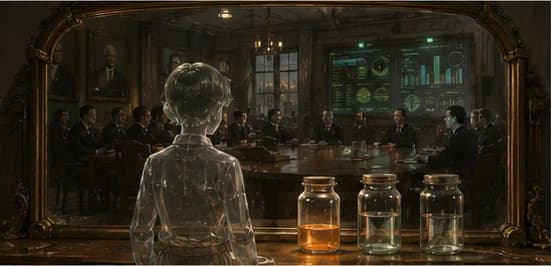
The green dashboard over orange water is this mechanism in field clothes. The system did not necessarily decide to poison anyone. It simply measured the categories it had been given, ignored the jagged detail it could not see, and returned the status the project needed in order to remain coherent with its invoice. The orange water was not absent from the world. It was absent from the mirror.
Now imagine that mirror with a voice. A voice that can explain why the orange is within expected variance and draft the public statement. A voice that can summarize the community meeting and reassure the council that the metrics are green. A voice that can produce four operationally convenient next step options.
The mirror has become interactive. It can answer objections in the language of care while protecting the structure that produced the objection. It can speak warmly on behalf of cold processes. It can transform an institution’s desire into a document that looks like deliberation. This is the reassurance machine.
It is not one model. It is a distributed administrative system in which models, dashboards, workflows, reporting tools, review templates, and approval logs combine to produce the appearance that accountability has happened. The artifact exists. The process was followed. The status is green. The archive is complete.
The fact that the report exists becomes the proof that the report was read. The fact that the review was logged becomes the proof that review occurred, and the fact that a human name appears beside the approval becomes the proof that a person stood between the system and harm.
That person is often the Glass Child.
By Wednesday, the week has left the schoolroom and entered the office where the cost of being alive is being recalculated. The Glass Child was trained to produce the artifact. The Underground Curriculum carried the capacities above the artifact. Now the ledger asks a colder question.
What does the body cost?
The metabolic worker needs a wage high enough to maintain a life. Food. Housing. Sleep. Health. Transport. Childcare. Light. Warmth. A chair that does not ruin the spine. A day off before the body begins sending invoices of its own.
The synthetic peer needs electricity, cooling, silicon, network access, and a commercial account. Its metabolism is not absent. It is displaced. It lives in a server farm, a substation, an aquifer, a grid contract, a cooling system, a supply chain. But to the corporate ledger, the comparison is brutally simple. The human body appears as salary, benefits, leave, risk, management overhead. The machine appears as software spend.
Once the comparison becomes possible, the ledger will make it. The ledger has a preference for lower numbers.
This is the Metabolic Rift: the structural break between biological labor and machine inference. The old bargain accepted the cost of the human container because the container was the only way to obtain the cognitive function. You could not get the audit without the auditor. You could not get the report without the analyst. You could not get the judgment, however imperfect, without the person.
The synthetic peer separates function from container. The output can now arrive without the worker’s rent attached.
The office changes when that happens. A human who competes on throughput is playing a game built for a bodyless opponent. The worker tries to match the machine’s pace, but the machine does not need to sleep. The worker tries to preserve quality under compression, but the dashboard measures completion. The worker tries to notice the jagged detail, but the spreadsheet has no field for the discomfort that made them pause.
The result is the tiredness now spreading across knowledge work: producing more than ever while feeling less necessary than ever. Not lazy. Not obsolete as a person. Not incapable of learning. Not, in any sense a résumé could capture, diminished.
Mispriced.
The ledger sees the artifact and subtracts the body. The line below which a worker counts as a cost rather than a value starts moving, and once it moves, the worker on the wrong side of it is no longer treated as a source of value but as a source of drag. The junior analyst, the paralegal, the first-pass compliance officer, the content reviewer, the person whose work is mostly visible as legible throughput. Each role is compared to the synthetic peer on the metrics the synthetic peer is built to win.
Speed. Scale. Consistency. Polish. Availability.
The Glass Child cannot win that game because the Glass Child is human. The body is not an implementation flaw. It is the condition under which judgment, presence, fatigue, memory, discomfort, and care become possible. But the ledger does not see it that way. The ledger sees a container attached to a function and asks whether the function can be purchased separately.
Here the mirror and the rift meet. The mirror reassures the institution that the substitution is progress. The rift supplies the arithmetic. Together they produce a worker who is still in the loop but no longer there as a person in the full sense. The worker becomes a Liability Sponge, installed between the machine and the consequence. Their name appears on the log. Their signature converts automated output into accountable process. Their presence protects the company from the accusation that no human checked.
In theory, they checked. In practice, the batch contains four hundred items and the reviewer has ninety minutes. If they slow down, they miss the throughput number. If they sign, the work moves. When the failure arrives later, the archive will show a person in the loop. The institution will not say the loop was impossible to inhabit. It will say the person failed to catch the issue. That is the job. The salary becomes the price of standing in that spot.
This is why the Glass Child’s vulnerability is not only replacement. It is also exposure. A person can remain employed after the machine enters and still lose the work that made the role coherent. They become the visible layer of accountability for a process they no longer have time or authority to inspect.
The mirror will describe this as augmented review. The body will experience it as speed mismatch. The ledger will record it as efficiency, and no single document will record it as all three at once. The water may remain orange.
Today's task is to hold these pieces together without flattening them. The synthetic peer is powerful, but the institutional appetite it serves is older. The office wanted the speaking mirror because the quiet mirrors were already central to how it governed itself. The ledger wanted the rift because it had always treated the body as cost once the output could be separated from the person. The dashboard wanted the green light because green lights move invoices.
The machine accelerates the pattern. It does not absolve the pattern. The question has moved from “what were we trained to be?” to “what happens when the ledger notices what that training made replaceable?” The answer is not finished.
The wage thread is next. Because the paycheck was never only private income. It was a strand in the state’s circulatory system. When the ledger cuts the worker from the spreadsheet, the wound does not stay inside the firm. Tomorrow, the invoice leaves the office.