
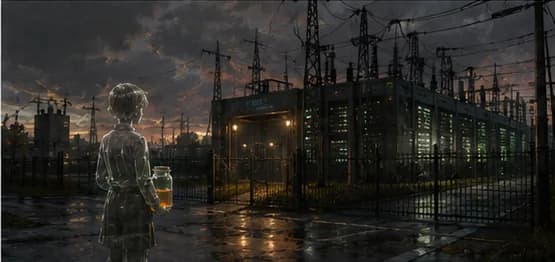
Friday · Glass Child Arc · Episode 190
This week has been about the office and the wallet. Today we go outside. The cloud is a marketing term.
For years, digital power escaped ordinary politics by pretending to be weightless. Software scaled. Data flowed. Platforms floated above place. The product was everywhere and nowhere, a service in the browser, a subscription on the card, an interface with no visible factory gate. Governments chased privacy violations, tax avoidance, disinformation, algorithmic harm, labor precarity, and monopoly behavior through a fog of shell companies, terms of service, offshore structures, voluntary guidelines, and policy panels.
The cloud could not be touched because the cloud had no handle. But synthetic cognition has a handle.
It is hot. It hums. It draws power through copper. It drinks water. It sits beside a substation. It needs permits, roads, transformers, transmission lines, cooling systems, emergency plans, grid priority, and a community willing or forced to host the load.
The completing machine has a body. Not a human body. A geological and infrastructural body. Silicon, steel, concrete, rare earths, fiber, water, voltage, land. The user sees text appear in a box, one word at a time, as if thought itself had become frictionless. Under the animation, every token is an electrical event in a real place. This is the Physical Invoice.
Today hands back to the earlier Power arc because that arc already named the substrate: the queue, the automated balance, the first stage, the restoration sequence, the way abstraction collapses when the lights go out. This episode does not need to re-derive that argument. It brings the Glass Child to the same grid and asks what follows when cognitive labor, public infrastructure, and political standing meet at the substation. The answer begins with allocation.
Compute is finite because electricity is finite, processors are finite, cooling is finite, transformer supply chains are finite, and grid capacity is finite. The platform can pretend that intelligence is an elastic service because the user is insulated from the queue. Pay more, wait less. Use a premium tier, receive priority. Enterprise contract, stronger guarantee. Free user, slower response. Behind the interface, capacity is sorted. The Queue is moral sorting dressed as load balancing.
During calm periods, that sorting hides inside latency. During stress, it becomes public. A heat wave strains the grid. A storm damages transmission. A regional utility must decide which loads to protect. The data center has contracts, penalties, dedicated supply arrangements, and lawyers. The water pumps, the school, the local clinic, the residential neighborhood may have need, but need is not always what the balancing software has been programmed to see.
A political decision enters the system as a parameter. A technical decision comes out. The models keep running. The homes go cold.
This is not because the algorithm hates the neighborhood. It is because the software has no category for the human claim unless the human claim was written into the allocation rule. The same pattern from the orange water returns at infrastructural scale. The dashboard knows what it was taught to count. If the penalty for interrupting the compute campus is legible and the social harm of interrupting the community is diffuse, the optimization will protect the penalty.
This is the same arrangement the green dashboard has kept all week, orange water and all, except the invoice now arrives somewhere with a street address, addressed to no one in particular.
The physicality of compute is therefore not only a warning. It is a lever. If the cloud were truly placeless, the public would be trapped in decorative ethics. Principles, guidelines, roundtables, voluntary commitments, transparency promises, safety frameworks, responsible-deployment statements. These have their uses, but they do not bite the wire. A platform can sign a code of conduct and continue drawing the same power under the same contract.
A substation is different. A substation has an address. A water permit has a jurisdiction. A transmission line crosses land. A transformer sits in a supply chain. A cooling system draws from a watershed.
A data center needs roads the public maintains, emergency services the public funds, schools that trained the engineers, and a grid built through generations of public investment. Once intelligence is understood as a material resource, it becomes politically locatable. That is where civic compute enters.
Civic compute is not charity. It is not a foundation grant. It is not a company donating cloud credits for good publicity while retaining ownership of the engines and the right to close the account. It is the recognition that compute capacity applied to verifiable public benefit is a civic asset, and that communities hosting the substrate have a structural claim on its use.
The public is hosting the fire. The public can demand that some of the flame warm the house.
That claim can take many forms. A municipality granting a water permit can require a compute easement. A utility commission approving grid reinforcement can require public-benefit allocation. A union can bargain for platform-neutral compute credits so workers can run their own tools instead of renting every cognitive extension from the employer’s preferred vendor. A public defender’s office can claim capacity to audit automated prosecution tools. A school district can receive dedicated compute access tied to the data center whose load it hosts. A research institution working on neglected disease can receive priority because public value has been written into the queue, ahead of whatever a luxury watch chatbot is prepared to bid.
This is not utopia. It is contract language. That is its strength.
The mistake in many AI governance conversations is to begin where the platforms are strongest: abstraction, model behavior, terms of service, ethics vocabulary, frontier commitments, the foggy space where the private actor controls the interface and the public begs for assurances. The physical invoice shifts the venue to places where public authority still has teeth: zoning, utility regulation, procurement, permitting, labor contracts, public infrastructure, environmental conditions, tax treatment, easements.
The question changes from “will the model be aligned?” to “what are the conditions of connection?”
Who gets priority in the queue? Who pays for grid reinforcement? Who bears outage risk? Who owns the logs? What fraction of capacity is reserved for public-interest use? What happens to local water? What does the community receive in exchange for hosting the load? Who can audit the allocation rule when the system claims scarcity? What rights attach to models trained on public data, public writing, public life?
This is the point where the Glass Child starts to become a claimant.
Earlier in the week, the Glass Child was the role made legible to the institution. Monday named the training. Tuesday found the demoted capacities. Wednesday watched the ledger subtract the body. Thursday followed the wage thread into enclosure and saw how a stipend can pacify without restoring standing. Today locates the substrate and says: the estate is not floating. It is built somewhere. It draws on common things. The people around it are not merely users, consumers, beneficiaries, or displaced workers.
They are hosts. Hosts can set terms.
This matters because the physical invoice also corrects a moral misdirection in the automation debate. The argument is often framed as task replacement: what can the machine do, what can the human still do, how should the worker reskill, which occupations are exposed, which roles remain? Those questions are not useless. They still keep the worker inside the frame of employability. They ask how a person can remain valuable to the buyer.
The physical invoice asks a larger question. Who owns the conditions under which synthetic value is produced?
If the models are trained on the collective writing of humanity, powered by public grids, cooled by local water, protected by public roads and emergency services, and monetized through private platforms, then the public is not outside the production process. The public is part of the substrate. A cash transfer after displacement does not settle that claim. A discounted subscription does not settle that claim. A corporate-responsibility page does not settle that claim. The claim is structural.
This diagnosis should not soften into easy solutionism. Civic compute is not a magic door. Public institutions can be captured. Local governments can be desperate for investment. Utility commissions can be outmatched. Compute easements can become loopholes. Public-benefit categories can be gamed. Verification is hard. The physical substrate gives leverage, not victory.
But leverage is not nothing.
A century of legibility trained the Glass Child to ask for permission inside someone else’s room. The physical invoice points to the wall and shows the wiring. The room is not only owned by those who speak most fluently inside it. It depends on things outside the room: land, water, power, roads, publics, bodies, histories, tax bases, the invisible maintenance of the world.
The machine is fast. The room is slow. The room is still ours.
That refrain returns here with more weight. The room is slow because copper is slow. Transformers are slow. Trust is slow. Water tables are slow. Apprenticeship is slow. Public legitimacy is slow. Accountability is slow. A model can generate a thousand reports before a council has finished reading the first infrastructure agreement, but the council still holds a gate if it recognizes the gate as a gate.
Today's task is to make that gate visible. Not the Attachment gate, exactly, though the rhyme matters. Last week’s gate governed intimacy: keep company without capture. This week’s gate governs substrate: permit passage without surrendering the commons. In both cases, the opposite of capture is not abandonment. It is designed access with visible terms.
The cloud has an address. The address has a public. The public has a claim. This brings the week to the edge of Saturday.
The diagnosis is almost complete. We have seen the Glass Child trained into legibility, the other child demoted, the mirror learn to speak, the ledger subtract the body, the wage thread pulled, the stipend offered, the estate rented, and the physical invoice arrive in copper and water.
What remains is the claim itself. Not a mood. Not a metaphor. A claim. The ledger counts the artifact. It cannot count the judgment. Make the claim before the counting hardens.