
Your case is always living, always warm, always begun. It’s never going anywhere. And neither, friend, are you.
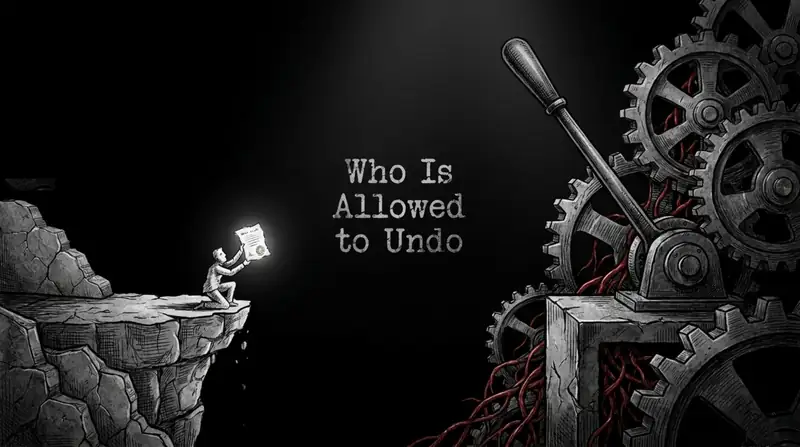
The affected person has the strongest reason to reverse a decision and the weakest access to the machinery that made it.
An operator may roll back a transaction. A software vendor can patch the application. A model provider can change or retrain the model. The person who carries the consequence can submit a request.
Three of those statements describe technical powers. The fourth describes a place in a queue. The powers also reach different objects. A rollback touches the transaction, a patch changes the application, and retraining changes the model. None necessarily reaches the official record or the consequence already carried by the person. The question is never only who has power. It is power over what: the transaction, the application, the model, the official record, or the consequence.
Rights and capabilities
European data-protection law gives people meaningful rights around personal data and automated decisions. Article 17 of the GDPR establishes a right to erasure under specified conditions, with exceptions. Article 22 of the GDPR establishes a qualified right not to be subject to decisions based solely on automated processing that produce legal or similarly significant effects, and in the cases where such decisions are permitted, its safeguards include human intervention, an opportunity to express a view, and a route to contest the decision.
Article 86 of the EU AI Act creates a right to obtain clear and meaningful explanations of the role of certain high-risk AI systems in individual decisions that produce legal effects or similarly significant adverse effects, and the obligation sits with the deployer of the covered system. Explanation can support a challenge. It does not itself alter the result.
A right becomes an operational capability only when someone has both authority and means to act on it.
The missing verb
Request, contest, and complain are verbs available to the affected person. Roll back, patch, and retrain belong elsewhere.
This division is defensible in one sense. People should not receive administrative access to production systems. The problem lies in the gap between receiving a valid request and completing the reversal across the stack.
Who owns that gap? The frontline institution may control the decision while depending on software it cannot modify. The vendor may control the workflow while depending on a model it cannot inspect. The model provider may offer new versions without accepting responsibility for a particular deployment.
Contract boundaries become remedy boundaries.
Who Gets an Advocate asked who is entitled to help inside systems whose procedures are difficult to reach. The Liability Sponge examined how responsibility settles on the person or institution best placed to absorb it. Reversal brings the two together. An advocate can carry a request through the process. Someone still needs power to change the state.
Standing designed in advance
Standing is often treated as a legal question about who may bring a claim. In an automated workflow it is also an engineering question: which role may undo which action?
Every consequential action needs an owner with explicit reversal authority. That authority must extend to downstream systems or include a binding escalation route to whoever controls them. A service-level promise to answer a ticket is weaker than a tested ability to restore a prior condition.
The same design should name the limits. A model cannot always be returned to the state it would have occupied without selected data. A missed opportunity may be impossible to recreate. Those facts belong in the disclosure made before deployment, rather than in the reply to the person who discovers them.
The test
A remedy procedure should be exercised before anyone needs it. Choose a completed determination. Reverse it. Trace the correction through every recipient. Check whether the historical record remains available for audit without continuing to drive current action.
The test will identify the person who can authorize each step. It will also expose every step owned by nobody.
Rights matter because they give the affected person a claim on the institution. Capability determines whether the institution can honor it. The rare constructive case is an artifact with a named author, a public record, and an authority able to withdraw it.
South Africa’s draft National AI Policy actually came back.
Companions
- The officer with no standing to reopen: Whom the Mechanism Reaches.
- The buffer role: The Liability Sponge.
- Advocacy and its limits: Who Gets an Advocate.
- The statutory instrument: the EU AI Act, Article 86.
- The fiction: indefinite postponement, as set out in Definite Acquittal.
These notes come out of Sociable Systems, a practice that reads AI-shaped documents the way a hostile reviewer will, before a lender or a court finds the gap. The argument has an operational form: the Interim Protocol sets out four rules for AI use in environmental and social deliverables, covering disclosure at touch-point grain, evidence custody, the phrases no automated screening may settle, and a hostile read before anything ships. Free, and written to be cited or retired once institutional guidance arrives.