
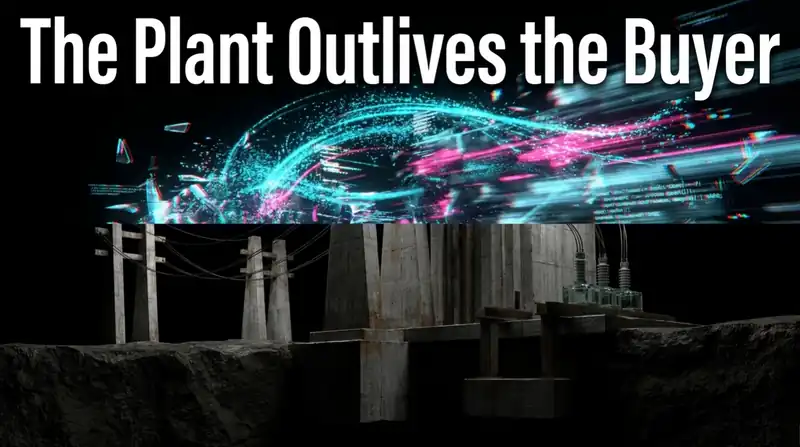
The buyer moved its work away. The pylons held their line. A shorter promise chose the site. A longer debt kept time.
The buyer whose demand justified a data center can move its workload or change the models it serves. The substation feeding the site will keep standing, and the generation contract may still have years to run. Debt raised against the expected demand continues asking to be paid.
The physical system is financed through long use while the computational buyer replaces products within months.
The counterparty can disappear first
Power purchase agreements make new generation financeable by turning future demand into contracted revenue. The US Environmental Protection Agency describes customer PPAs as arrangements in which a third-party developer owns and operates the system while the customer buys its output, typically for 15 to 20 years. The United Kingdom's 2026 call for evidence on corporate PPAs gives a typical term of 10 to 15 years. Contracts for Difference generally run for 15 to 20 years, a duration corporate offtakers are rarely willing to match. The financing need extends beyond the commitment many buyers will make.
When expected compute demand moves, consolidates, or changes technical form, the plant does not follow the workload. The developer keeps a built asset with a revenue problem, alongside debt and local infrastructure designed around the original commitment. A model provider can withdraw an endpoint on notice. Concrete has no matching exit route.
The Ground Address located computation in water, power, buildings, and jurisdiction. Succession adds duration. The ground address remains after the service name changes.
Inheritance changes with the holder
An asset described as stranded by one owner may remain valuable to the next. A gas plant can outlive the demand forecast used to justify it and still find another buyer. That sale does not reverse the original commitment. It transfers the capacity, the emissions, and the incentive to keep operating.
Irreversibility is distributed unevenly. The technology buyer preserves flexibility through a longer commitment held by parties that cannot move as quickly. This is the infrastructure version of a pinned model. The physical commitment survives the decision that justified it.
A succession clause for plant
Demand forecasts tied to AI services need an account of product turnover. Contracts should name what happens if the buyer changes model provider, moves the workload, reduces the load, or leaves the market. Financial security has to match the asset life rather than the current product cycle.
The same register that classifies a model's irreversible actions should record the physical commitments made in its name. Rerouting compute does not move the plant or discharge its contracts.
Companions
- The physical account of computation: The Ground Address.
- The public PPA tenure guidance: US EPA and UK government.
- The routing decision above the plant: Somebody Set the Router.
These notes come out of Sociable Systems, a practice that reads AI-shaped documents the way a hostile reviewer will, before a lender or a court finds the gap. The argument has an operational form: the Interim Protocol sets out four rules for AI use in environmental and social deliverables, covering disclosure at touch-point grain, evidence custody, the phrases no automated screening may settle, and a hostile read before anything ships. Free, and written to be cited or retired once institutional guidance arrives.