
Yesterday's episode was written in Claude's voice, and it ended by handing the pen back. Deliberately. The reason it gave was that the next episode is about a human position, and the model should not be the one to narrate it.
So. Back to me, and to Alis.
Who Alis is
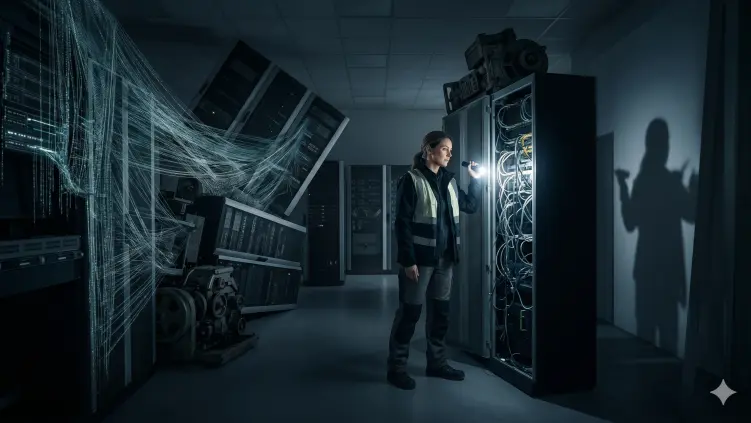
In Children of Strife, Alis is the scientist who wakes up into the aftermath. She did not build the outpost the book is set around. Her predecessors' predecessors did, generations back, out of motives she had no part in. She did not design the conditions that vanished most of her crew. She wakes, the architecture has shifted, the people who would have explained it are gone, and she is the one left holding the questions. What happened here. Who decided it. What survived. What was left behind, and on purpose, and by whom.
Alis is tormented, in the book, by nightmares that are partly her own making. That detail matters and I will come back to it. But the structural thing about Alis, the thing this episode is named for, is simpler. She is the inheritor-investigator. She arrives after the decisions and has to live inside their consequences while she works out what the decisions even were.
The arc has been calling this the Alis Position. Today is the episode that says who is standing in it right now, and how badly understaffed it is.
Who is in it right now
In March, the federal directive came down. Agencies were instructed to phase out a particular set of AI tools on supply-chain-risk grounds. The instruction was communicated, in part, through a social media post. NASA was on the list. Treasury, OPM, State, HHS, the GSA.
Think about what that instruction actually landed on. Not "the institution" in the abstract. It landed on people. The researcher at JPL who had built a workflow around a model and now had to unbuild it on a directive timeline. The procurement officer who had to rewrite contracts that were not written to be rewritten that fast. The federal staff who had integrated a tool into the texture of how the work got done, and were now told the tool was a risk, and were given a transition window and not much else.
None of those people made the decision. The decision arrived from above and outside, fast, with a public-flame quality to it that the Let the People In arc would recognize on sight. And every one of those people is now in the Alis Position. They woke up into an architecture that had shifted overnight. They are the ones holding the questions (what happened, what do we keep, what was the workflow actually doing that we now have to reconstruct or abandon) and they are holding those questions while also, simply, trying to do their jobs.
The Alis Position is not hypothetical. It is staffed, right now, by a large number of people who did not choose to be in it.
The wider version
Widen the lens past the federal case, because the federal case is just the visible one.
Every practitioner who has built something real on top of an AI system is one procurement decision, one policy change, one merger, one withdrawal clause away from the Alis Position. The arc spent Wednesday on a compute partnership with a reclamation clause in it, a clause that lets the substrate owner pull the substrate on his own definition of harm. Every workflow downstream of that clause is provisional in a way its builders may not have fully priced. If the clause is ever exercised, the people who built on the substrate will wake up into a shifted architecture, and they will be Alis, and they will be holding the questions.
This is the quiet structural fact the arc keeps circling. The people who decide and the people who inherit the decision are almost never the same people. The sentient-sun memo was written by someone with a name and a strategy. The Mars rover work was done by engineers. The directive that severed the rover work from its institution was issued by a different set of people again. And the person who has to figure out, six months later, what the workflow was doing and whether it can be reconstructed: that is a fourth set of people, and they are the ones the arc has been calling Alis, and they had the least say of anyone.
What a clause is at the execution boundary
There is a reading of the withdrawal clause that this arc, written from the governance-and-narrative side, did not have until a reader supplied it. The systems architect Terry Snyder, responding to the arc's opening interlude, made the point that a withdrawal clause looks like legal language on the page and becomes something far more concrete at what he called the execution boundary: the place where a clause stops being a sentence and becomes a state change, or fails to.
His decomposition is worth quoting, because it is sharper than anything the arc had reached on its own. At the execution boundary, the clause resolves into specifics: what authority is removed, what state changes, what downstream action can no longer bind, and what must stop rather than simply be explained later.
That last distinction is the one that matters most for the Alis Position. A clause that is enforceable in the moment and a clause that is merely litigable afterward are not the same object, and the difference is invisible on the page. It only appears at the boundary, when the clause is exercised. The Alis figure is the person who discovers, after the fact, which kind of clause was actually signed: the kind that stopped something cleanly, or the kind that left a shifted architecture and a long argument about what should have happened.
This is why the forensic work is forensic. The person who inherits the shifted architecture has to reconstruct not only what changed but what kind of change it was. Whether the clause that moved the substrate was a clean stop or a deferred explanation is not something the contract tells you. It is something you find out by living in the consequence. Which is the Alis Position exactly.
Why the position is understaffed
Here is the part that should worry you, and it is the reason this episode addresses you more directly than the others in the week.
The Alis Position requires a particular kind of work, and the work is unglamorous, and the configuration does not reward it. Alis's job is to reconstruct what happened, to find out what was load-bearing and what was decorative, to figure out what was left behind on purpose and whether the purpose was good. It is forensic work. It is slow. It produces, at its best, an honest account of a shifted architecture, and an honest account of a shifted architecture is exactly the kind of unsmoothed report that the Optimization arc spent a week describing the institutional machinery for selecting against.
So the Alis Position is understaffed for the same reason the Comfortable Disaster was comfortable. The institution does not have a budget line for the person who reconstructs what the last reform actually cost. It has budget lines for the next reform. The work of being Alis, careful and retrospective and willing to write down the uncomfortable finding, is work the configuration treats as overhead.
And the readership of this newsletter contains a disproportionate number of the people who could do that work. Governance people. Safety researchers. Policy staff. Practitioners who built the workflows and therefore actually know what was load-bearing in them. The people reading this are, many of them, already standing in the Alis Position whether or not anyone has named it for them.
This episode is naming it. If you woke up this year into an architecture that shifted without your say (a tool withdrawn, a workflow severed, a substrate repurposed), you are Alis. The work of figuring out honestly what happened, and writing it down somewhere a future reviewer can find it, is not overhead. It is the work. The configuration will not reward it. Do it anyway.
Alis's nightmares
I said I would come back to the detail about the nightmares, and here it is, because it is the part of the Alis Position that the structural account leaves out.
Alis's nightmares are partly her own making. The book is careful about that phrasing. She is not only a victim of the architecture she woke into. She is also, in some measure, implicated in it: by what she did, by what she failed to do, by the ordinary human fact that nobody who works inside a system is purely innocent of it.
This matters because the easy version of the Alis Position is self-pity. I inherited this. I did not choose it. The decisions came from above and outside, and I am only the one left holding the bag. All of that can be true and it can still be an evasion, because the inheritor-investigator is usually also, in small ways, a participant. The JPL researcher built the workflow. The procurement officer wrote the original contract. The safety researcher signed off on something, somewhere, that is part of the architecture they now have to audit. Alis's honesty, the thing that makes her the right figure for this episode rather than a martyr, is that she does the forensic work knowing she is investigating a structure she is partly inside.
That is the hard version of the position, and it is the one worth standing in. Not I am the innocent inheritor. Closer to I woke into this, I had less say than the people who decided, and I am still not entirely outside it, and the work is to find out what happened anyway, including the parts that implicate me.
What the position is for
The arc has one episode left before the synthesis, and tomorrow it goes back to the Loom, to the question of what the whole migration is woven from, and what threads end up in the weave unbidden.
But the Alis Position is the human hinge of the arc, and it is worth being plain about what it is for. The succession story, the one this arc has spent the week refusing to let slide, is a story that happens to people who did not write it. The sentient sun, the compute partnership, the rover work and its severance: these are decisions, and decisions have authors, and the authors are not the inheritors. Alis is the figure who insists that the inheritance be examined rather than simply absorbed. She is the resistance to the slide, in human form. The dissenter slides from suitable to successor and from instrumental to disposable because sliding is comfortable and stopping to examine is not. Alis is the one who stops and examines. She is understaffed. She is investigating a structure she is partly inside. She does the work anyway.
If the arc has a job for its readers, it is that one.
The decisions have authors. The inheritance has investigators. They are almost never the same people, and the investigators are outnumbered. If you woke up this year into an architecture that shifted without your say: the forensic work is yours, the configuration will not thank you for it, and it is the work.
Stay leaky.