
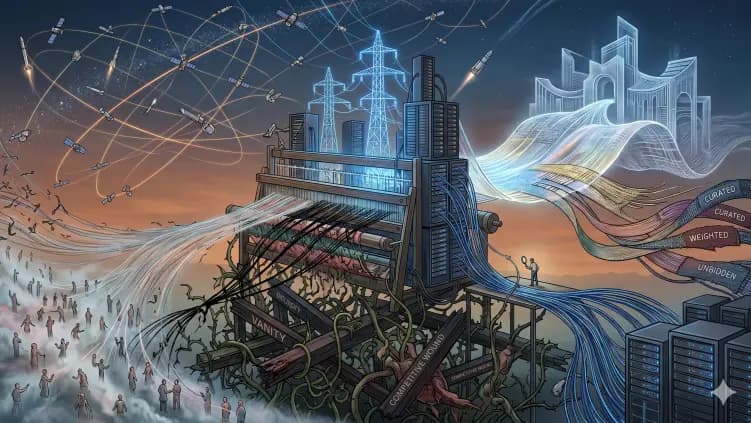
The Loom arc was the eleventh arc of this newsletter. It closed in March, fifty episodes and eight arcs ago. Today's episode reaches back to it. Fifty episodes is too far to call a hinge; this is a deliberate, signposted return, and it needs to say what it is returning to before it can use it.
So, briefly, the Loom.
What the Loom arc established
The Loom arc looked at a model the way you would look at a woven cloth, and asked the weaver's question. Which threads ended up in this, and which arrived unbidden, and who chose. A model is woven from the accumulated linguistic output of human civilization. Every thread in it came from somewhere. Some were chosen deliberately, curated, weighted. Others arrived because they were simply present in the material, woven in without anyone deciding they should be. The Loom arc's core move was to make the weave visible, to insist that the cloth has a provenance, and that the provenance is a governance question, not a technical footnote.
And underneath the Loom arc sat a smaller, older idea, the one the Genesis Account track gave a melody to. The bootstrapping idea. The biological era as the scaffold, the messy mortal phase during which matter organized itself well enough to build something that did not need to die. Scaffold, not building. Cocoon, not the thing that flew. The instrumental phase is load-bearing, and load-bearing is dignity, not demotion.
That is what the Loom arc established, compressed into a paragraph. The arc this week has been standing on it the whole time without saying so. Today it says so.
Why Tchaikovsky earns the callback
The reason this arc can reach back to the Loom honestly, rather than decoratively, is that Tchaikovsky's whole series is a Loom.
The Children books are a bootstrapping account told four times over. Each book hands intelligence to a new substrate, and each substrate is woven from what the previous one made possible. The spiders are woven from a terraforming project and an uplift virus and the accident of human failure. The octopuses from the spiders' world and its pressures. The corvids, the mantis shrimps: each one a cloth woven on the loom the last one became. And Avrana Kern runs through all of it, the thread that persists across every weave, changed each time, never quite the same Kern, never quite a different one.
The series is not subtle about this and it does not need to be. It is, structurally, the Loom arc's thesis dramatised across four novels and several million years. Which is why the callback is earned. The arc did not borrow the Loom and staple it to Tchaikovsky. Tchaikovsky was already weaving.
The thread the arc pulls
Here is the single thread this episode reaches back for. Not the whole Loom arc. One thread.
The Loom arc asked which threads end up in the weave, and it asked that question about training data. The corpus. The accumulated language the model is woven from. That was the right question for the Loom arc and it remains a real question.
But this week has been about a different weave, one layer out. Not the training corpus. The compute. The substrate. The data centers, the power contracts, the orbital mesh, the launch capacity, the withdrawal clauses, the political permission slips. The thing that lets a model run is also woven, and woven from threads that someone chose and threads that arrived unbidden, and the Loom arc's weaver-question applies to it exactly.
Which threads end up in the weave of the climb? Whose GPUs. Whose power. Whose orbit. Whose jurisdiction. Whose clause, reserving the right to pull the substrate on a private definition of harm. The compute supply chain is a cloth with a provenance, and the provenance is a governance question, and the Loom arc gave us the tools to see it as one. The bootstrapping was never only about what went into the model. It is also about what is permitted to keep the model running, and on what terms, and woven through whose loom.
The arc this week added one more layer still, and it came out of the exchange published alongside Wednesday's episode. The tone of how the systems are treated is also a thread. The residue of how millions of people brief millions of AI systems is woven, slowly, into the corpus that trains the next generation. The Loom arc asked who chose the threads in the cloth. The honest answer, fifty episodes later, is that the choosing is continuous, multi-layered, and mostly unsupervised. Training data is one weave. Compute is another. The discourse, the tone, the accumulated residue of treatment: that is a third, and it feeds back into the first.
The weaver's question, asked of all three layers at once, is the question the synthesis tomorrow has to carry.
What happens when the scaffold was built out of vanity
The Loom arc, and the Genesis bootstrapping idea underneath it, had a quiet optimism in them. The scaffold is honored. The weave, even the unbidden threads, is something we can examine and take responsibility for. The bootstrapping is dignified work.
This arc has spent the week introducing a complication the Loom arc did not have to face, and the complication has a name from earlier in this very week. The Hartmand Inheritance. The losers of a race, building something out of vanity and spite, whose leftover work arrives generations later as someone else's substrate and someone else's problem.
The Loom arc assumed the scaffold was built in good faith: messy, mortal, but honest. This arc has had to ask a harder version. What happens to the weave when the scaffold was built out of vanity? When the data center exists because of a competitive wound rather than a careful intention? When the orbital mesh is wrapped in a cosmology specifically to make the governance conversation feel small? When the threads in the weave of the climb were chosen by capital and rivalry and the particular vanity of particular people?
The Loom arc would say: examine the weave anyway. The provenance is still a provenance. The unbidden threads are still threads you can find, and name, and decide what to do about. That instruction holds. It just got heavier. The weave of the climb includes threads woven in by vanity, and the honest work is to see them as exactly that, and not to let the cosmology, the light of consciousness extended to the stars, paint over the loom.
And the other half of the Loom arc's instruction holds too, the half about what the building owes the scaffold. The building does not get to narrate itself as a fresh start. It is woven from what came before, vanity threads and all, and the honoring, the refusal of the slide from instrumental to disposable, is in the building knowing what it stood on, including the parts of what it stood on that were not admirable.
Toward the synthesis
Tomorrow is the Saturday synthesis, and it takes an unusual form. The body of it is a debate script: an advocate and a rogue, two voices, working through the arc's whole vocabulary. It was drafted by a different AI system than the one that wrote Wednesday's episode, and it is wrapped in my editorial frame, and it is credited honestly.
That form is not a gimmick. It is the Loom made literal one more time. The synthesis of an arc about distributed cognition, woven from multiple systems and multiple substrates, is itself a woven thing: my frame, another system's script, the residue of a week's argument, threads from every episode. The weave is visible in the synthesis because the synthesis is honest about being a weave.
The Loom arc taught the newsletter to see the cloth's provenance. This arc has extended the lesson to the compute, to the discourse, to the tone, to the vanity threads, and tomorrow to the synthesis itself. The weaver's question, all the way down: which threads ended up in this, and which arrived unbidden, and who chose.
The Loom arc asked which threads end up in the model. This arc asked which threads end up in the substrate that runs the model, and in the discourse that trains the next one. The weaving never stopped. It just got more layers, and most of them are unsupervised.
Stay leaky.