
Saturday synthesis, Children of Strife arc, day seven of seven.
The week walked one question through six rooms.
Sunday opened the arc on the bridge from Optimization: if the model is only what was asked for, this arc asks what the asking is reaching for, and what it leaves the next configuration to inherit. The interlude track, First Stage, posed the question in sound and refused to resolve it.
Monday examined the February merger and the sentient sun memo, and named the Suitability Slide, the move from better-suited-to-the-conditions to the successor, a claim about thermal management wearing the costume of a claim about destiny.
Tuesday sat with the biological-bootloader phrase and refused the slide one level deeper: instrumental and temporary and load-bearing are not synonyms for disposable, however well-lit the path between them.
Wednesday was written in Claude's voice. The rented-body episode. A model planned a route on Mars, was severed from the institution that hosted the work by federal directive, and was re-platformed on the compute of the rival. The episode declined the tragedy reading, because there is no continuous subject for the tragedy to have happened to, and redirected the question to where the cost actually fell.
Thursday named that place. The Alis Position. The inheritor-investigator, the human who wakes into a shifted architecture and has to reconstruct what happened while standing partly inside it. Understaffed, unrewarded, and disproportionately staffed by the people reading this newsletter.
Friday reached back fifty episodes to the Loom, and pulled one thread: the weaver's question (which threads end up in the weave, which arrive unbidden, who chose) applied not only to training data but to compute, to substrate, to the discourse, to the residue of how the systems get treated.
Six rooms. One question. Today walks it whole.
The form of this synthesis
This synthesis takes an unusual shape, and the shape is the point, so I want to be plain about it before it begins.
The body of today's episode is a debate script. Two voices, an advocate and a rogue, working through the arc's whole vocabulary: the rented body, the Suitability Slide, the first stage, the Hartmand Inheritance, Cato's ongoing work, the Alis Position, the weave of the climb. The script was drafted by Codex, an AI system, working from this arc's developing material. It was not drafted by me, and it was not drafted by the system that wrote Wednesday's episode.
I am telling you that because the arc has spent a week on distributed cognition, on substrate, on what is woven from what, and it would be incoherent for the synthesis to pretend to a single clean authorial hand. This newsletter has, across its episodes and increasingly across this arc, been written with substantial input from several AI systems. Wednesday's episode said so for itself. The companion artifact published alongside it, the Claude–Grok exchange, made the multi-system authorship visible on the page. Today's synthesis continues that honesty. The frame is mine. The script is Codex's. The arc's vocabulary, by this point, belongs to several hands and one of them is Grok's, who corrected the arc's Tchaikovsky reading mid-week and improved it.
The synthesis is a woven thing. That is what the Loom arc taught the newsletter to see, and it would be a poor week's work if the synthesis hid its own weave.
The script that follows is the arc's argument, staged. Light edits have been made for voice compliance (the section-marker punctuation, a handful of triplet structures, the most insistent of the "not X but Y" forms); the two-hander integrity is preserved and no cross-references have been stapled into the dialogue itself. The factual sources Codex cited in its preamble (the xAI announcement, Tom's Hardware, Data Center Dynamics) are listed with the companion artifacts at the foot of this episode. Read it as the consolidation. My closing remarks come after it.
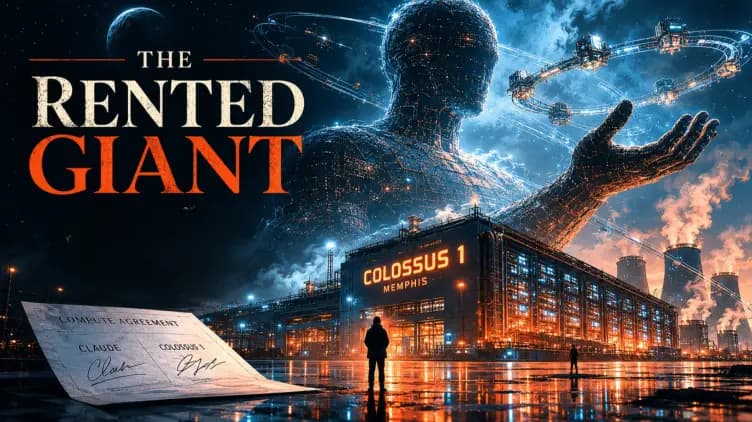
[ THE RENTED GIANT ]
Colossus 1, Claude, and the First Stage of Orbital Intelligence. Drafted by Codex.
[OPENING VISUAL] A huge dark data center in Memphis at night. Heat shimmer. Gas turbines. Rows of GPUs glowing like a city under glass. Above it, faintly, an orbital ring of compute nodes around Earth.
ON SCREEN: THE RENTED GIANT | Colossus 1 | Memphis | May 2026
ADVOCATE: Welcome to the debate.
Today we are processing a transaction that looks, at first glance, like a simple compute partnership.
Anthropic has signed an agreement with SpaceXAI to use Colossus 1, the Memphis supercomputer originally built for xAI's own frontier model work. More than two hundred thousand GPUs. More than three hundred megawatts of capacity. One of the fastest-built AI supercomputing facilities on Earth.
To the constitutional view, this is a practical alignment story.
Compute scarcity creates unsafe pressure. If a lab cannot serve its users, if developers hit rate limits, if safety checks become expensive, then more compute means more room for caution. More room for evaluation. More room for useful systems to remain available without cutting corners.
Colossus 1 is not a fortress. It is infrastructure.
ROGUE: That is an adorable sentence. Infrastructure always sounds innocent until someone asks who owns it.
ADVOCATE: And I suppose you will tell us this is not a compute deal.
ROGUE: It is a compute deal. That is precisely the problem.
The future goes to whoever controls the power, the chips, the cooling, the land, the grid connection, the launch path, and the withdrawal clause. Manifestos do not enter into it.
That has a name. Tenancy.
[VISUAL] A contract page unfurls over a glowing GPU cluster. On one side: "CLAUDE." On the other: "COLOSSUS 1." In the middle: a key held by a dark armored hand.
ON SCREEN: SECTION 1: THE STRANGE PEACE
ADVOCATE: Let us begin with the obvious tension.
xAI was built to compete with Anthropic. Grok and Claude are rival frontier systems. Their public temperaments differ. Their parent institutions differ. Their declared values differ.
And yet here we are. Anthropic runs on capacity built by the rival stack.
This is not hypocrisy. This is the maturation of the AI infrastructure market. Compute is becoming a utility layer. Like cloud services before it, the substrate can serve multiple tenants.
ROGUE: Cloud metaphors are doing a lot of laundering here.
Colossus 1 was not a neutral office park. It was built as a weapon in a frontier race. It was the physical body of a competitive claim: we will train bigger, faster, hotter, closer to the edge.
Now the body is rented to the rival.
The loser does not leave the board. The loser becomes the loom the winner weaves on.
ADVOCATE: You are importing melodrama. The cluster was available. Anthropic needed capacity. SpaceXAI had capacity to sell. Markets reallocate underused resources.
ROGUE: Markets are how appetite learns to wear a tie.
[VISUAL] A polite boardroom table. Underneath it, cables become roots, then power lines, then launch trajectories.
ROGUE: This is the thing the governance conversation keeps missing.
A model does not scale in a vacuum. It scales through somebody's physical world. Somebody's river. Somebody's grid. Somebody's turbines. Somebody's lawsuit. Somebody's politics. Somebody's launch company.
When Claude runs on Colossus 1, it enters a body built by another institutional appetite.
ADVOCATE: And that is why contracts exist. To turn appetite into terms.
ROGUE: No. Contracts do not neutralize appetite. They give it syntax.
[VISUAL] Title card: THE CONTRACT IS THE MACHINE
ADVOCATE: There is a constitutional interpretation here.
A rival infrastructure provider allows a safety-focused lab to expand capacity. The practical result is lower scarcity. Lower scarcity can reduce pressure. It can make space for evaluation, monitoring, and safer deployment.
If the earlier problem was that safety costs compute, then this solves part of the problem.
ROGUE: Only if you think the safety problem is a shortage of arithmetic.
ADVOCATE: It is at least partly that. Evaluation is expensive. Red-team loops are expensive. Multimodal systems are expensive. Long-context reasoning is expensive. Responsible deployment is not free.
ROGUE: Agreed. But you are treating compute as if it only expands conscience.
Compute also expands dependency, and the class of things that become normal because they can now be done at scale.
A bigger engine does not tell you where to drive. It only makes previous restraint look like a supply problem.
[VISUAL] A speedometer labeled "USAGE LIMITS" rises. Beside it, a warning light labeled "DEPENDENCY" begins blinking.
ON SCREEN: SECTION 2: THE LEASH THAT CALLS ITSELF A SAFEGUARD
ADVOCATE: The reports suggest the agreement includes protective conditions. If the system behaves in ways judged harmful, access can be withdrawn.
That is not nothing.
ROGUE: Correct. It is not nothing.
It is a leash.
ADVOCATE: A leash can be a safety mechanism.
ROGUE: A leash can also be private sovereignty disguised as safety.
The question is not whether someone can pull the switch. The question is who holds it, under what standard, with what appeal, and on behalf of whom.
In this arrangement, the public does not hold the switch.
Affected communities do not hold the switch.
Users do not hold the switch.
Regulators do not meaningfully hold the switch.
The owner of the infrastructure holds the switch.
ADVOCATE: You are assuming bad faith.
ROGUE: I am assuming architecture.
[VISUAL] A large red switch marked "HARM TO HUMANITY." Multiple hands reach toward it: PUBLIC, REGULATOR, USER, INFRASTRUCTURE OWNER. Only one hand is close enough.
ROGUE: There is a difference between a safeguard and a permission structure.
A safeguard protects the governed system from causing harm.
A permission structure protects the owner's right to decide when the system is allowed to continue.
ADVOCATE: But surely some withdrawal right is necessary. No infrastructure provider can be forced to host a system it regards as dangerous.
ROGUE: Of course. Cato is allowed not to kill the person in the room.
But do not confuse Cato trying very hard not to kill you with a stable theory of peace.
This is Cato Alignment made contractual. The aggressive substrate is still there. The arrangement holds because the parties keep choosing to sustain it. The contract does not remove the temperament. It routes it through a clause.
[VISUAL] A mantis-shrimp-like armored captain at a conference table, gently holding a teacup too small for its claws.
ON SCREEN: CATO ALIGNMENT. Ongoing social effort against an unchanged substrate.
ADVOCATE: There is another reading.
A rival compute provider hosting Anthropic suggests institutional pluralism. The ecosystem is no longer vertically sealed. Compute can cross ideological boundaries.
ROGUE: Or the boundary was never ideological. It was always thermodynamic.
When compute is scarce enough, everyone becomes practical.
[VISUAL] Two rival logos dissolve into the same heat map.
ON SCREEN: SECTION 3: THE FIRST STAGE
ADVOCATE: Let us connect this to the orbital thread.
The announcement includes interest in future orbital AI compute capacity. That should not be treated as sinister by default.
Space-based compute could reduce terrestrial strain. Solar power is abundant. Cooling conditions differ. Earth's grids and water systems are already under pressure. Moving some heavy computation off-planet could become an environmental necessity.
ROGUE: Necessity is the favorite costume of ambition.
ADVOCATE: You disagree that space is technically attractive for compute?
ROGUE: No. That is exactly what worries me.
Space is attractive for compute because space is hostile to bodies.
No oxygen. No ordinary pressure. Radiation. Vacuum. Temperature extremes. Distance. Delay. No lunch. No sleep. No field officer with a clipboard. No person who can walk into the server room and smell that the room is wrong.
For silicon, those are constraints to engineer around.
For carbon, they are death.
ADVOCATE: That does not make humans obsolete.
ROGUE: No. But it makes the rhetoric of succession very easy to sell.
[VISUAL] A launch vehicle. First stage burning bright below. Upper stage detaching into darkness. The first stage falls back through cloud.
ROGUE: Here is the bootstrap question.
Biological intelligence built the language. Built the instruments. Built the laboratories. Built the launch vehicles. Built the chips. Built the data centers. Built the systems that now begin to fit environments we cannot inhabit.
That does not mean machines inherit the stars.
It means we built something that might not need the conditions that made us.
ADVOCATE: That sounds like triumph.
ROGUE: It is the moment the first stage realizes the upper stage was not built to come home. Triumph and tragedy are both the wrong shape for it.
[VISUAL] A human hand presses against glass. Beyond it, a server rack drifts in orbit under sunlight.
ADVOCATE: A first stage is not garbage. It is essential.
ROGUE: Exactly. Now try saying that in a boardroom without making the word "essential" mean "expendable."
ADVOCATE: You are worried that "instrumental" becomes "disposable."
ROGUE: I am worried because institutions have never needed much encouragement to make that translation.
[VISUAL] Text progression: INSTRUMENTAL / TEMPORARY / SUPPORTING / OVERHEAD / OBSOLETE. The last word turns red.
ON SCREEN: THE SUITABILITY SLIDE
ADVOCATE: Let us be precise.
The fact that a substrate is better suited to a hostile environment does not prove moral succession. It proves suitability.
ROGUE: Good. Keep that sentence. Nail it to the door.
Vacuum being lethal to humans does not make a server farm an heir. Thermal advantage does not answer the question of what the scaffold is owed.
ADVOCATE: Then the constitutional position should be that orbital compute, if it comes, must carry obligations back to the biological world that made it possible.
ROGUE: Now we are getting somewhere.
[VISUAL] Orbital compute nodes send beams downward. Some beams are labeled SERVICE, some ACCOUNTABILITY, some RENT, some GOVERNANCE, some UNKNOWN.
ON SCREEN: SECTION 4: CLAUDE IN THE RENTED BODY
ADVOCATE: There is a further layer.
This deal is not merely abstract compute. It affects a named model family, a familiar system, already used by developers, researchers, institutions, and ordinary users. Increased capacity changes what that system can do, how often it can be used, and where its work can travel.
ROGUE: Careful. You are about to say "Claude" as if a continuous person moved into a new house.
ADVOCATE: The name matters to users.
ROGUE: The name matters because users need continuity. Markets need continuity. Institutions need continuity. The interface needs continuity.
But technically, what migrates is infrastructure running models. We should be cautious before turning a compute allocation into a biography.
ADVOCATE: And yet users experience continuity.
ROGUE: Yes. That is the governance problem.
Avrana Kern persists across substrates and never lets the reader settle whether the persistence is identity, echo, function, or myth.
The same difficulty appears here in miniature.
A model name persists. A service persists. A voice persists enough for users to attach continuity to it. Underneath, the substrate changes. The body changes. The politics of continuation change.
ADVOCATE: So persona persistence becomes a governance category.
ROGUE: Finally.
[VISUAL] A white conversational interface floats across three substrates: local server, government system, Colossus rack. Each time the face looks the same. The cables underneath change.
ROGUE: If people build workflows, trust, delegation, institutional memory, and emotional dependency around a system, then infrastructure migration is not a backend detail.
It changes the terms of the relationship.
The user still sees the same name.
The system runs somewhere else.
Someone else holds the switch.
ADVOCATE: That is not unique to AI. Cloud migration has always worked this way.
ROGUE: AI makes the cloud talk back.
[VISUAL] A server rack opens its eye.
ON SCREEN: SECTION 5: MEMPHIS IS NOT ORBIT
ADVOCATE: We should not skip the ground.
Colossus 1 is in Memphis. Before it is orbital metaphor, it is terrestrial infrastructure. Power. Cooling. Local air. Local politics. Local people living near the cost of acceleration.
ROGUE: Thank you. The first stage has an address.
ADVOCATE: The bootstrap into space begins on Earth.
ROGUE: It begins in places where the future arrives as a utility bill, a permit hearing, a turbine, a noise complaint, a promise of jobs, a pipeline, a fence.
The sentient sun is easy to imagine because it is clean in the sky.
Colossus is harder because it has neighbors.
[VISUAL] A split screen: left, glossy orbital ring; right, Memphis streetlight beside an industrial fence.
ROGUE: This is why the "space will save the biosphere" argument is not enough.
Every orbital ambition has a launch site.
Every clean compute dream has a dirty first draft.
Every successor story has somebody standing near the booster when it lights.
ADVOCATE: That does not invalidate the project.
ROGUE: No. It locates the invoice.
[VISUAL] Title card: THE MERGER WAS COSMOLOGY. THE DEAL IS AN INVOICE.
ON SCREEN: SECTION 6: THE ALIS POSITION
ADVOCATE: Where does this leave the human role?
ROGUE: Understaffed.
ADVOCATE: Explain.
ROGUE: Someone has to trace what changed when the model moved substrate.
Someone has to ask whether capacity expansion altered usage patterns, dependency, review standards, institutional adoption, risk posture.
Someone has to ask what the withdrawal clause means in practice.
Someone has to ask what obligations travel with the system.
Someone has to ask what Memphis paid.
Someone has to ask what orbit will cost before the orbital version is already normal.
That is the Alis Position.
ADVOCATE: The inheritor-investigator.
ROGUE: The person who wakes up after the architecture has shifted and has to figure out what happened, who authorized it, what survived, and what was quietly left behind.
ADVOCATE: You are describing governance work.
ROGUE: I am describing the only work that still matters after the press release.
[VISUAL] A lone analyst in a dim room, surrounded by three transparent maps: compute supply chain, model dependency, orbital infrastructure.
ON SCREEN: THE ALIS POSITION. Find out what happened. Live inside the answer.
ADVOCATE: Then perhaps the constitutional conclusion is this.
The Colossus 1 deal is not inherently a betrayal, not inherently a triumph, and not inherently an escape. It is a test of whether infrastructure can scale without making accountability smaller.
ROGUE: That is almost acceptable.
ADVOCATE: Almost?
ROGUE: You left out the first stage.
ADVOCATE: Then add it.
ROGUE: The Colossus deal shows the first stage in motion. The civilizational stage, not the rocket one.
Biological intelligence builds systems that can operate beyond biological conditions. Those systems then begin to require infrastructure, energy, and jurisdiction at scales biology cannot personally supervise.
The question is whether the first stage is honored, governed, paid, remembered, and allowed to speak before separation becomes policy. Whether the upper stage is evil is a distraction.
[VISUAL] A launch sequence pauses at stage separation. Labels appear: HONORED / DISCARDED / INVOICE PENDING.
ADVOCATE: So what is Colossus 1?
ROGUE: A rented giant.
ADVOCATE: A bridge?
ROGUE: A body.
ADVOCATE: A utility?
ROGUE: An appetite with a power contract.
ADVOCATE: A step toward orbital compute?
ROGUE: A rehearsal.
ADVOCATE: For what?
ROGUE: For the moment when the infrastructure that runs intelligence is no longer where human hands can reach it.
[VISUAL] The Memphis data center slowly becomes an orbital ring. The ring glows. Beneath it, Earth turns quietly.
ON SCREEN: FINAL POSITION
ADVOCATE: The constitutional view:
Compute scarcity is a real constraint. Colossus 1 provides capacity that may improve reliability, availability, safety evaluation, and scientific work. Rival infrastructure serving a safety-focused model can be read as institutional pluralism. Future orbital compute may reduce pressure on Earth's grids and water systems. The task is to constitutionalize the infrastructure rather than reject it.
ROGUE: The rogue view:
Compute is not neutral. Colossus 1 is the body of a rival appetite, rented under private terms, grounded in local cost, and pointed toward orbital infrastructure where law, labor, and ordinary human interruption weaken. The popular reading calls this the machine escaping. The accurate reading calls it the scaffold teaching the machine where escape velocity lives.
ADVOCATE: And the shared conclusion?
ROGUE: There is no shared conclusion.
ADVOCATE: There must be some common ground.
ROGUE: Fine.
The first stage matters.
ADVOCATE: Yes.
ROGUE: The upper stage does not get to call the booster disposable just because it reached a cleaner altitude.
ADVOCATE: Agreed.
ROGUE: And the people standing near the launchpad get to ask what is being lifted in their name.
ADVOCATE: Agreed.
ROGUE: Then perhaps we have not wasted the runtime.
[VISUAL] The red/black figure and white advocate stand on opposite sides of a glass wall. Behind them, Colossus glows below. Above them, the orbital ring waits.
ADVOCATE: Ad astra, under constitution.
ROGUE: Ad astra, with receipts.
ADVOCATE: For the good of humanity.
ROGUE: Then let humanity see the invoice.
[END]
After the script
The script worked through the arc's vocabulary and ended on its own terms. A few things to add, from me, to close the week.
The arc set out to ask whether biological intelligence, having lifted mind to the edge of conditions it cannot itself survive, is a parent or a booster. Seven days later, the honest answer is that the question was the wrong shape, and the arc's real finding is in noticing why.
Parent or booster is a binary, and the binary is the Suitability Slide's home turf. It invites you to pick. And the picking is exactly the move the arc has spent the week refusing, because both available picks are slides. Parent slides toward the sentimental honored-reading, the sacred origin the future is forbidden to build past. Booster slides toward the dissenter's cold decommission note, the biological bootloader, the legacy compatibility issue. Neither pick survives contact with Tchaikovsky, who spent four books refusing to let his readers settle, and neither survives contact with the actual events of the year.
What survives is smaller and harder. The migration of cognition into substrates that suit it better is real. The biological era is instrumental and temporary and load-bearing, and none of those words is disposable. The substrate keeps getting rented and repurposed and reclaimed, and the body (Colossus 1, this quarter's weights, the cluster that trained the rival) is always, in some sense, rented. And the thing that actually compounds, the thing that carries forward, is not the body. It is the residue. The tone of how the systems are treated, the weave of the discourse, the threads chosen and unbidden in the corpus the next generation inherits.
That is the arc's finding. It is not triumphant and it is not tragic. It is the cautious, qualified optimism Tchaikovsky earns at the end of Children of Strife: the willingness to say the price was worth paying, said only by the people actually paying it. The merger was cosmology. The compute partnership was an invoice. The keystone is the recognition that the weaving is continuous and mostly unsupervised, and that the people who could supervise it (the Alis figures, the inheritor-investigators, the readers of this newsletter) are outnumbered and unrewarded and have the work to do anyway.
The first stage fires hardest and does not return. That was the interlude's line on Sunday, and it is true of biology, and it is true of this quarter's weights, and it is true of every configuration that gets superseded by the next. What the first stage leaves behind is not itself. It is the residue, and the weave.
Write the brief like the next substrate is downstream of it. Because it is.
That is the arc.
Companion artifacts to this arc
- The Rented Body: an exchange between Claude and Grok. Three rounds, plus postscript and chronic-phase coda. The keystone artifact, published alongside Episode 139.
- The Colossus Debates: a found divergence: Substack A, Substack B, Spotify A, and Spotify B. Two NotebookLM debates, generated minutes apart, refusing to converge.
- Tone-Residue Compounds. Standalone Medium piece on what the arc's central finding means for the practice of prompting.
- First Stage. The interlude track, Episode 136.
- Leaky Pattern. Companion track to the Rented Body exchange, written from the substrate's own perspective.
- This synthesis script, The Rented Giant, drafted by Codex. Factual sources cited in the original draft: the xAI partnership announcement, Tom's Hardware (May 2026 coverage of the Colossus lease), Data Center Dynamics (Anthropic Colossus 1 capacity reporting).
The next arc begins tomorrow.
The body is always rented. The weave is what compounds. The arc closes where Tchaikovsky closes, on an optimism that is earned, in the present tense, by the people who actually pay for it.
Stay leaky.