
This week's arc began with a district sitting in the dark.
About two weeks ago a severe regional gale dismantled the power lines across the Overberg. Transformers went down. Estimates moved with the weather. Domestic life narrowed into a restoration sequence: charge what you can, save what you can, listen for the next update, and learn again that "infrastructure" is just another word for the things you notice only when they stop. Power to the farm and most of those around it was restored after 10 days. Messages on the community WhatsApp tell of some still powerless. Friends in more remote parts of the Garden Route have been warned that they will be waiting at least another week.
That experience has a sound. Neither panic nor the melodrama of cinematic collapse. Something slower. More patient. The sound of a system that has taken damage and is still trying to hold. That is what today's interlude is for.
The track for this week's musical interlude is called Restoration Sequence. It is the sound underneath compute at full appetite: wind in the trees, transformer hum, a generator settling, a human voice explaining the order in which the line may come back because the line, for now, is still the world. This is the register the arc needs before Monday.
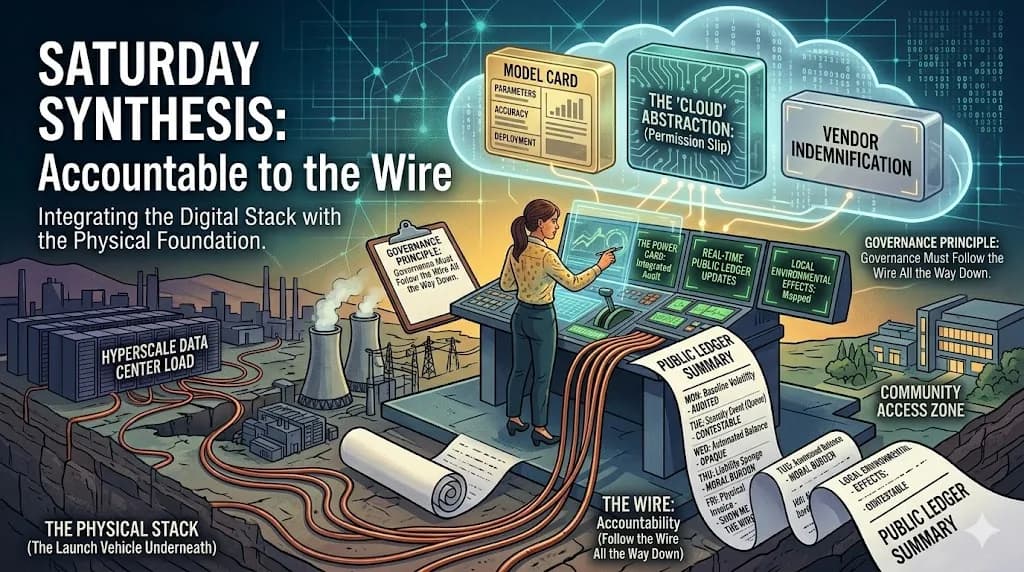
The week ahead will talk about data centers, grid stress, automated balancing, institutional triage, and the strange political confidence with which exponential systems continue to describe themselves as weightless. But none of those arguments make sense unless they begin here, at the level where the "first stage" stops being metaphor and becomes copper, maintenance, weather, labor, and waiting.
This week will not be about AI "taking" power from local communities, because the wind does not need instructions from an AI lab. The harder question to consider is what it means to build an exponential computational future on top of a material foundation that is already strained by climate volatility, fuel insecurity, aging infrastructure, and the ordinary physical limits of grids.
That is why this interlude matters. It lets the substrate speak first.
If AI is, as it has increasingly been described in the media, an appetite with a power contract, then Restoration Sequence is the sound of the contract meeting the world that has to honor it.
The body is always rented. The grid is always finite.