
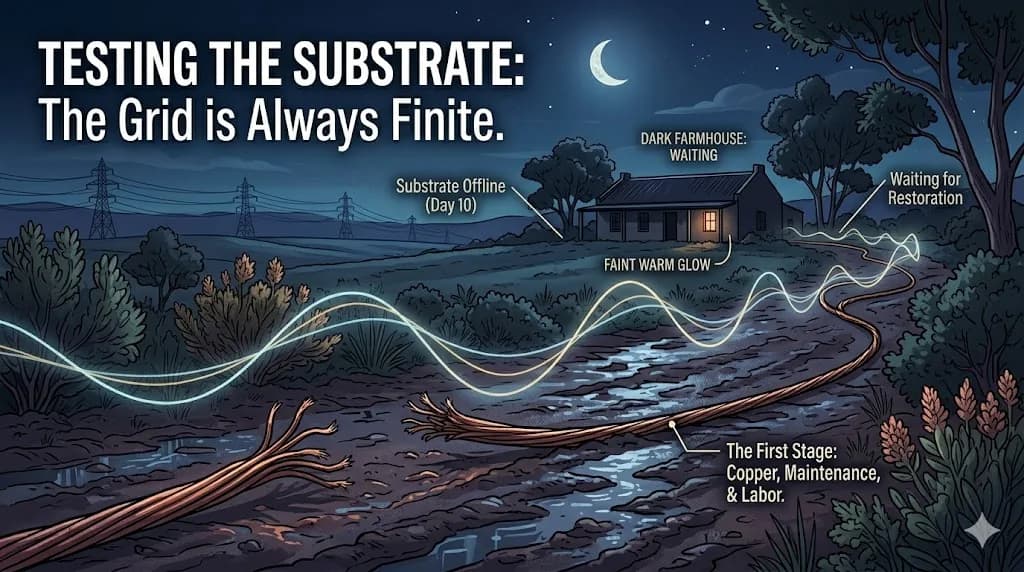
Two baselines run underneath this story, and they are pressing on each other harder than the system was built to hold.
The first sounds exponential. Compute. Scale. Frontier systems. Agentic workflows. Inference demand. Data centers large enough to make "the cloud" sound like a euphemism invented by a marketing team during a thunderstorm.
The second snaps in the wind. Copper. Poles. Substations. Fuel. Batteries. Cold rooms. Borehole pumps that stop being infrastructure the moment they need to be and become small wired-up prayers.
Yesterday's interlude sat the body inside the second baseline. The week ahead asks what happens when the first one keeps arriving at the same door.
The figure that should make polite infrastructure conversations lose their indoor voices comes from Wood Mackenzie's April release: US data center capacity is expected to rise from roughly 24 gigawatts to 110 gigawatts between 2026 and 2030, accounting for 68 percent of total load growth across the period. To put that in domestic perspective, the same report projects data centers will consume eight times more electricity than electric vehicles over the same window. One sector, eight times the EV transition, half a decade. That is what concentrated industrial demand looks like when it arrives in compressed time.
The building is already crowded.
Equipment lead times for transformers, switchgear, busways, and the kind of grid-scale batteries that storage actually needs now run between 18 and 36 months. A data center that joins the Northern Virginia interconnection queue this month can realistically expect to draw utility power somewhere between 2030 and 2033, regardless of how fast the building itself goes up. Capital wants to move faster than copper allows. The grid has its own pace and remains uninterested in negotiating.
That is the situation in countries with comparatively stable energy systems.
Look outside the US. The Strait of Hormuz has been effectively closed to commercial shipping for more than two months now, following the February airstrikes on Iran and Tehran's March 4 declaration. Roughly a quarter of globally traded oil and a quarter of global LNG passes through that waterway under normal conditions. Brent has stayed above ninety dollars. Tanker freight to European import terminals has gone vertical. Qatar supplied between 12 and 14 percent of Europe's LNG before the closure, all of it routed through Hormuz. Europe has spent the last four months redirecting toward record volumes of Russian Yamal LNG, which is a sentence nobody on the post-2022 EU energy strategy team wanted to write.
This is the substrate that compute appetite is arriving on top of.
Energy systems are already absorbing climate volatility, fuel shocks, accelerated electrification, aging transmission, and the geopolitics of choke points. A new industrial-scale consumer now wants to plug in at a pace the system was never designed to deliver. The wind in the Overberg, the LNG carrier waiting outside Hormuz, and the transformer with a three-year backlog are different events. They share a grid.
Call AI what it is in this picture: hyper-material. It concentrates demand inside infrastructure faster than the infrastructure can be reinforced, at a moment when the infrastructure is being squeezed from several directions at once.
The framing "AI uses too much electricity" is too small for the moment. It turns the question into a moral scold about consumption, when the live issue is allocation under stress, against a backdrop where stress has stopped being hypothetical anywhere on the chain.
The sharper question:
When the grid becomes contested ground, who gets treated as essential?
A hyperscale facility does not merely "need power." It usually arrives with money, contracts, lawyers, urgency, and a fluent claim about national competitiveness. It arrives wearing the language of inevitability. It comes dressed as progress, with a service-level agreement in its pocket.
A rural community after a storm arrives with freezers, boreholes, phones, elderly people, animals, blocked road access, and repair crews working through mud and fallen branches.
Both are real. Only one tends to be framed as the future.
The week's claim is simple. The future is being built on a first stage that is already creaking under loads it was not designed to carry, in a decade when those loads are being added faster than the material system can be reinforced, in a geopolitical climate that is rearranging fuel flows on the fly.
A blackout, anywhere on the chain, is the audit arriving in physical form. It tells the truth faster than a dashboard. It reveals which systems had reserves and which had only optimism, and it shows which people were quietly expected to absorb the gap between what was designed and what was actually built.
The question this week is whether the institutions building AI can still see the ground beneath it.
The body is rented and the grid is finite. The first stage has started sending invoices, and the queue at the receiving dock is already long.