
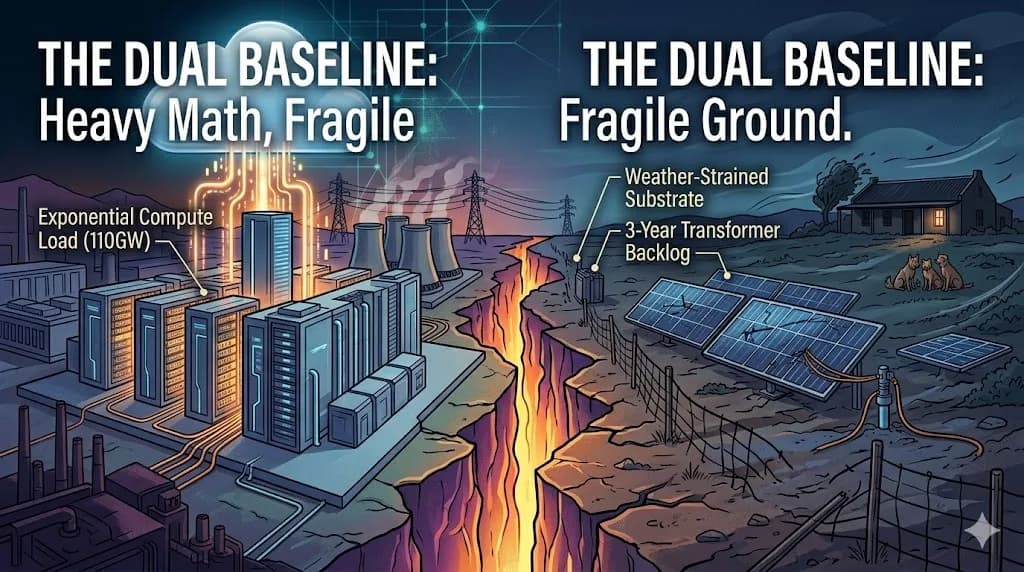
Scarcity rarely announces itself honestly. It arrives as a queue.
A queue sounds neutral. It sounds administrative. It suggests that some fair sequence exists somewhere in the back office, presumably wearing a lanyard and doing the moral arithmetic. First come, first served. Highest need, highest priority. The procedural language is reassuring in precisely the way that should make a person suspicious.
Then the actual world walks in.
Queues are never just queues. They are moral systems wearing procedural clothing.
When grid capacity becomes scarce, the question is not only how much power exists. The question is whose demand becomes legible, bankable, contractual, deferrable, interruptible, politically useful, or easy to ignore. The available answers depend on who is asking.
AI infrastructure is entering energy systems as a new kind of claimant. Large. Concentrated. Capitalized. Extremely time-sensitive. Frontier AI has trained itself, and its investors, to treat any delay as strategic loss. Power has stopped being a utility input in that world. Power has become competitive territory.
This creates a pressure that public language struggles to name.
A data center can present itself as economic development, national security, innovation infrastructure, and local investment all at once. It can promise jobs, tax revenue, resilience, cloud capacity, sovereign capability, and future-readiness in the same breath. It arrives with polished diagrams and phrases like "AI leadership" and "critical digital infrastructure," delivered by someone who has been briefed on how to look thoughtful in a town-hall photograph.
A rural outage arrives as a fault report.
That asymmetry is the queue.
One claim becomes strategy. The other becomes maintenance.
This is why grid governance cannot be reduced to supply. More generation helps. More transmission helps. Better storage helps. Demand response helps. All the plumbing is required, because the plumbing is the system. But the governance question begins where engineering capacity becomes social allocation.
Who can be curtailed?
Who gets backup?
Who receives firm power?
Who is asked to be flexible?
Who pays for the upgrades?
Who lives within breathing distance of the turbines, substations, diesel generators, gas plants, water demands, and transmission corridors?
Who gets the future, and who gets the noise?
This is where the public-benefit story around AI needs a sharper test. If a system claims to serve society while privately hardening its own power access ahead of that society's basic resilience, the public-benefit claim is decoration.
The grid hears contracts before it hears speeches. That does not turn every data center into a villain. It does turn every large load into a governance event.
There is a difference there worth holding.
A villain story is emotionally satisfying and usually operationally useless. It lets everyone point at the obvious monster while the queue keeps quietly sorting people in the dark.
A governance story asks for documents.
Show the interconnection request. Show the curtailment agreement. Show the backup plan. Show the water use. Show the local air-quality tradeoff. Show the emergency priority rules. Show who is interruptible and who is not. Show the public cost of private urgency.
"Available capacity" is not a neutral phrase. It often means capacity made available through assumptions about whose discomfort can be delayed, dispersed, normalized, or externalized.
This is where the Western Cape blackout becomes more than local color. It gives the argument a body-memory of the queue.
When the power is down for days, people stop experiencing infrastructure as a policy abstraction. They experience it as sequence. Which town first. Which line next. Which crew has access. Which road is blocked. Which battery still holds. Which phone still has signal. Which freezer is lost. Which pump survived. Which neighbor has a generator. Which official update can be trusted today.
Scarcity becomes order. Order becomes consequence. The third beat is yours to find in your own street.
Scale that up to the AI-energy collision and the same pattern repeats, only with more money and better vocabulary.
The danger is quieter than theft. Its claims become structurally privileged before the public notices the queue has changed.
The claim:
Grid capacity is becoming an accountability surface.
The AI audit cannot stop at model behavior, training data, bias, safety evaluations, or deployment context. Those remain necessary. They are no longer sufficient.
The audit has to follow the wire.
It has to ask what kind of power the system uses, where that power comes from, which communities carry the physical burden, which institutions receive the benefit, and what happens when the grid cannot satisfy every claimant at once.
Under stress, the queue tells the truth.
And the future is already standing in line with a very large appetite.