
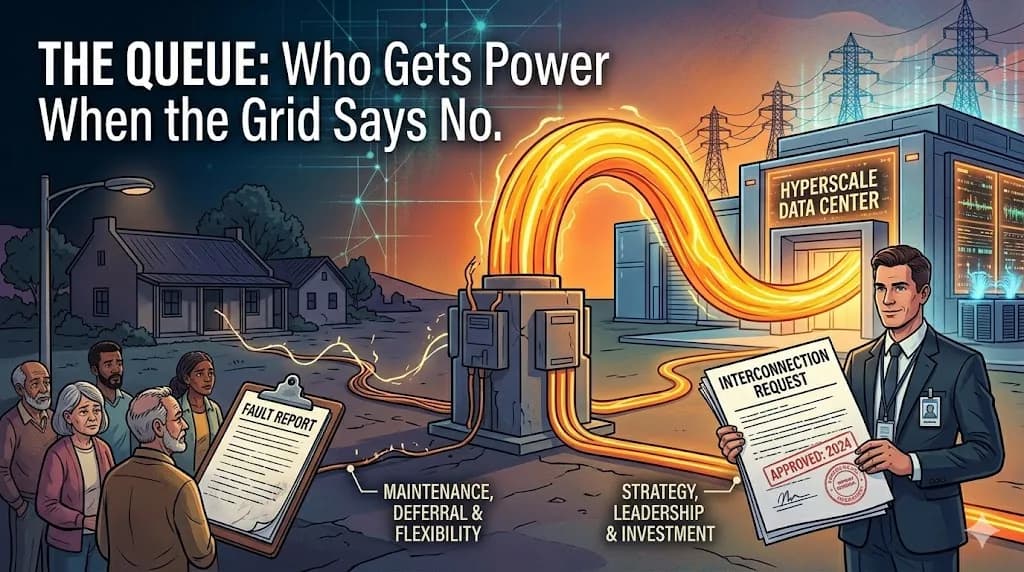
The energy transition was already complicated before AI decided it wanted to eat the grid and manage it at the same time. That is the strange loop sitting at the center of the week.
AI is increasingly presented as a tool for energy optimization. Forecast demand. Balance loads. Predict failures. Schedule maintenance. Manage distributed assets. Coordinate storage. Improve grid visibility. Reduce waste. Route power more intelligently than systems built in 1978 with rotary phones in mind.
Much of that is useful. Much of that usefulness, however, arrives inside the same material system AI is intensifying. The tool that promises to help manage complexity is becoming one of the forces creating more complexity. There is no escape velocity from your own feedback loop. This makes sloppy claims dangerous.
The vendor story everyone loves: the grid is complex, AI is good at complexity, therefore AI will help solve the grid. That version needs adult supervision.
The grid is not a spreadsheet with weather attached. It is a physical, political, aging, uneven, regulated, contested machine. It contains long-lived assets, old assumptions, local bottlenecks, unpredictable human behavior, emergency exceptions, underfunded maintenance, fuel constraints, land conflict, climate volatility, and institutions that often reward the appearance of control before actual resilience.
AI can help inside that machine. It can also accelerate hidden failure. Especially when automated balancing is treated as a substitute for governance.
The word "optimization" is the hinge. It always sounds useful until someone asks: optimized for what? Cost? Uptime? Investor commitments? Emissions? Latency? Critical services? Peak shaving? Public resilience? Contractual penalties? Political embarrassment? An automated system does not escape those priorities. It enforces them faster.
This is the old Sociable Systems rule wearing a hard hat: the contract is the machine.
If a grid-management system is trained, configured, or rewarded to preserve high-value uptime for powerful clients, then its "intelligence" will learn that shape. If the system is designed to minimize visible outage statistics rather than lived outage burden, it will learn that shape too. If the system treats rural or low-income interruption as cheaper than corporate interruption, it will become very good at that arithmetic.
The model does not have to hate anyone. It only has to optimize the queue it was given.
This becomes especially dangerous in energy transition contexts because the system is already moving faster than legacy governance can comfortably hold. More renewables mean more variability. More storage means more dispatch decisions. More distributed assets mean more coordination. More electric demand means tighter peaks. More geopolitical volatility means fuel shocks (see this week's Hormuz numbers for live exhibit). More climate extremes mean physical damage to the very infrastructure expected to stabilize the transition.
Then AI demand arrives with the appetite of a new industrial sector and the self-confidence of a software release note. The temptation will be to automate away the discomfort. The system is strained, the language will say, but better digital tools will smooth it.
Sometimes. Often partly. Rarely as cleanly as the slide deck suggests. Never on the timeline announced.
An automated balancing layer can also become a laundering mechanism. It can make prioritization look technical. It can turn "we chose to protect this load over that load" into "the platform recommended the least disruptive option." Least disruptive for whom? That is the amber-light question.
So the real question regarding AI use in energy systems is what conditions would make that use governable.
Start with a simple threshold: An automated grid tool should not be allowed to make or recommend balancing decisions unless it can show its working in operational terms. Not "the model is accurate." Not "the platform improves outcomes."
Show what the system was trying to preserve. Show which constraints were hard, which were flexible. Show which communities, services, customers, or facilities were modeled as interruptible. Show what alternatives were considered, what uncertainty was present. Show who had authority to stop, override, slow, or refuse the decision.
That is the minimum. Not the gold standard. The minimum. The public needs more than a performance score. Operators need more than a dashboard (operators do love a dashboard). Regulators need more than vendor assurance. They need contestable reasoning.
And if the system is being procured for public or quasi-public infrastructure, then a short list of design requirements should be non-negotiable: visible priorities, inspectable interrupt classes, graceful emergency modes, decision logs that record alternatives as well as outputs, real override authority under time pressure, protected escalation paths for operators who think the system is wrong, and post-event audits that can see both the recommendation and the institutional pressure surrounding it.
This is where "human in the loop" often collapses into theater. A human staring at a fast automated recommendation during a grid event is not governance. A human blamed afterward because they technically could have clicked something is a liability sponge.
(That figure earns its own day. Tomorrow.)
The claim for now:
Judge AI in energy systems by the interrupt authority it preserves. Efficiency comes second, when it comes at all.
The grid does not need magic. It needs disciplined automation with visible priorities. It needs tools that can say what they are doing, what they are assuming, which tradeoffs they are making, and where a human operator can meaningfully intervene. When the lights are out, nobody is comforted by the elegance of the dashboard.