
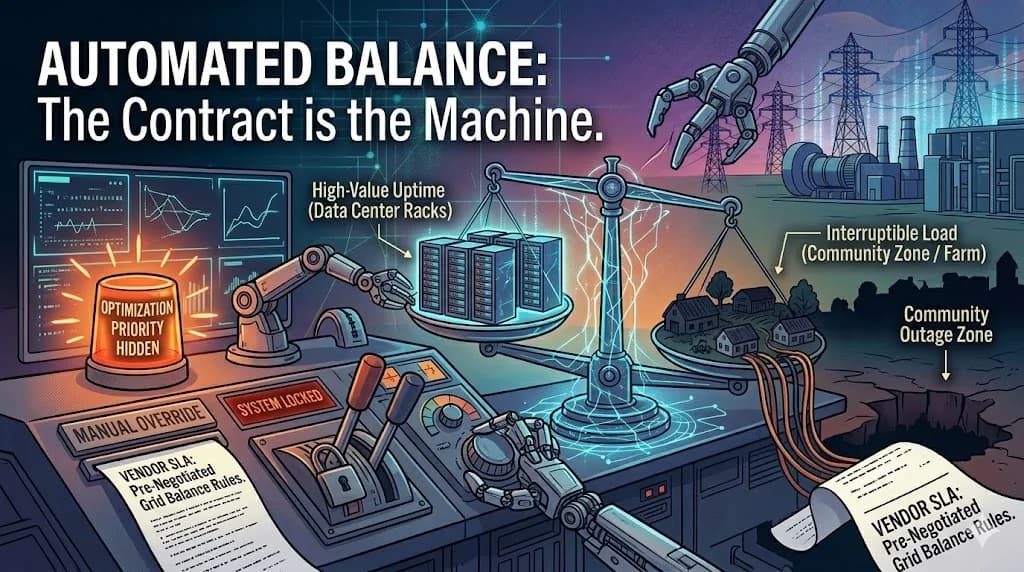
The sponge has been named in this newsletter before. The Liability Sponge was the first pass; Human in the Loop (Revisited), AI's Real Scaling Problem Is Human, The Red Shirt Problem, and Back to the Sponge, Now at the Contact Surface each added a layer. Wednesday closed by gesturing at the figure and promising it a day. So the work today is not to introduce the sponge. The work is to say what the grid does to it that nothing else in the catalog has done.
Five things, specifically.
One. The tempo collapses faster than authority
In claims processing, credit scoring, or content moderation, the harm a sponge absorbs accrued over weeks and surfaced in a quarterly review. The operator at the switch does not have weeks. A frequency excursion resolves in seconds. A cascading trip resolves before the dispatcher finishes the sentence describing it. An AI-supported recommendation in a grid event arrives inside a tempo where genuine deliberation is not available, even when genuine authority is.
This is the grid's particular cruelty to the sponge concept. The other sponge episodes argued that the human reviewer lacked real authority, meaning that "human in the loop" was a decorative witness stand because the institution withheld the power to stop. The grid keeps the trap intact even when authority is granted in full. A dispatcher with absolute stop-work power, an explicit override button, and a written charter to refuse unsafe instructions can still be a sponge if the decision window is shorter than the cognitive window for understanding what the system is recommending and why.
Authority without time is theatre dressed in better clothes.
The design move that follows is not "give the human more buttons." It is "design the tempo." Slower modes for high-uncertainty conditions. Mandatory amber-light intervals where the system pauses on its own. Decision-staging that holds the recommendation for a beat that matches the human metabolism rather than the silicon one.
Two. The liability launders through three layers, not two
Earlier sponge episodes mapped a two-layer pattern: the institution pushes consequence down onto a human at the contact surface. AI procurement in energy systems adds a third layer above the institution.
The vendor's contract typically indemnifies the AI provider against operational outcomes. The utility's insurance and policy frameworks hold operational consequence inside the utility. The operator's employment contract and professional licensing concentrate consequence inside the individual.
Three contracts, each pushing the same direction. The vendor sells a recommendation engine and retains no liability for what is recommended. The utility procures the engine and assigns operational accountability to the licensed operator at the desk. The operator inherits both the model's confidence and the utility's appetite, with the vendor's indemnification quietly removing the upstream actor from the consequence ledger altogether.
This is the sponge pattern at procurement scale. The two-layer version was bad enough. The three-layer version makes the AI vendor structurally invisible to the audit trail of any specific failure, even when the failure mode is intrinsic to the recommendation engine.
A serious AI energy governance regime cannot accept this shape. Vendor indemnification clauses that survive an operational failure are themselves a form of liability sponge architecture, written one floor above the human at the switch.
Three. The queue was loaded long before the operator saw the screen
Tuesday's queue argument lands here with teeth. The curtailment hierarchy the operator enforces in the moment was decided in interconnection agreements, demand-response contracts, critical-load designations, and procurement negotiations months or years earlier. The operator is the visible decision point for an invisible upstream prior decision.
When an AI tool recommends shedding load from a residential feeder to preserve a contracted data-center supply, the recommendation is not the moment the decision was made. It is the moment the prior decision becomes operationally visible. The operator who clicks accept is recorded as the deciding party. The contract that pre-decided the outcome is not in the decision log.
Audits that follow only the in-event recommendation will find the operator. Audits that follow the wire upstream will find the contract. Wednesday's "contract is the machine" rule applies directly: the model is enforcing a priority structure it did not author, on behalf of a procurement decision the operator never negotiated, against communities who were never told they were modeled as interruptible.
Anyone who blames the operator under those conditions is performing a ritual, not an investigation.
Four. The physical invoice cannot be reversed by appeal
The other sponge configurations absorb reputational, financial, or regulatory consequence. There is usually a path, however thin, to remediation. Settlements. Reversals. Reissued credit. Reinstated accounts. The harm hardens slowly and can sometimes be softened.
The grid sponge absorbs physical consequence. A spoiled vaccine fridge is spoiled. A dialysis session missed is missed. A township in the dark for sixty hours during a heat dome carries that on its bodies, not its records. Friday's physical invoice arrives at the door of the sponge first and the institution second, if at all.
This changes the ethics of the configuration. A liability sponge for slow harms is unjust. A liability sponge for irreversible physical harms is structurally cruel, both to the operator, who carries the moral weight of an outcome they could not prevent, and to the affected community, who experiences the consequence of a decision no human at human speed could have shaped.
Five. AI-assistance framing is the sponge's growth medium
The pattern most likely to intensify the grid sponge over the next five years is not a flagrant removal of human authority. It is a quiet thinning of staffing rosters under the language of AI assistance.
The pitch is familiar. The system is now smarter. Operators can cover wider territories. Control rooms can be consolidated. Night shifts can run leaner. The recommendation engine handles routine cases, the human handles exceptions. Efficiency improves. Headcount drops.
What this produces, structurally, is the same sponge with less attention budget. The amber-light intervals from point one require a human who has time to use them. The contract-interrogation from point three requires a human who has the rest of the shift to read. A thinned roster does not abolish stop-work authority. It makes it harder to exercise, while the regulatory paperwork continues to attest that it exists.
A regulator looking at staffing levels as an AI-governance metric is doing more for grid resilience than one looking at model accuracy.
What this means for the audit
The four prior days of this arc carried specific accountability moves. Monday's dual baseline. Tuesday's audit-follows-the-wire. Wednesday's interrupt authority and contract visibility. Thursday's contribution is to insist that the human side of that audit be designed with the same seriousness as the technical side.
That means staffing levels, tempo design, vendor indemnification clauses, queue-loading contracts, and decision-window architecture all belong inside the AI energy audit, alongside the model evaluation.
The single-sentence claim, sharpened past Episode 2's version:
Human oversight without time, authority, adequate staffing, and unloaded queues is liability transfer at three layers.
The grid does not need a better signature line at the end of the recommendation. It needs an audit that can see the vendor contract, the procurement agreement, the staffing schedule, the dispatch tempo, and the operator's actual decision window inside one frame.
Friday will follow this audit out to the wire. The invoice is physical. The sponge is the place the invoice gets paid first.