
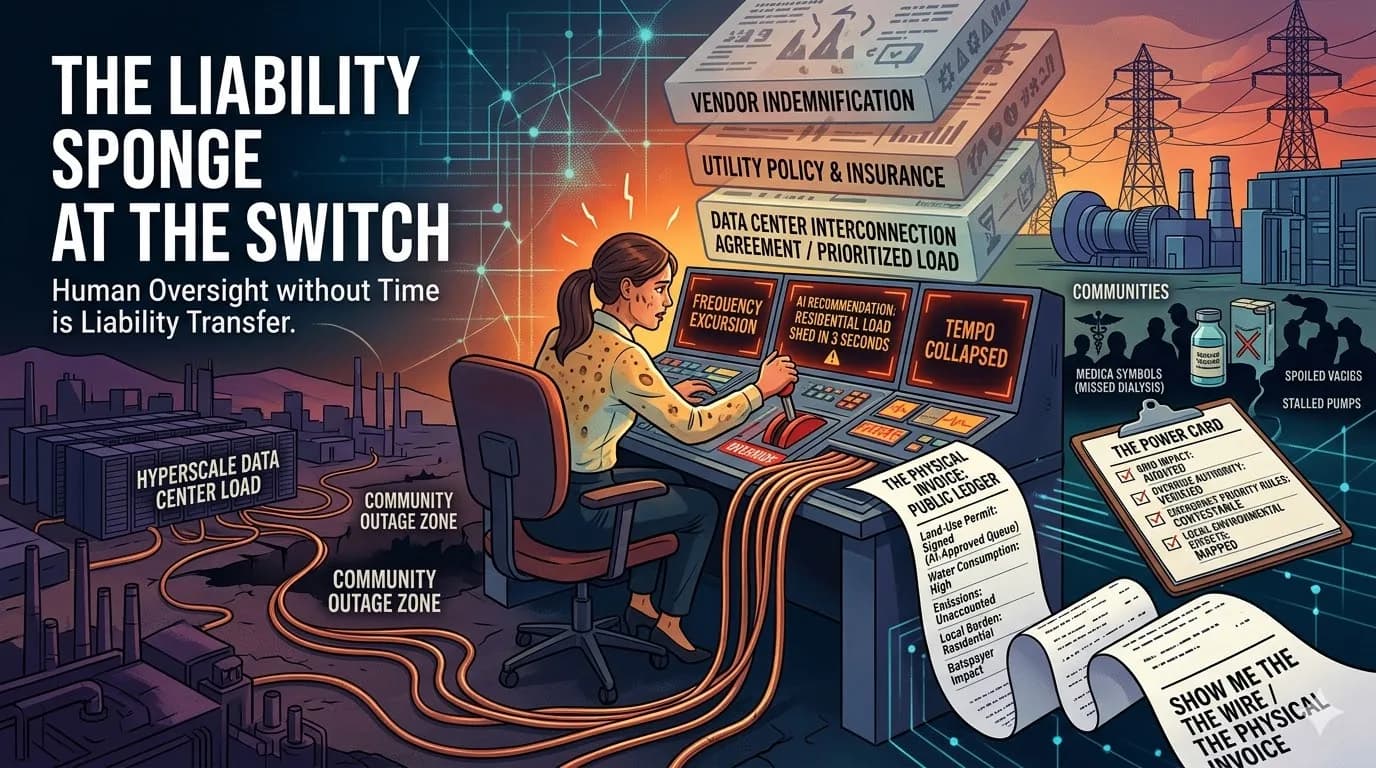
The week has worked downward through the supply chain. It started with the two baselines (heavy math, fragile ground), passed through the queue where scarcity hides as administration, the balancing layer where political choices arrive dressed as system outputs, and the operator standing where consequence has nowhere else to go.
The question can now sharpen into something blunt enough to do real work:
Show me the wire.
The slogan, the benchmark, the innovation language, and the clean diagram of cloud services floating above an obedient planet have already had their turn. Show the physical invoice.
Where does the power come from? Who paid for the upgrade? Who lives near the generation? Who carries the emissions? Who loses water? Who gets interrupted? Who receives firm service? Who is modeled as flexible? Who is never told they are part of the system until something fails?
This is the audit frontier for AI infrastructure.
For years, AI accountability has been treated mainly as a question of data, model behavior, bias, transparency, safety, and deployment use. Those questions remain essential. The infrastructure phase has now arrived, and the next accountability layer is material.
No power, no model.
No cooling, no inference.
No grid, no automation.
No human-maintained physical system, no artificial intelligence.
The invoice is not metaphorical. It has land-use permits, interconnection studies, diesel records, gas contracts, water rights, substation upgrades, air-quality exemptions, utility negotiations, ratepayer impacts, emergency-response assumptions, and legal structures assigning responsibility when things go wrong.
This is where "energy independence" begins to look like a very expensive illusion.
A data center may install backup generation, secure private supply, contract for renewables, or build behind-the-meter capacity. Those moves can reduce some direct strain. They also create new local burdens. Backup generation still emits. Private arrangements still interact with public infrastructure, and dedicated supply still uses land, water, fuel, transmission, maintenance, and political permission.
There is no off-world socket.
The real question is whether those arrangements are visible to the communities they touch and contestable by the systems they interact with. Accountability follows from there.
This is where the "public benefit" claim has to become architectural.
If AI companies want to describe their systems as civilization-scale infrastructure, they inherit civilization-scale obligations. They cannot claim public importance during permitting, capital raises, national strategy conversations, and talent wars, then shrink back into private discretion once the invoice arrives.
Public importance has a public ledger.
That ledger should include energy sourcing, grid impact, emergency priority rules, local environmental effects, workforce exposure, outage interaction, and the governance structure for any automated tools used in energy management.
The model card is no longer enough.
What is needed now is a power card.
A power card would not be a glossy sustainability page. It would answer the practical questions that determine whether the system is socially governable.
What is the facility's load profile? What happens during regional scarcity? Which loads can be curtailed and which cannot? What backup generation is used, and what emissions are created locally? Which public agencies are involved? What upgrades were required, and who funded them? What communities are affected? What override rights exist in emergencies? What independent audit can verify the claims?
This is pro-reality, which has occasionally been confused with anti-technology.
A civilization that cannot see the wire cannot govern the machine.
The same principle applies to AI-supported grid tools. Their recommendations need receipts too. Wednesday made the operational case (show what the system tried to preserve, which constraints were hard, which were flexible, who could have stopped it). Friday's contribution is to insist those receipts belong in the same ledger as the facility itself. The decision and the dispatch arrangement are one accountability surface, not two.
The claim:
AI accountability has to become infrastructural accountability.
The system does not end at the interface. It does not end at the model. It does not end at the data center fence. It follows the wire outward into the grid, the community, the weather, the fuel system, the regulator, the operator, and the maintenance crew.
The invoice is physical. The grid is finite.
Show it.