
The week started in the dark.
That is not a poetic opening. It is a factual one. The arc began while the Overberg was still carrying the aftershock of severe weather, storm damage, and prolonged outages, and while the Strait of Hormuz had been effectively closed for more than two months. Two unrelated events on different scales, sharing one substrate.
The cloud has weather.
That was the move Monday made. AI is hyper-material, arriving at a concentrated industrial scale, into a grid that is already absorbing climate volatility, fuel shocks, electrification, aging transmission, and the geopolitics of choke points. Wood Mackenzie's number (24 gigawatts to 110 gigawatts of US data center capacity between 2026 and 2030, accounting for 68 percent of total load growth) is not a side issue. It is one of several simultaneous pressures on a system that was never designed to grow this fast, in this direction, against this geopolitical weather.
Treating the substrate as background is a category error. The substrate is the machine.
Tuesday followed the appetite into the queue.
Scarcity rarely announces itself as moral conflict. It arrives as scheduling, prioritization, capacity planning, interconnection requests, emergency categories, and service-level agreements. A queue feels neutral until someone asks who is waiting, who is protected, who is treated as flexible, and who never knew they had been placed in line.
That is where large AI loads become governance events. A hyperscale facility enters the grid as a powerful claimant with money, urgency, legal structure, and strategic language. It can present itself as national infrastructure while local communities still experience outage as a fault report. One claim becomes the future. The other becomes maintenance. The audit has to notice that asymmetry before it hardens into precedent.
Wednesday turned the appetite into a manager.
The same AI now offers to help manage the grid it is straining: forecasting, balancing, anomaly detection, coordination of distributed assets. Some of that help will be genuinely useful. Some will become another layer of institutional opacity wearing a more confident dashboard.
The hinge word is optimization. Optimized for what, and by whose contract? An automated system does not transcend institutional priorities. It enforces them faster. Which is why AI-supported grid tools cannot be judged on accuracy alone. They have to be judged on the interrupt authority they preserve, on whether their reasoning is contestable in operational terms, and on whether the operator near the screen has actual levers, not just a seat.
Thursday named the person who absorbs the gap when those conditions are missing.
The liability sponge. The supervisor near the screen. The engineer who "approved" the recommendation. The municipal official later asked, by the institution that designed the workflow, why they did not stop the very system they were trained to trust. The human in the loop becomes useful to the organization mainly after harm has occurred, because a name is easier to discipline than a procurement architecture, a dashboard default, a board-level appetite for uninterrupted growth, or a contract priority nobody is supposed to mention out loud.
Human oversight without interrupt authority is liability transfer. Full stop.
That is the old failure mode in a harder setting, because the grid does not let bad decisions stay inside a PDF. They become outages, delays, emissions, unsafe work, spoiled medicine, failed pumps, and communities asked to carry burdens they did not choose.
Friday demanded the receipt.
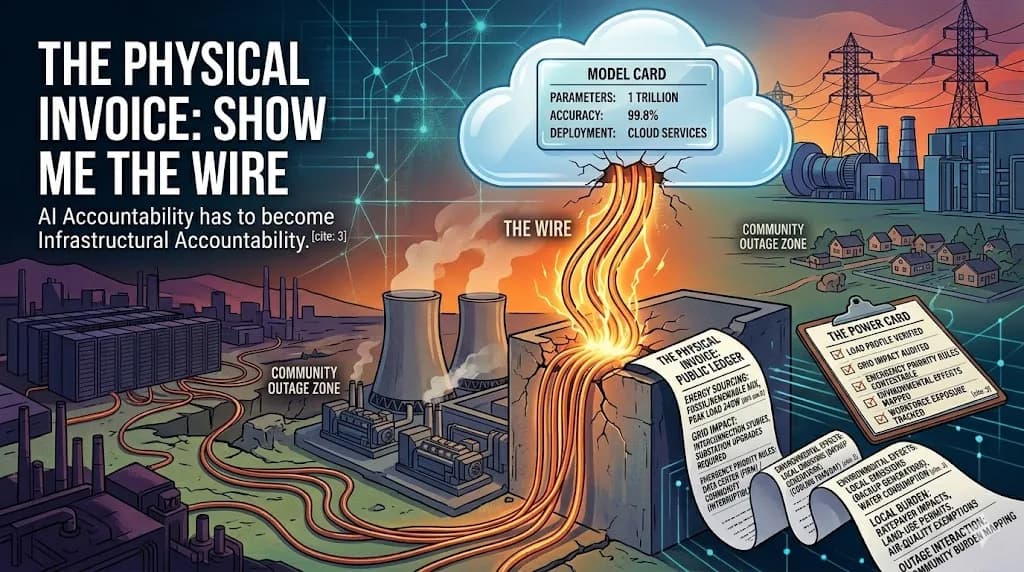
Show me the wire. The infrastructure phase of AI accountability is material. The model card is no longer enough; what is needed is a power card, a public ledger covering energy sourcing, grid impact, emergency priority rules, environmental effects, workforce exposure, override authority, and the governance of any automated tool used in energy management. If AI companies want to describe their systems as civilization-scale infrastructure, the invoice cannot remain private.
Civilization-scale claims require civilization-scale accountability.
That is the spine of the week. Five frames, one accountability surface.
The through-line is worth saying plainly. Every day asked a version of the same question: who absorbs the gap between what the system claims and what it actually delivers?
Monday: the planet does, when the substrate is treated as background. Tuesday: the unprotected do, when the queue is left to sort itself. Wednesday: the optimized-against do, when the contract becomes the machine. Thursday: the operator does, when oversight is decorative. Friday: the communities downstream of the wire do, when the invoice stays private.
In every case, the gap is real. The only variable is who carries it.
The thing the week kept circling is the succession story. The "first stage" was never only a metaphor for biological intelligence. It was always also the physical stack underneath the digital one. The world that made AI possible has not been left behind. It is still holding the launch vehicle upright.
The danger is the slide that changes the word quietly. First the substrate is instrumental. Then transitional. Then temporary. Then disposable. That slide is not inevitable. It is a governance failure dressed as progress.
Rockets shed their first stage. Societies are not rockets. The people, grids, landscapes, workers, communities, and repair systems underneath AI are not disposable because the model became impressive. They are the condition of possibility.
So the arc ends with a practical demand:
Treat AI infrastructure as infrastructure.
That means public ledgers, visible tradeoffs, emergency rules, interrupt authority, environmental accounting, local burden mapping, and governance that follows the wire all the way down. It means refusing the "cloud" abstraction as a permission slip to avoid the receipt.
The body is rented. The grid is finite. The invoice is physical.
The future does not get to call itself intelligent while pretending it has no plug.
If the closing note of the week has a sound, it is not the fantasy of frictionless compute. It is what Restoration Sequence tried to catch. Wind in the trees. Copper under strain. The long patience of waiting. A voice on the line explaining the order in which the line will come back, because the line is still her job and the wire still holds.
Mechanical Baseload was the appetite with a power contract. Restoration Sequence answered from below. Endurance, not elegy. The substrate keeping time in its own name.
That is where the week began, and that is where the arc rests.